• HOME
  • NEWS
  • EXPLORE
    • CAREER
      • Companies
      • Jobs
    • EVENTS
    • iGEM
      • News
      • Team
    • PHOTOS
    • VIDEO
    • WIKI
  • BLOG
  • COMMUNITY
    • FACEBOOK
    • INSTAGRAM
    • TWITTER
Thursday, May 14, 2026
BIOENGINEER.ORG
No Result
View All Result
  • Login
  • HOME
  • NEWS
  • EXPLORE
    • CAREER
      • Companies
      • Jobs
        • Lecturer
        • PhD Studentship
        • Postdoc
        • Research Assistant
    • EVENTS
    • iGEM
      • News
      • Team
    • PHOTOS
    • VIDEO
    • WIKI
  • BLOG
  • COMMUNITY
    • FACEBOOK
    • INSTAGRAM
    • TWITTER
  • HOME
  • NEWS
  • EXPLORE
    • CAREER
      • Companies
      • Jobs
        • Lecturer
        • PhD Studentship
        • Postdoc
        • Research Assistant
    • EVENTS
    • iGEM
      • News
      • Team
    • PHOTOS
    • VIDEO
    • WIKI
  • BLOG
  • COMMUNITY
    • FACEBOOK
    • INSTAGRAM
    • TWITTER
No Result
View All Result
Bioengineer.org
No Result
View All Result
Home NEWS Science News Chemistry

Improving the lifetime of bioelectrodes for solar energy conversion

Bioengineer by Bioengineer
April 26, 2019
in Chemistry
Reading Time: 2 mins read
0
IMAGE
Share on FacebookShare on TwitterShare on LinkedinShare on RedditShare on Telegram

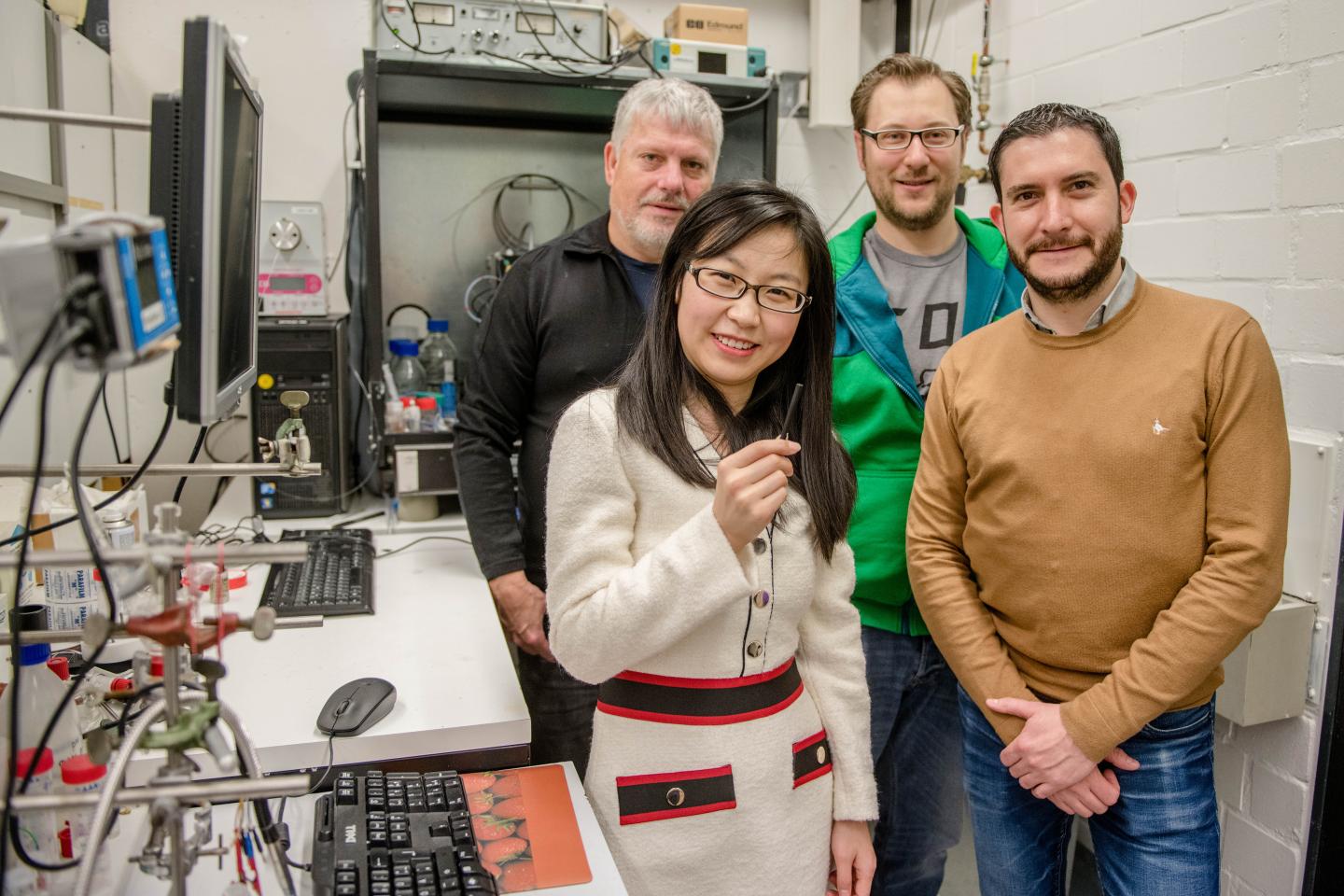
The key to a long life for bioelectrodes lies in an oxygen-free environment
IMAGE

Credit: RUB, Marquard

The use of proteins involved in the photosynthetic process enables the development of affordable and efficient devices for energy conversion. However, although proteins such as photosystem I are robust in nature, the use of isolated protein complexes incorporated in semi-artificial electrodes is associated with a considerably short long-term stability. In consequence, the technological application of these kind of biodevices is still limited. Researchers at Ruhr-Universität Bochum (RUB) showed that a careful operation of the photosystem-based bioelectrode under the exclusion of oxygen is the key for achieving high stability.

The team involving Dr. Fangyuan Zhao, Dr. Adrian Ruff, Dr. Felipe Conzuelo, and Professor Wolfgang Schuhmann from the Chair of Analytical Chemistry and Center for Electrochemical Sciences, together with Professor Matthias Rögner from the Bochum Chair of Plant Biochemistry describes the results in the Journal of the American Chemical Society.

Using green energy

Efficiently producing energy for a more sustainable society is nowadays a continuous challenge. Therefore, it is important not only to understand but also to overcome the processes that currently limit the lifetime of technologies for green and renewable energy conversion. Among different promising techniques, the use of protein complexes involved in the photosynthetic process for the fabrication of semi-artificial devices is of particular interest due to their high efficiency and large natural availability.

Oxygen is to blame

The scientists have already shown in a previous study that under operation of the bioelectrode reactive molecules are formed that damage photosystem I and are responsible for a limited lifetime of the biodevice. These reactive species are associated to the use of oxygen as final electron acceptor. Therefore, the design of bioelectrodes operating in an oxygen-free environment was suggested.

An important step towards the application

Now, operation of the bioelectrode under the exclusion of oxygen has proven to effectively increase the lifetime of the device for a substantial period in comparison with the results obtained in the presence of ambient oxygen. As the authors explain, the obtained results are an important step towards the efficient development and possible application of photobiodevices for energy conversion.

###

Media Contact
Wolfgang Schuhmann
[email protected]

Original Source

https://news.rub.de/english/press-releases/2019-04-26-chemistry-improving-lifetime-bioelectrodes-solar-energy-conversion

Related Journal Article

http://dx.doi.org/10.1021/jacs.8b13869

Tags: BiochemistryBiotechnologyChemistry/Physics/Materials SciencesEnergy/Fuel (non-petroleum)Industrial Engineering/ChemistryMaterials
Share12Tweet8Share2ShareShareShare2

Related Posts

EU regulations may drive up costs and energy use for fossil-free aviation fuels — Chemistry

EU regulations may drive up costs and energy use for fossil-free aviation fuels

May 14, 2026
Researchers Develop High-Efficiency Hydrogen Separation Membranes Using Innovative ‘Mortar-and-Brick’ Design — Chemistry

Researchers Develop High-Efficiency Hydrogen Separation Membranes Using Innovative ‘Mortar-and-Brick’ Design

May 13, 2026

Green Electrosynthesis Paves the Way for Direct Amines Production from Atmospheric Nitrogen

May 13, 2026

Decoding Life’s Chemistry: A Revolutionary Search Engine from Molecules to Meaning

May 13, 2026
Please login to join discussion

POPULAR NEWS

  • Research Indicates Potential Connection Between Prenatal Medication Exposure and Elevated Autism Risk

    842 shares
    Share 337 Tweet 211
  • New Study Reveals Plants Can Detect the Sound of Rain

    729 shares
    Share 291 Tweet 182
  • Salmonella Haem Blocks Macrophages, Boosts Infection

    62 shares
    Share 25 Tweet 16
  • Breastmilk Balances E. coli and Beneficial Bacteria in Infant Gut Microbiomes

    57 shares
    Share 23 Tweet 14

About

We bring you the latest biotechnology news from best research centers and universities around the world. Check our website.

Follow us

Recent News

α-Synuclein Fibrils Trigger LRRK2, Disrupt Synapses

Synchronous Climbing Fibers Drive Cerebellar Learning Signals

FAU’s CA-AI Awarded $2.2M U.S. Air Force Grant to Advance Next-Generation Autonomous Systems

Subscribe to Blog via Email

Enter your email address to subscribe to this blog and receive notifications of new posts by email.

Join 82 other subscribers
  • Contact Us

Bioengineer.org © Copyright 2023 All Rights Reserved.

Welcome Back!

Login to your account below

Forgotten Password?

Retrieve your password

Please enter your username or email address to reset your password.

Log In
No Result
View All Result
  • Homepages
    • Home Page 1
    • Home Page 2
  • News
  • National
  • Business
  • Health
  • Lifestyle
  • Science

Bioengineer.org © Copyright 2023 All Rights Reserved.