Tropical oceans and fisheries are threatened by climate change, generating impacts that will affect the sustainable development of both local economies and communities, and regions outside the tropics.
Credit: Lam et al, Nature Reviews Earth & Environment
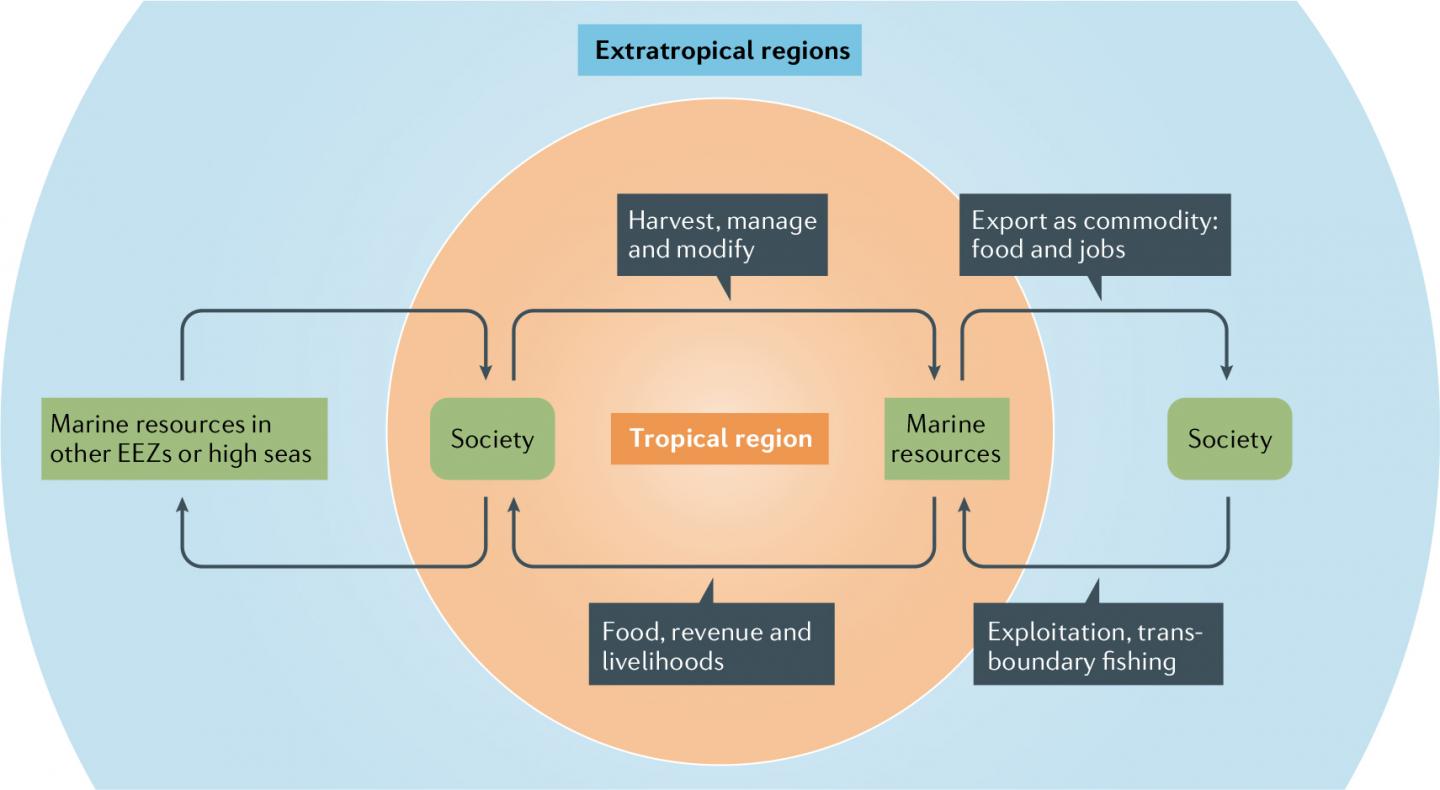
Tropical oceans and fisheries are threatened by climate change, generating impacts that will affect the sustainable development of both local economies and communities, and regions outside the tropics through ‘telecoupling’ of human-natural systems, such as seafood trade and distant-water fishing, says a scientific review from UBC and international researchers.
Seafood is the most highly traded food commodity globally, with tropical zone marine fisheries contributing more than 50 per cent of the global fish catch, an average of $USD 96 billion annually. Available scientific evidence consistently shows that tropical marine habitats, fish stocks and fisheries are most vulnerable to oceanic changes associated with climate change. However, the scientific review highlights that telecoupling, or linkages between distant human-natural systems, could generate cascades of climate change impacts from the tropics that propagate to other ‘extra-‘ tropical natural systems and human communities globally.
“Telecoupling interactions between two or more linked areas over distance between tropical fisheries and elsewhere include distant-water fishing, the international seafood supply chain, transboundary fisheries resources and their governance would allow benefits derived from tropical fisheries to transfer to the people in the extratropical regions,” said Vicky Lam, lead author and research associate in the UBC’s Institute for the Oceans and Fisheries. “Although these linkages could enable the flow of benefits, including food, livelihoods and government revenue, from tropical fisheries to extratropical locations, their dependence on tropical fisheries also exposes them to the negative consequences of climate change in tropical regions. The effects of climate change on tropical fisheries also affect the profitability and employment opportunities of fish-processing industries in extratropical regions.”
“Pacific Island countries and territories, for example, are expected to see a redistribution of skipjack and yellowfin tuna – their two most exported fish species – that could see decreased catches of between 10 and 40 per cent by 2050 in many countries such as Palau and the Solomon Islands, while catches are expected to increase by 15 to 20 per cent in Kiribati and the Cook Islands. This will have a tremendous effect on the economies of these small island developing states,” said Rashid Sumaila, co-author and professor at UBC’s Institute for the Oceans and Fisheries and School of Public Policy and Global Affairs. “There are similar projections in African nations, where climate-related changes are expected to decrease the value of landed catch by approximately 20 per cent by 2050, as well as reduce fisheries-related jobs by 50 per cent.”
To reduce the effect of climate change on the benefits derived from tropical fisheries, both locally and in extra-tropical regions, the root causes of climate-driven problems in tropical fisheries need to be recognized and rectified. Effective and practical adaptation and mitigation solutions with stakeholder commitment and involvement, as well as supporting policies, are therefore necessary in the tropics.
“We already see that there are close linkages between the tropical regions and the extra-tropical nations through trade and distant-water fishing” said William Cheung, co-author and professor at UBC’s Institute for the Oceans and Fisheries. “Solving climate change impacts in the tropics will benefit the whole world; this provides an additional argument for non-tropical countries to support climate mitigation and adaptation in tropical countries.”
###
The article “Climate change, tropical fisheries and prospects for sustainable development” appeared in Nature Reviews Earth & Environment.
Media Contact
Katherine Came
[email protected]
Original Source
https:/
Related Journal Article
http://dx.