• HOME
  • NEWS
  • EXPLORE
    • CAREER
      • Companies
      • Jobs
    • EVENTS
    • iGEM
      • News
      • Team
    • PHOTOS
    • VIDEO
    • WIKI
  • BLOG
  • COMMUNITY
    • FACEBOOK
    • INSTAGRAM
    • TWITTER
Tuesday, May 12, 2026
BIOENGINEER.ORG
No Result
View All Result
  • Login
  • HOME
  • NEWS
  • EXPLORE
    • CAREER
      • Companies
      • Jobs
        • Lecturer
        • PhD Studentship
        • Postdoc
        • Research Assistant
    • EVENTS
    • iGEM
      • News
      • Team
    • PHOTOS
    • VIDEO
    • WIKI
  • BLOG
  • COMMUNITY
    • FACEBOOK
    • INSTAGRAM
    • TWITTER
  • HOME
  • NEWS
  • EXPLORE
    • CAREER
      • Companies
      • Jobs
        • Lecturer
        • PhD Studentship
        • Postdoc
        • Research Assistant
    • EVENTS
    • iGEM
      • News
      • Team
    • PHOTOS
    • VIDEO
    • WIKI
  • BLOG
  • COMMUNITY
    • FACEBOOK
    • INSTAGRAM
    • TWITTER
No Result
View All Result
Bioengineer.org
No Result
View All Result
Home NEWS Science News Chemistry

Idaho laboratory joins national research programs for making ‘green’ hydrogen

Bioengineer by Bioengineer
October 8, 2020
in Chemistry
Reading Time: 3 mins read
0
IMAGE
Share on FacebookShare on TwitterShare on LinkedinShare on RedditShare on Telegram

IMAGE

Credit: Idaho National Laboratory

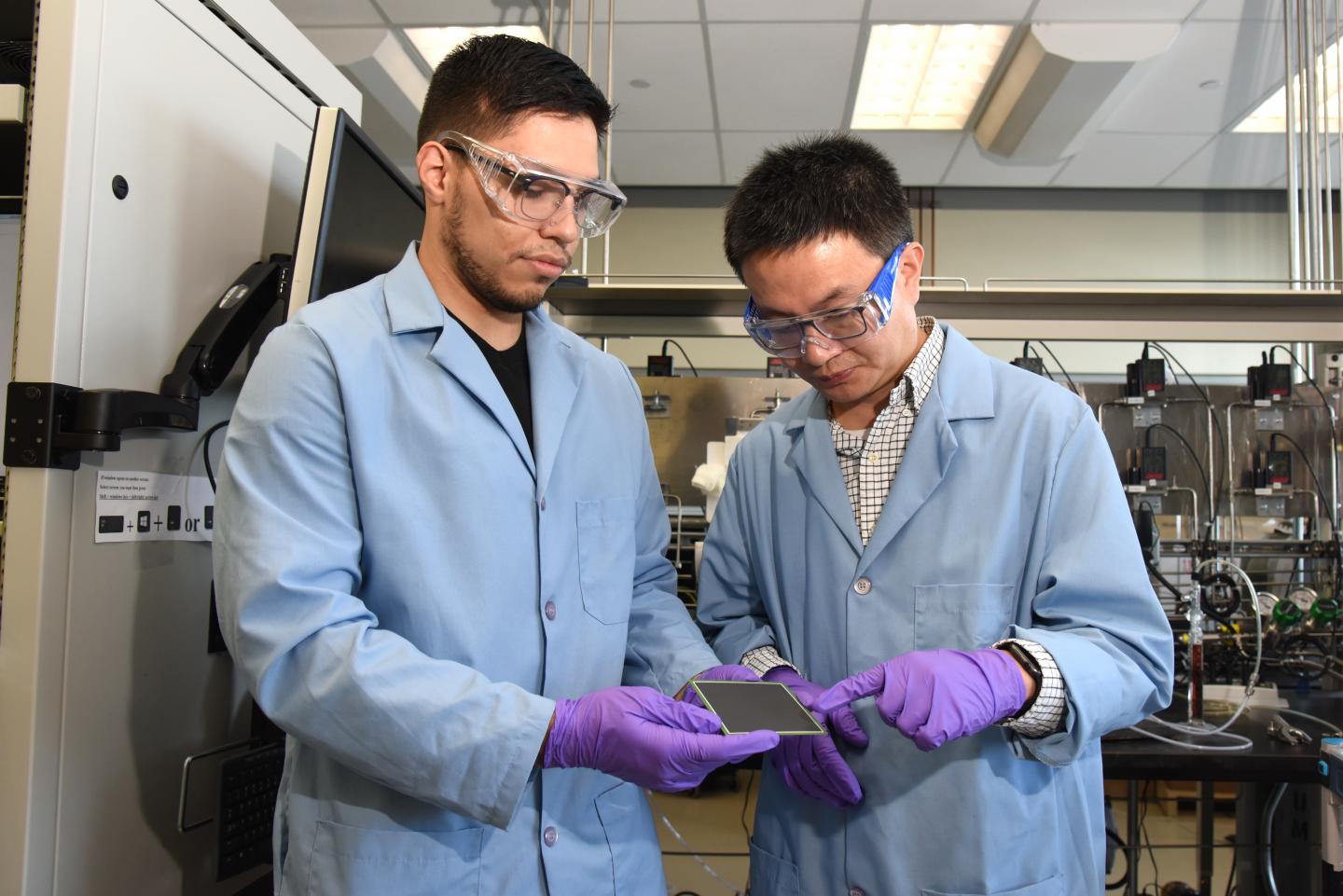
Idaho National Laboratory is a member of two new Department of Energy research consortia charged with exploring new methods and technologies for hydrogen production. Hydrogen can effectively store excess electricity, which can be harvested later via fuel cells. These consortia – H2NEW and HydroGEN 2.0 – were formed to discover how “green” hydrogen can be produced more efficiently and less expensively.

“DOE has a strong interest in hydrogen generation,” said INL researcher Gary Groenewold, who is leading the lab’s involvement in the H2NEW consortium. “They’ve got technology they feel can be pushed from mid-range research to the pilot plant level.”

INL and the National Renewable Energy Laboratory (NREL) will co-lead H2NEW, which will advance state-of-the-art hydrogen production using low temperature electrolysis and high temperature electrolysis. The program will conduct research, development and demonstration of large-scale, affordable electrolyzers — devices that use electricity to split water into oxygen and hydrogen. The end goal is to be able to produce hydrogen at a generalized cost of $2 per kilogram. Today, carbon-free hydrogen from electrolysis costs about $5 to $6/kg to make assuming electricity prices of $0.05/kWh to $0.07/kWh.

The second consortium, HydroGEN 2.0, is led by NREL. It will focus more on fundamental science questions by facilitating collaborations between national laboratories, academia and industry. The consortium’s steering committee has representatives from DOE and each of the six member labs. Dr. Richard Boardman is INL’s representative.

Both consortia are funded by DOE’s Hydrogen and Fuel Cell Technologies Office, within the Office of Energy Efficiency and Renewable Energy. Collectively, these efforts support EERE’s H2@Scale vision for affordable hydrogen production, distribution, storage and utilization across multiple applications.

INL is widely known for its expertise in solid oxide electrolysis cells (SOECs). For years, INL researchers have experimented with solid oxide electrolysis stacks, splitting water molecules at lower temperatures and reducing stress on SOEC materials. In 2018, INL researcher Dong Ding and his colleagues demonstrated high-performance electrochemical hydrogen production at a lower temperature than seen before. In a paper published by the journal Advanced Science, Ding reported on a highly efficient proton-conducting solid oxide electrolysis cell (P-SOEC) that incorporates a 3D ceramic steam electrode. During testing, the cells operated below 600 degrees Celsius at a highly sustained rate for days.

In 2020, Ding led a team of INL researchers to pioneer a reversible electrochemical cell that efficiently converts excess electricity and water into hydrogen but also, when called for, can convert hydrogen back into electricity for the grid. The hydrogen can be used as fuel for heat, vehicles or other applications. The results appeared in the scientific journal .

“The people in his group are working at a very high level,” Groenewold said.

INL is a U.S. Department of Energy (DOE) national laboratory that performs work in each of DOE’s strategic goal areas: energy, national security, science and environment. INL is the nation’s center for nuclear energy research and development. Day-to-day management and operation of the laboratory are the responsibility of Battelle Energy Alliance.

###

See more INL news at http://www.inl.gov. Follow us on social media: Twitter, Facebook, Instagram and LinkedIn.

Media Contact
Abby Todd Bloxham
[email protected]

Original Source

https://inl.gov/article/inl-joins-hydrogen-research-programs/

Tags: AgricultureChemistry/Physics/Materials SciencesClimate ChangeEarth ScienceEnergy SourcesEnergy/Fuel (non-petroleum)Industrial Engineering/ChemistryMaterialsTechnology/Engineering/Computer Science
Share12Tweet8Share2ShareShareShare2

Related Posts

Humans and Zebra Finches Share Similar Speech Learning Techniques #ASA190 — Chemistry

Humans and Zebra Finches Share Similar Speech Learning Techniques #ASA190

May 11, 2026
Unveiling Dark Matter Through Molecular Insights — Chemistry

Unveiling Dark Matter Through Molecular Insights

May 11, 2026

From Touch to Sight: A Bioinspired Multisensory Framework Endows Robots with Human-Like Perception

May 11, 2026

Announcing the 2026 Carbon Future Young Investigator Award Winners

May 11, 2026
Please login to join discussion

POPULAR NEWS

  • Research Indicates Potential Connection Between Prenatal Medication Exposure and Elevated Autism Risk

    841 shares
    Share 336 Tweet 210
  • New Study Reveals Plants Can Detect the Sound of Rain

    728 shares
    Share 290 Tweet 182
  • Salmonella Haem Blocks Macrophages, Boosts Infection

    62 shares
    Share 25 Tweet 16
  • Breastmilk Balances E. coli and Beneficial Bacteria in Infant Gut Microbiomes

    57 shares
    Share 23 Tweet 14

About

We bring you the latest biotechnology news from best research centers and universities around the world. Check our website.

Follow us

Recent News

Humans and Zebra Finches Share Similar Speech Learning Techniques #ASA190

New Study Uncovers How Fungal Parasites Attack Strawberries and Raspberries

City of Hope Researchers to Present Groundbreaking Immunotherapy and Precision Medicine Advances Across Multiple Cancer Types at ASCO 2026

Subscribe to Blog via Email

Enter your email address to subscribe to this blog and receive notifications of new posts by email.

Join 82 other subscribers
  • Contact Us

Bioengineer.org © Copyright 2023 All Rights Reserved.

Welcome Back!

Login to your account below

Forgotten Password?

Retrieve your password

Please enter your username or email address to reset your password.

Log In
No Result
View All Result
  • Homepages
    • Home Page 1
    • Home Page 2
  • News
  • National
  • Business
  • Health
  • Lifestyle
  • Science

Bioengineer.org © Copyright 2023 All Rights Reserved.