• HOME
  • NEWS
  • EXPLORE
    • CAREER
      • Companies
      • Jobs
    • EVENTS
    • iGEM
      • News
      • Team
    • PHOTOS
    • VIDEO
    • WIKI
  • BLOG
  • COMMUNITY
    • FACEBOOK
    • INSTAGRAM
    • TWITTER
Sunday, May 10, 2026
BIOENGINEER.ORG
No Result
View All Result
  • Login
  • HOME
  • NEWS
  • EXPLORE
    • CAREER
      • Companies
      • Jobs
        • Lecturer
        • PhD Studentship
        • Postdoc
        • Research Assistant
    • EVENTS
    • iGEM
      • News
      • Team
    • PHOTOS
    • VIDEO
    • WIKI
  • BLOG
  • COMMUNITY
    • FACEBOOK
    • INSTAGRAM
    • TWITTER
  • HOME
  • NEWS
  • EXPLORE
    • CAREER
      • Companies
      • Jobs
        • Lecturer
        • PhD Studentship
        • Postdoc
        • Research Assistant
    • EVENTS
    • iGEM
      • News
      • Team
    • PHOTOS
    • VIDEO
    • WIKI
  • BLOG
  • COMMUNITY
    • FACEBOOK
    • INSTAGRAM
    • TWITTER
No Result
View All Result
Bioengineer.org
No Result
View All Result
Home NEWS Science News Chemistry

Hyperactive immune system gene causes schizophrenia-like changes in mice

Bioengineer by Bioengineer
January 14, 2020
in Chemistry
Reading Time: 3 mins read
0
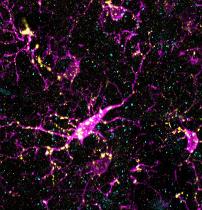
IMAGE
Share on FacebookShare on TwitterShare on LinkedinShare on RedditShare on Telegram

IMAGE

Credit: Rhushikesh A. Phadke


Excessive activity of an immune system gene previously linked to schizophrenia reproduces neural and behavioral aspects of the disease in mice, according to a new study publishing on January 14 in the open-access journal PLOS Biology by Ashley Comer and Alberto Cruz-Martín of Boston University and colleagues. The finding provides mechanistic support for the importance of the gene in the development of schizophrenia, and may offer a new avenue for therapy development.

Genetics variants that increase the activity of the C4 gene, which encodes part of the immune system’s so-called “complement” cascade, have previously been shown to increase risk for schizophrenia in large genome-wide association studies. However, the mechanism through which such variants might contribute to the emergence of schizophrenia have not been clear because C4 has not previously been experimentally overexpressed.

During normal brain development, it’s known that complement sticks to neuronal synapses and attracts microglia (immune cells in the brain), which engulf synaptic material in the process known as “synaptic pruning.” When mis-regulated, this process can lead to abnormal connectivity in the brain.

Loss of synapses in the prefrontal cortex is a hallmark of schizophrenia, which led the authors to ask whether an overactive C4 gene might contribute to development of schizophrenia through mis-regulation of complement-mediated synaptic pruning by microglia. When they overexpressed complement C4 in the mouse prefrontal cortex, they found an increase in the level of microglial engulfment of synapses, reduced functional connectivity between neurons, and alterations in the properties of neuronal membranes.

Schizophrenia is characterized by deficits in social cognition and social interactions, effects that often precede the development of psychosis. The authors found that juvenile mice with too much complement C4 reduced the time they spent seeking out their mothers compared to control mice, and that adult mice spent less time than control mice interacting with new cage mates.

Together, these results suggest that the genetic association found between increased C4 gene activity and schizophrenia may be due at least in part to an inappropriate increase in synaptic pruning during brain development. “This critical developmental window may provide an opportunity to intervene to alter the developmental trajectory of schizophrenia,” Cruz-Martín, the senior investigator, said. While there are currently few approved drugs that can block the complement system, it is an area of intense pharmaceutical research, and these findings are likely to spur even further interest in this approach.

###

Peer-reviewed; Experimental Study; Animals

In your coverage please use this URL to provide access to the freely available article in PLOS Biology: https://journals.plos.org/plosbiology/article?id=10.1371/journal.pbio.3000604

Citation: Comer AL, Jinadasa T, Sriram B, Phadke RA, Kretsge LN, Nguyen TPH, et al. (2020) Increased expression of schizophrenia-associated gene C4 leads to hypoconnectivity of prefrontal cortex and reduced social interaction. PLoS Biol 18(1): e3000604. https://doi.org/10.1371/journal.pbio.3000604

Funding: This work was supported by Biogen (AC-M, #973630), a NARSAD Young Investigator Grant (AC-M, #27202), the Brenton R. Lutz Award (ALC), the NSF NRT UtB: Neurophotonics National Research Fellowship (ALC and LNK, #DGE-1633516), and the Boston University Undergraduate Research Opportunities Program (JL, FSH, TPHN, KLK, ERN, WWY) (https://www.biogen.com/en_us/home.html; https://www.bbrfoundation.org/grants-prizes/grants, https://www.nsf.gov/; http://www.bu.edu/urop/). The funders had no role in study design, data collection and analysis, decision to publish, or preparation of the manuscript.

Competing Interests: The authors have declared that no competing interests exist.

Media Contact
Alberto Cruz-Martín
[email protected]

Related Journal Article

http://dx.doi.org/10.1371/journal.pbio.3000604

Tags: BiochemistryBiologyGenesGeneticsImmunology/Allergies/AsthmaMedicine/HealthMental HealthPets/EthologySocial/Behavioral ScienceZoology/Veterinary Science
Share12Tweet8Share2ShareShareShare2

Related Posts

Miniature Sensor Uses Light to Detect Touch — Chemistry

Miniature Sensor Uses Light to Detect Touch

May 8, 2026
Iron Minerals Determine Whether Dissolved Organic Matter Fuels Microbes or Becomes Long-Term Carbon Storage — Chemistry

Iron Minerals Determine Whether Dissolved Organic Matter Fuels Microbes or Becomes Long-Term Carbon Storage

May 8, 2026

Kate Evans Appointed Associate Lab Director for Biological and Environmental Systems Science at ORNL

May 8, 2026

Advancing Multiscale Modeling and Overcoming Operational Challenges in Autothermal CO₂-to-Methanol Reactors

May 8, 2026
Please login to join discussion

POPULAR NEWS

  • Research Indicates Potential Connection Between Prenatal Medication Exposure and Elevated Autism Risk

    840 shares
    Share 336 Tweet 210
  • New Study Reveals Plants Can Detect the Sound of Rain

    727 shares
    Share 290 Tweet 181
  • Scientists Investigate Possible Connection Between COVID-19 and Increased Lung Cancer Risk

    68 shares
    Share 27 Tweet 17
  • Salmonella Haem Blocks Macrophages, Boosts Infection

    61 shares
    Share 24 Tweet 15

About

We bring you the latest biotechnology news from best research centers and universities around the world. Check our website.

Follow us

Recent News

Evaluating Digoxin Use in Patients with Symptomatic Rheumatic Heart Disease

Evaluating the Effectiveness and Safety of Digitalis Glycosides in Treating Heart Failure

Urdu Fall Risk Questionnaire Adapted for Elderly

Subscribe to Blog via Email

Enter your email address to subscribe to this blog and receive notifications of new posts by email.

Join 82 other subscribers
  • Contact Us

Bioengineer.org © Copyright 2023 All Rights Reserved.

Welcome Back!

Login to your account below

Forgotten Password?

Retrieve your password

Please enter your username or email address to reset your password.

Log In
No Result
View All Result
  • Homepages
    • Home Page 1
    • Home Page 2
  • News
  • National
  • Business
  • Health
  • Lifestyle
  • Science

Bioengineer.org © Copyright 2023 All Rights Reserved.