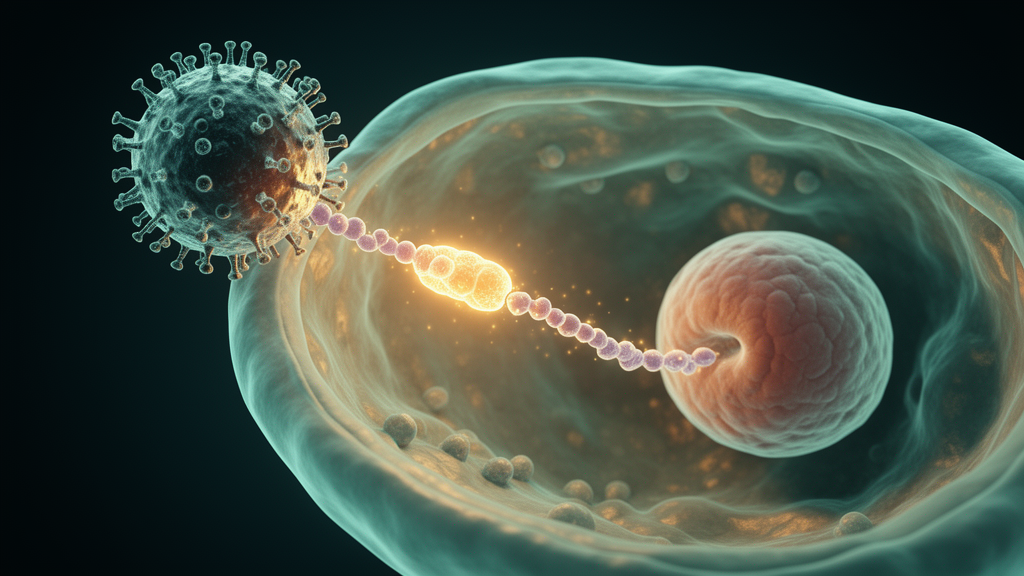
A new review published in Virology Journal brings together evidence on one of the more intriguing intersections in cancer biology: the point at which human oncogenic viruses take control of the Notch signaling pathway. Written by Ebrahim Faghihloo and Shaian Tavakolian of Shahid Beheshti University of Medical Sciences in Tehran, the review examines how six major human oncoviruses—human papillomavirus (HPV), human T-lymphotropic virus type 1 (HTLV-1), Epstein–Barr virus (EBV), Kaposi’s sarcoma-associated herpesvirus (KSHV), hepatitis B virus (HBV), and hepatitis C virus (HCV)—manipulate a pathway that normally acts as a master regulator of cell fate. The authors argue that this virus–Notch crosstalk is not a peripheral curiosity but a central mechanism through which infected cells acquire the hallmarks of malignancy.
The Notch pathway is one of the most evolutionarily conserved signaling systems in multicellular organisms. In mammals it comprises four transmembrane receptors, NOTCH1 through NOTCH4, and five membrane-bound ligands of the Delta-like and Jagged families. Signaling is unusual in that it does not rely on a second-messenger cascade: when a ligand on a neighboring cell engages a Notch receptor, the receptor undergoes sequential cleavage, first by ADAM-family metalloproteinases and then by the γ-secretase complex. This releases the Notch intracellular domain (NICD), which translocates to the nucleus and binds the DNA-associated transcription factor CSL, together with the coactivator Mastermind-like (MAML), to switch on target genes. Foremost among these are the Hairy and Enhancer of Split (HES) and HEY family transcriptional repressors, which in turn control genes governing proliferation, differentiation, and survival.
Because Notch sits at the helm of decisions about when cells divide, when they differentiate, and when they die, even modest dysregulation can be dangerous. The review emphasizes that abnormal Notch activity has been implicated in cell proliferation, resistance to apoptosis, maintenance of stem-like cell populations, epithelial–mesenchymal transition (EMT), and immune evasion. In normal tissue these processes are carefully balanced; in cancer they are the engine of tumor growth and spread. The authors’ central thesis is that oncoviruses exploit this pathway deliberately, co-opting its transcriptional output to create a cellular environment favorable to viral persistence and, ultimately, malignant transformation.
HPV provides one of the clearest examples. The viral oncoproteins E6 and E7, which drive degradation of the tumor suppressors p53 and pRB, also interact with Notch signaling in ways that shift the pathway’s effects. Notch signaling in HPV-infected keratinocytes can cooperate with viral gene expression to sustain proliferation and block terminal differentiation—the very process the virus must arrest to complete its life cycle. The review notes that HPV-positive lesions show altered expression of Notch receptors and ligands, and that the interplay between E6/E7 and NICD-dependent transcription blurs the line between the productive viral life cycle and neoplastic progression, particularly in cervical carcinogenesis.
HTLV-1, the causative agent of adult T-cell leukemia/lymphoma (ATLL), takes a different route. Its trans-activator protein Tax is a potent manipulator of host transcription factors, and the review describes how Tax-driven activation of NF-κB and AP-1 converges with Notch signaling to keep infected T cells in a proliferative, apoptosis-resistant state. The HTLV-1 basic leucine zipper factor (HBZ), expressed from the antisense strand, further entrenches this program, supporting the survival and expansion of leukemic clones. The same virus is also associated with HTLV-1-associated myelopathy/tropical spastic paraparesis (HAM/TSP), underscoring that Notch manipulation has consequences beyond cancer.
Among the herpesviruses, EBV and KSHV display especially intricate relationships with Notch. EBV latency proteins, including the Epstein–Barr nuclear antigens (EBNAs) and latent membrane proteins (LMPs), modulate Notch receptor processing and downstream transcription; LMP1 and LMP2A signaling intersects with NICD-mediated gene activation in nasopharyngeal carcinoma and EBV-associated lymphoid malignancies. KSHV, the etiologic agent of Kaposi’s sarcoma, deploys its own arsenal: the latency-associated nuclear antigen (LANA), the viral FLICE-inhibitory protein (vFLIP), and the viral G protein-coupled receptor (vGPCR) each contribute to Notch pathway activation, fostering the angiogenesis, inflammation, and cell survival that characterize the tumor. The replication and transcription activator (RTA), which controls the viral lytic switch, adds a further layer of regulation linking viral life cycle dynamics to host signaling.
The hepatitis viruses illustrate that even viruses not conventionally classed as DNA-tumor viruses participate in this crosstalk. HBV’s X protein (HBx) promotes Notch activation in hepatocytes, contributing to the proliferative and survival signals that underlie hepatocellular carcinoma, while HCV proteins engage the pathway in ways that reinforce chronic inflammation and fibrogenic progression toward malignancy. In both cases, the review suggests that Notch dysregulation acts as a bridge between chronic viral injury and the molecular events of carcinogenesis, potentially offering biomarkers that distinguish progressing lesions from indolent disease.
A recurring theme across all six viruses is context dependence. Notch can behave as an oncogene in some tissues and as a tumor suppressor in others, and the review stresses that the outcome of viral manipulation depends on cell type, the differentiation state of the infected cell, and which receptors and ligands are expressed. Additional layers of control—including microRNAs, long non-coding RNAs, the E3 ubiquitin ligase FBXW7 that targets NICD for degradation, and fringe glycosyltransferases such as Manic Fringe that modify ligand–receptor affinity—determine where the signaling dial sits. Viruses appear to nudge these layers simultaneously, producing a coherent pro-tumor transcriptional state rather than a single wholesale switch.
The therapeutic implications are significant. γ-secretase inhibitors (GSIs), originally developed for Alzheimer’s disease and already tested in Notch-driven T-cell leukemias, emerge as a class of compounds that could, in principle, sever the viral exploitation of the pathway. The review also points toward Notch-related biomarkers for early detection and risk stratification in virus-associated cancers, and toward combination strategies in which antiviral therapy is paired with pathway-targeted agents. However, the authors caution that Notch’s dual roles and its importance in normal stem cell maintenance demand careful dosing and tissue-specific approaches.
The review closes by flagging the field’s unresolved questions: the precise order in which viral proteins and Notch activation act during multi-step carcinogenesis, the contribution of Notch to immune evasion in virally infected tissue, and whether Notch signatures can reliably predict transformation in premalignant lesions. What is already clear, the authors conclude, is that deeper mechanistic understanding of virus–Notch crosstalk could reshape basic research on viral carcinogenesis, yield diagnostic biomarkers, and guide the next generation of targeted antiviral and anti-cancer therapies. As the list of virus-associated malignancies continues to grow, the Notch pathway looks increasingly like common ground on which these diverse pathogens meet.
Subject of Research: Dysregulation of the Notch signaling pathway by human oncogenic viruses in carcinogenesis
Article Title: Oncogenic human viruses and notch signaling: a focus on key dysregulation within the NOTCH pathway
Article References: Oncogenic human viruses and notch signaling: a focus on key dysregulation within the NOTCH pathway. (n.d.). https://doi.org/10.1186/s12985-026-03324-w
Image Credits: AI Generated
DOI: 10.1186/s12985-026-03324-w
Keywords: Notch signaling, oncogenic viruses, HPV, HTLV-1, EBV, KSHV, HBV, HCV, carcinogenesis, NICD, gamma-secretase inhibitors, EMT
News Source: Drew Townsend. (October 9, 2026). How Cancer-Causing Viruses Hijack the Notch Signaling Pathway. Scienmag.