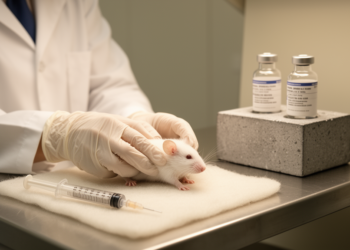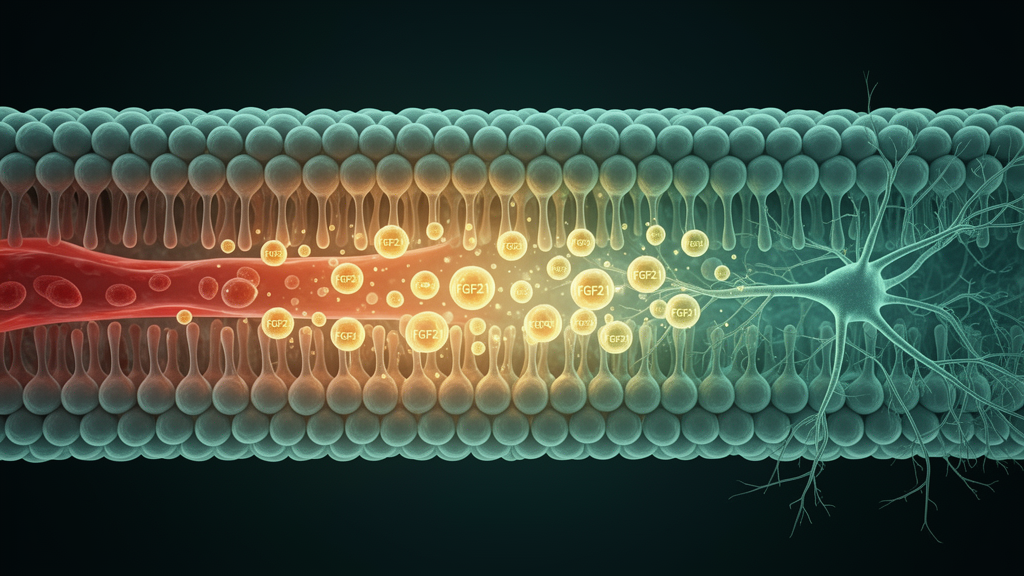
Fibroblast growth factor 21 (FGF21), a hormone produced mainly by the liver with effects on multiple organs including the brain, can cross the blood-brain barrier in mice via a saturable transport system, according to a new study published in Fluids and Barriers of the CNS. Using intracarotid cerebral perfusion, the researchers measured a brain transport coefficient of 0.30 ± 0.03 µl·g⁻¹·s⁻¹ for radiolabeled 3H-FGF21, demonstrating that the circulating hormone actively enters brain tissue rather than being excluded by this barrier.
The transport showed hallmarks of a carrier-mediated mechanism. When increasing concentrations of unlabeled FGF21 were perfused alongside the tracer, the uptake rate of 3H-FGF21 decreased, consistent with a saturable process in which competing molecules occupy a finite number of transport sites. The integrity of FGF21 recovered from the brain after perfusion was confirmed by ELISA, indicating that the hormone crosses the barrier in a form capable of biological activity. Mechanical capillary depletion of brain homogenates revealed that more than 40% of the labeled hormone was found in parenchymal fractions, with the remainder still associated with the cerebrovasculature.
Entry into the parenchyma appears to have functional consequences. Intracarotid infusion of FGF21 led to increased phosphorylation of FGFR1, its canonical receptor, in the brain parenchyma, suggesting receptor activation beyond the vessel wall. Notably, inhibitors of FGFR1 phosphorylation did not affect the uptake of FGF21 itself but mitigated the phosphorylation of FGFR1 in the brain, separating the transport step from the downstream signaling event. The authors also report evidence that FGFR1 is located in the brain parenchyma, where it can be activated by FGF21 injected into the carotid artery.
The study also identified efflux transport as a constraint on brain delivery. Inhibition of P-glycoprotein alone increased the brain transport coefficient by 200%, and combined inhibition of P-gp and BCRP raised it by 600%, indicating that these efflux transporters normally limit how much FGF21 accumulates in the brain. Uptake was uniform across brain regions and unaffected by age or sex in the mice studied. Interestingly, co-perfusion with BDNF, another endocrine factor, reduced FGF21 transport by 66%, pointing to competition at a shared or overlapping transport mechanism.
The authors conclude that circulating FGF21 accesses the brain through a saturable transport system and activates parenchymal FGFR signaling, findings they say support the therapeutic potential of FGF21 for brain disorders. As with any animal study using intracarotid perfusion, the results describe transport and receptor activation in mice and do not by themselves establish clinical efficacy; the article is being shared early as peer-reviewed, accepted research prior to production of the final version of record. Nevertheless, by quantifying in vivo transport, identifying efflux limitation, and demonstrating receptor activation within brain tissue, the work provides a mechanistic basis for evaluating FGF21-based strategies targeting the central nervous system.
Subject of Research: Saturable transport of the hormone FGF21 across the mouse blood-brain barrier and its activation of FGFR1 signaling in brain tissue
Article Title: Transport of FGF21 across the blood-brain barrier: mechanisms and receptor activation
Article References: Linhares, S., Leclerc, M., Valentin-Escalera, J., Seguin, D., Courteau, É., Émond, V., Tremblay, C., & Calon, F. (2026). Transport of FGF21 across the blood-brain barrier: mechanisms and receptor activation. Fluids and Barriers of the CNS. https://doi.org/10.1186/s12987-026-00885-4
Image Credits: AI Generated
DOI: 10.1186/s12987-026-00885-4
Keywords: FGF21, blood-brain barrier, FGFR1, intracarotid perfusion, P-glycoprotein, BCRP, BDNF, brain transport, saturable transport, Fluids and Barriers of the CNS, receptor phosphorylation, therapeutic potential
News Source: Cassandra Pierce. (October 29, 2026). Hormone FGF21 Crosses the Blood-Brain Barrier by a Saturable Transport System. Scienmag.