


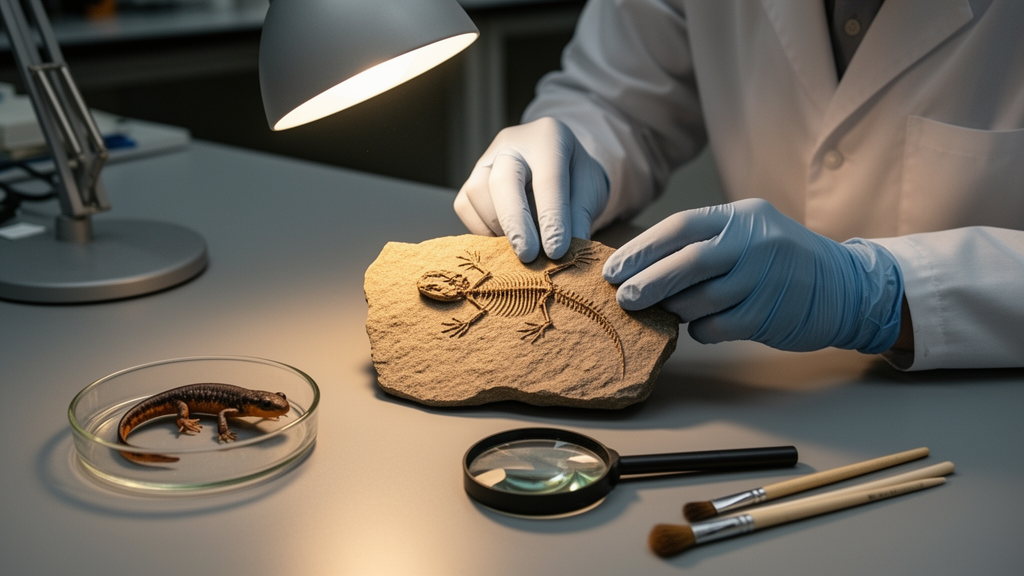
Neoteny, the retention of larval traits into sexual maturity, has long fascinated biologists because it appears repeatedly across the salamander tree and even in the deep fossil record. A new open-access study published in BMC Ecology and Evolution set out to answer a deceptively simple question: if an animal never grows up in the conventional sense, does its bone structure or life history betray that fact?
The study is notable for its methodology as much as its conclusion. Living amphibians are usually studied with stained, microtomized thin sections, while fossil bones can only be examined in petrographic ground sections. Because the two techniques produce different optical features, direct comparisons between modern and fossil material have always been awkward. To solve this, the researchers prepared petrographic ground sections of modern salamander bones for the first time, allowing a like-for-like comparison with fossilized bone. They sampled four obligate neotenic species: the axolotl Ambystoma mexicanum, the olm Proteus anguinus, the common mudpuppy Necturus maculosus and the two-toed amphiuma Amphiuma means. Facultative neotenic newts included the smooth newt Lissotriton vulgaris, the northern crested newt Triturus cristatus, the Pyrenean brook newt Calotriton asper and the Alpine newt Ichthyosaura alpestris, alongside the non-neotenic, viviparous fire salamander Salamandra salamandra.
The fossil counterpart was Apateon, a branchiosaurid temnospondyl from the Lower Permian Saar-Nahe Basin of Germany, represented by the species A. pedestris and A. caducus. Apateon is among the most ancient unequivocally documented neotenic tetrapods: ontogenetic series show poor ossification of the skull and postcranial skeleton and the lifelong presence of a larval hyobranchial apparatus complete with branchial denticles. Histological evidence of sexual maturation in individuals still bearing larval characters supports this interpretation. No metamorphosed specimens of Apateon have ever been found, although metamorphosis is known in another branchiosaurid genus, which suggests but does not prove obligate neoteny in Apateon itself.
Across the modern sample, one feature did turn out to be nearly universal. All adult individuals showed avascular lamellar bone matrix, meaning slowly deposited, highly organized tissue lacking blood vessel canals, with a single exception: Necturus maculosus grew with avascular parallel-fibered bone, a slightly less organized tissue type that indicates a somewhat faster growth rate. The researchers also documented, for the first time in petrographic ground sections, transforming osteoblasts scattered within the cortex of non-larval caudates. These bone-forming cells, caught in the act of becoming osteocytes, indicate a prolonged bone mineralization process in salamanders, a feature that persisted even in fully grown and old-aged axolotls. Yet because this occurs across neotenic and non-neotenic taxa alike, it carries no signal about developmental mode.
Microanatomy proved equally uninformative. The researchers used the relative size of the medullary cavity, the hollow core of the limb bones, as their proxy for bone compactness, and the variation they measured was striking. Medullary cavity size ranged from 10 percent of the cross-sectional diameter in the humerus of Calotriton asper to as much as 80 percent in some axolotl humeri, with femora of that species holding steady around 65 percent. In Apateon, humeral values ranged from 17 to 40 percent and femoral values from 35 to 55 percent. The widest variation appeared precisely where sample sizes were largest, in axolotl humeri and in Apateon, which the authors suggest reflects high genuine intraspecific variability rather than any ontogenetic, sexual or environmental signal. The compactest bones, below 15 percent, belonged to the female Necturus, Amphiuma and the facultatively neotenic Calotriton, a mix of developmental modes that undermines any neat classification.
Growth marks, the annual lines of arrested growth recorded in bone, told a story about environment rather than evolution. Apateon, the fire salamander, the crested newt, Amphiuma and the female mudpuppy all showed distinct lines of arrested growth, consistent with life in seasonal climates. By contrast, the axolotl and the olm, both kept or living in stable, low-seasonality aquatic conditions, showed only faint growth marks. Some young specimens, including the Alpine newt and Calotriton individuals in the sample, had poorly mineralized matrix that obscured their records. A cautionary finding emerged from the captive axolotls of known age: their growth mark counts considerably underestimated the animals’ actual ages, a reminder that skeletochronology, the reading of annual lines in bone, is far from infallible. Calotriton asper also displayed a distinct rest line in the inner cortex that the authors interpret as a metamorphosis line, marking the transition from larval to juvenile bone.
To complement the histological work, the team compiled a large comparative dataset on three life history traits: adult body mass, maximum longevity and age at maturation, drawing on published compilations and assigning each species a developmental mode. The final dataset covered representatives of nine caudate families, including 141 species with body mass, longevity and developmental mode data, and 161 species with body mass, maturation age and mode. Sixteen species in each analysis were obligate neotenic. Using phylogeny-informed statistical models built on a large lissamphibian family tree, the researchers tested whether these traits scale differently with body mass in the two groups.
The statistical results were nuanced but ultimately inconclusive as a diagnostic tool. Maximum longevity and age at maturation both increased significantly with adult body mass across all caudates, and the allometric regressions for obligate and non-obligate neotenic species differed in their scaling of age at maturation, though not of longevity. However, once the allometric effect of body mass was accounted for, phylogenetic analysis of covariance showed that the two groups do not differ in their mean longevities or maturation ages. What did differ was scatter: obligate neotenic species showed significantly greater dispersion of residuals around the allometric lines for both traits, and a Wilks’ lambda test found a significant but weak separation in how the two traits associate with each other. A handful of giants, including the Japanese and Chinese giant salamanders and the olm, stood out as extreme outliers, living very long and maturing late for their size, but this pattern does not generalize.
The practical consequence for paleontology is sobering. Apateon’s estimated profile, an adult body mass of roughly three to five grams, a maximum longevity of about nine years and maturation at five to seven years, closely resembles that of the similarly sized dwarf waterdog Necturus punctatus, which might seem to corroborate its neoteny. But several non-obligate neotenic caudates of comparable size show similar trait combinations, weakening the argument. The authors also caution that Apateon’s age estimates rest on skeletochronology of a small fossil sample, that growth marks can under- or overestimate true age, and that nothing is known about its egg size, clutch size or breeding frequency. Given the enormous variability observed even among living species, the three traits examined here simply cannot be used to infer unequivocally whether any taxon, extinct or extant, was obligately neotenic.
The broader lesson is one of developmental plasticity. Neoteny has evolved independently many times in salamander history, and the new study suggests that each lineage finds its own solution: bone tissue type, bone compactness and life history pacing all respond strongly to environmental conditions, ontogenetic stage and individual circumstance rather than to developmental mode itself. For researchers hoping to read neoteny directly from fossilized bone, the message is that no single histological fingerprint exists. Instead, identifying neoteny in extinct amphibians will continue to depend on comprehensive ontogenetic series and anatomical evidence of larval characters retained into adulthood, with histology serving as supporting context rather than definitive proof.
Subject of Research: Osteohistology, microanatomy and life history traits of neotenic and non-neotenic salamanders and the Permian temnospondyl Apateon
Article Title: Do osteohistology, microanatomy or life history traits show patterns linked to neotenic lifestyles in extant Caudata and the Permian temnospondyl Apateon?
Article References: Klein, N., Konietzko-Meier, D., Schoch, R. R., & Griebeler, E. M. (2026). Do osteohistology, microanatomy or life history traits show patterns linked to neotenic lifestyles in extant Caudata and the Permian temnospondyl Apateon?. BMC Ecology and Evolution, 26(1), Article 90. https://doi.org/10.1186/s12862-026-02577-x
Image Credits: AI Generated
DOI: 10.1186/s12862-026-02577-x
Keywords: neoteny, Caudata, salamanders, osteohistology, Apateon, temnospondyl, growth marks, life history traits, medullary cavity, skeletochronology, Paleozoic, BMC Ecology and Evolution
News Source: Gavin Prescott. (October 29, 2026). Bone Clues Fail to Reveal Neoteny in Salamanders and an Ancient Relative. Scienmag.



