• HOME
  • NEWS
  • EXPLORE
    • CAREER
      • Companies
      • Jobs
    • EVENTS
    • iGEM
      • News
      • Team
    • PHOTOS
    • VIDEO
    • WIKI
  • BLOG
  • COMMUNITY
    • FACEBOOK
    • INSTAGRAM
    • TWITTER
Thursday, June 25, 2026
BIOENGINEER.ORG
No Result
View All Result
  • Login
  • HOME
  • NEWS
  • EXPLORE
    • CAREER
      • Companies
      • Jobs
        • Lecturer
        • PhD Studentship
        • Postdoc
        • Research Assistant
    • EVENTS
    • iGEM
      • News
      • Team
    • PHOTOS
    • VIDEO
    • WIKI
  • BLOG
  • COMMUNITY
    • FACEBOOK
    • INSTAGRAM
    • TWITTER
  • HOME
  • NEWS
  • EXPLORE
    • CAREER
      • Companies
      • Jobs
        • Lecturer
        • PhD Studentship
        • Postdoc
        • Research Assistant
    • EVENTS
    • iGEM
      • News
      • Team
    • PHOTOS
    • VIDEO
    • WIKI
  • BLOG
  • COMMUNITY
    • FACEBOOK
    • INSTAGRAM
    • TWITTER
No Result
View All Result
Bioengineer.org
No Result
View All Result
Home NEWS Science News Health

Helping physio students get to grips with complex motor skills

Bioengineer by Bioengineer
March 19, 2019
in Health
Reading Time: 2 mins read
0
IMAGE
Share on FacebookShare on TwitterShare on LinkedinShare on RedditShare on Telegram

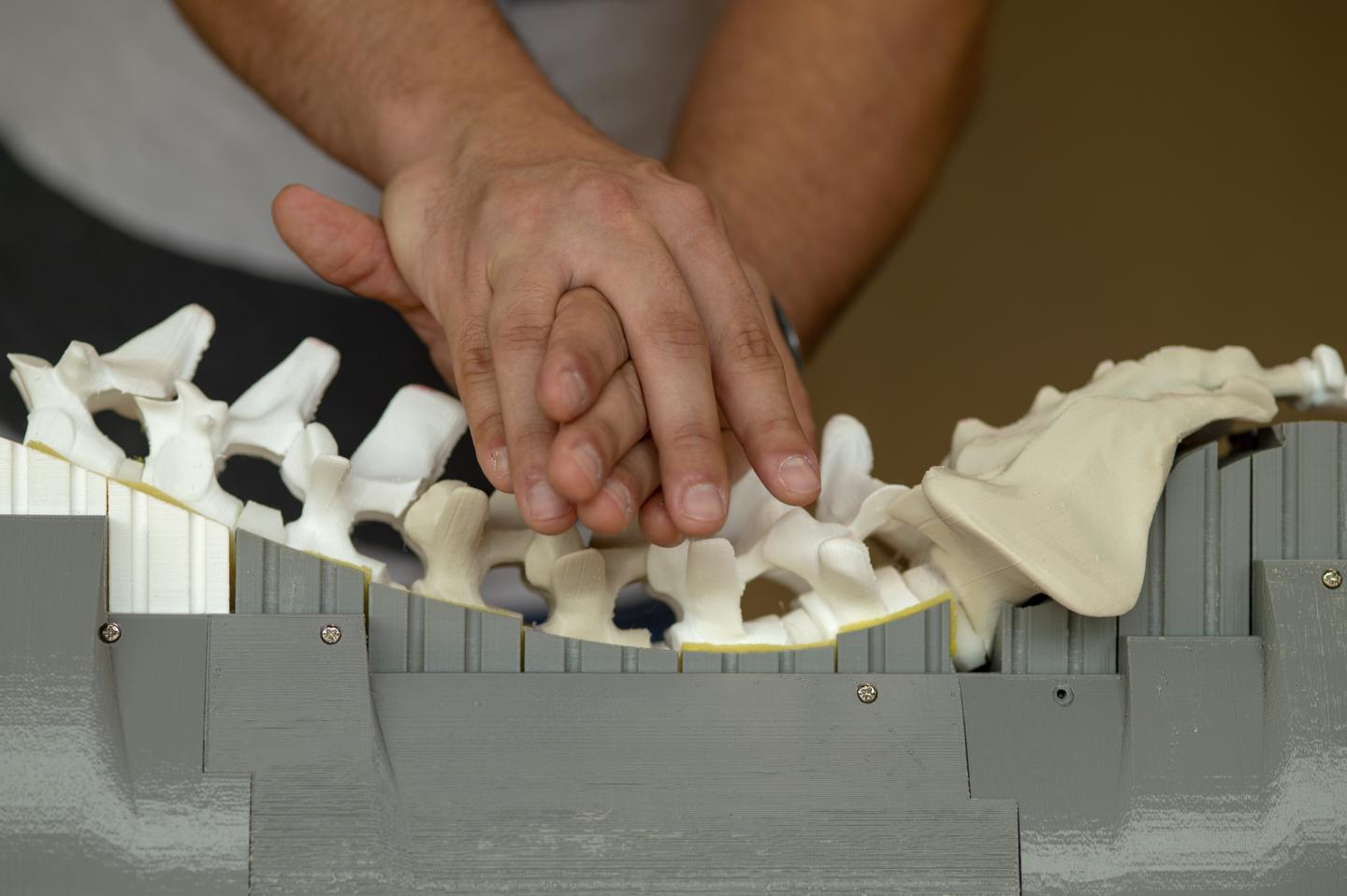
A new tool to help physiotherapy students master complex fine motor skills needed to assess and treat patients suffering physical conditions, such as back pain and spinal cord injuries, is being used at the University of Melbourne
IMAGE

Credit: Image: Sarah Fisher, University of Melbourne

A new tool to help physiotherapy students master complex fine motor skills needed to assess and treat patients suffering physical conditions, such as back pain and spinal cord injuries, is being used at the University of Melbourne.

Developed by researchers in the University’s School of Computing and Information Systems and the Department of Physiotherapy, the device – SpinalLog – looks and feels like a human spine.

Using smart foam sensors, SpinalLog measures the pressure being applied to the spine by the student’s hand or fingers during a simulated assessment.

This information is then displayed on a 3D spinal model depicted on-screen, providing real-time visual feedback on the pressure pattern and technique used to mobilise the spine.

University of Melbourne Human-Computer Interaction lecturer Eduardo Velloso, who helped design the device, said SpinalLog offers students a safe way of practising their skills.

“Traditionally, to teach these skills, the instructor demonstrates a force pattern on a volunteer and asks students to practice on each other by replicating the moment,” Dr Velloso said.

“However, because these movements are very subtle, it is difficult for students to obverse them fully. Similarly, when students perform the movements themselves, it is difficult for instructors to provide feedback based on what they can see.”

Preliminary tests show the visual feedback has a huge impact on students’ ability to replicate the force pattern demonstrated by the instructor.

University of Melbourne physiotherapy senior lecturer David Kelly said SpinalLog represents the real-life conditions of a human spine suffering different levels of stiffness, bringing the clinic, to the classroom.

“Students get clear and immediate feedback on an authentic feeling spine,” Dr Kelly said.

“This means they get a better experience; they learn faster and are able to mimic what the instructor is teaching them, making them better prepared for the sorts of techniques that they’ll need as practitioners.”

This research won the Best Paper Award at the International Conference on Tangible, Embedded and Embodied Interactions in the US, 17 – 20 March.

###

Watch SpinalLog in action: https://www.youtube.com/watch?v=GYwCwGsYdtA&feature=youtu.be

Media Contact
Holly Bennett
[email protected]

Related Journal Article

http://dx.doi.org/10.1145/3294109.3295626

Tags: BiotechnologyComputer ScienceHardwareMedicine/HealthMultimedia/Networking/Interface DesignPhysiologySoftware EngineeringSports MedicineTechnology/Engineering/Computer Science
Share14Tweet8Share2ShareShareShare2

Related Posts

Tracking Lanthanide-Labeled Microplastics in Plants

June 25, 2026

Neural Design Enables Zero-Shot Drug-Binding Proteins

June 25, 2026

Genomic Insights into Human Skin Fungi Diversity

June 25, 2026

Chiral Laser Gyroscopes Surpass Lock-In Limit

June 25, 2026
Please login to join discussion

POPULAR NEWS

  • Saying Goodbye to PGY-6: Pediatric Fellowship Realities

    103 shares
    Share 41 Tweet 26
  • Multi-Hospital Study Reveals Long Covid Burden Is Twice as High as Current Estimates

    92 shares
    Share 36 Tweet 23
  • Detection of EDCs in Breast Milk and Infant Urine Up to Six Months Highlights Early Exposure Risks

    77 shares
    Share 31 Tweet 19
  • New Drug Candidate Developed at McMaster Shows Potential for Treating Brain Cancer

    58 shares
    Share 23 Tweet 15

About

We bring you the latest biotechnology news from best research centers and universities around the world. Check our website.

Follow us

Recent News

Tracking Lanthanide-Labeled Microplastics in Plants

POSTECH Researchers Slash Cost of Reconstituted Cell-Free Systems by 95%

AI and Physics Collaborate to Design Advanced Hydrogen Storage Materials

Subscribe to Blog via Email

Success! An email was just sent to confirm your subscription. Please find the email now and click 'Confirm' to start subscribing.

Join 82 other subscribers
  • Contact Us

Bioengineer.org © Copyright 2023 All Rights Reserved.

Welcome Back!

Login to your account below

Forgotten Password?

Retrieve your password

Please enter your username or email address to reset your password.

Log In
No Result
View All Result
  • Homepages
    • Home Page 1
    • Home Page 2
  • News
  • National
  • Business
  • Health
  • Lifestyle
  • Science

Bioengineer.org © Copyright 2023 All Rights Reserved.