Immune checkpoint inhibitors have transformed the treatment of non-small cell lung cancer, yet most patients still do not benefit durably from them. A new review published in Frontiers in Oncology argues that a decisive, and largely overlooked, variable sits far from the tumor itself: the community of microbes living in the gut. The authors, a team from Shandong Second Medical University and Shandong First Medical University in China, synthesize mechanistic and clinical evidence that intestinal bacteria, their metabolites and even gut fungi remotely reprogram the immune landscape of lung tumors, shaping both the efficacy of PD-1 and PD-L1 blockade and the risk of severe side effects.
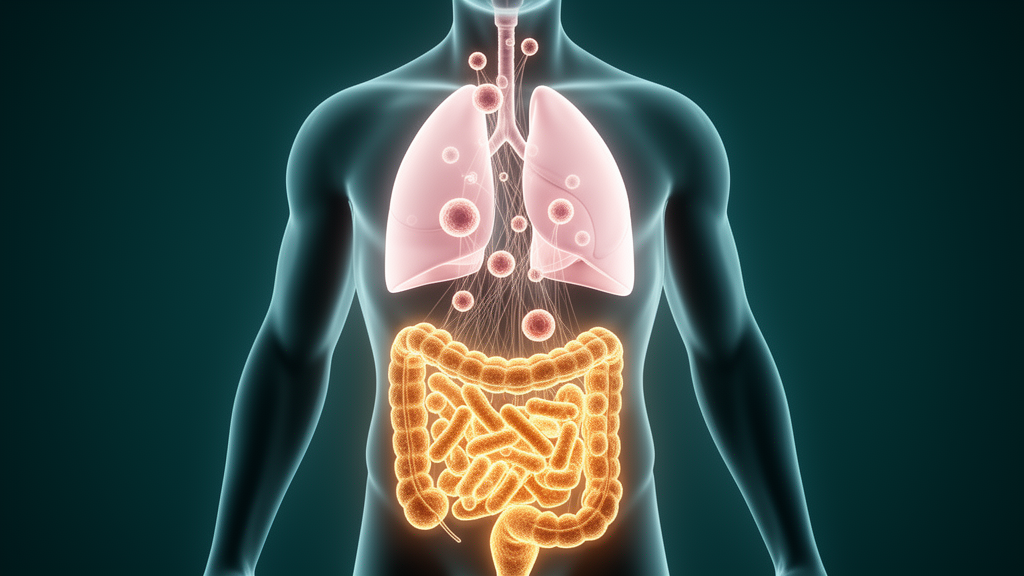
The core of the argument is the gut-lung axis, a bidirectional communication network in which intestinal dysbiosis can impair pulmonary immunity. Epidemiological data show that antibiotic-induced disruption of the gut flora significantly compromises the survival benefits of checkpoint inhibitors in patients with non-small cell lung cancer. But the review goes beyond that association, mapping specific molecular routes by which gut-derived signals reach the tumor immune microenvironment, the ecosystem of immune cells, stromal cells and metabolic networks that surrounds a lung cancer and largely determines whether immunotherapy can work.
One of the most clearly defined routes runs through bacterial metabolites that travel in the bloodstream and act as epigenetic regulators. Butyrate, a short-chain fatty acid produced by obligate anaerobic gut bacteria such as Faecalibacterium prausnitzii, Roseburia and members of the Lachnospiraceae and Ruminococcaceae, functions as a natural histone deacetylase inhibitor. In CD8-positive T cells, it raises acetylation at the promoters of the Pdcd1 and Cd28 genes, enhancing T cell receptor signaling and boosting cytotoxic function and responsiveness to PD-1 blockade. Integrated microbiota-metabolite analyses in non-small cell lung cancer have linked gut short-chain fatty acid profiles to the efficacy of combined chemotherapy and immunotherapy.
The same metabolite acts on tumor cells themselves, with effects that depend on concentration and compartment. In lung adenocarcinoma, intratumoral butyrate inhibits the enzyme HDAC2, increases H3K27 acetylation at the H19 promoter, and drives MMP15 secretion and M2 macrophage polarization, a pro-tumor immune shift. At higher concentrations, however, butyrate suppresses tumor-cell PD-L1 expression through acetylation of STAT1. The review also describes indole-3-acetic acid, a microbial metabolite produced by Bifidobacterium animalis, which acts as a ligand for the aryl hydrocarbon receptor and inhibits the METTL3-STAT3 axis in lung cancer cells, blocking STAT3-mediated M2 macrophage polarization. A related bacterial indole derivative, trans-3-indoleacrylic acid, signals through the same receptor to upregulate ALDH1A3 and, via FSP1-dependent coenzyme Q10 reduction, inhibit ferroptosis in tumor cells.
The vulnerability of this metabolite-dependent crosstalk is defined by the kinetics of antibiotic-induced depletion. Because butyrate producers are obligate anaerobes, they are among the taxa most rapidly eliminated by broad-spectrum antibiotics. In healthy adults given a four-day course of meropenem, gentamicin and vancomycin, butyrate-producing species and Bifidobacterium were depleted within days; although the community returned to near-baseline composition within roughly six weeks, nine common species remained undetectable in most subjects at day 180, meaning functional recovery lags behind compositional recovery. A seven-day clindamycin course produced disturbances that persisted throughout two years of follow-up. Clinically, the adverse impact of antibiotics on checkpoint inhibitor outcomes is concentrated in a narrow peri-initiation window, whereas antibiotics given concurrently with checkpoint blockade were not associated with worse survival in the same cohort, suggesting the timing, not the antibiotic itself, is the critical variable.
On the therapeutic side, the review draws a sharp distinction between primary resistance, in which patients never respond to PD-1 blockade, and acquired resistance, in which disease progresses after an initial response. Fecal microbiota transplantation has emerged as a direct intervention, building on seminal mouse studies in which fecal material from immunotherapy-responsive patients reinstated antitumor efficacy, and oral Akkermansia muciniphila restored checkpoint blockade in an interleukin-12-dependent manner. Most early FMT experience, including the phase 2 FMT-LUMINate trial and the PERFORM trial, was generated in treatment-naive or first-line settings, where the objective response rate reached 75 to 80 percent.
Evidence in acquired resistance is newer and more modest. In one prospective single-arm study, seven patients whose disease had progressed after an initial response to PD-1 or PD-L1 blockade received oral fecal microbiota capsules from healthy donors together with a PD-1 inhibitor re-challenge. The regimen was well tolerated, with only grade 1 related adverse events, but activity was limited: one partial response, an objective response rate of 14.3 percent, median progression-free survival of 1.5 months and median overall survival of 12.1 months. In a larger study, 27 patients with documented secondary resistance received fecal microbiota capsules with PD-1 re-challenge and chemotherapy, achieving an objective response rate of 29.6 percent, a disease control rate of 63.0 percent, median progression-free survival of 6.8 months and median overall survival of 11.1 months. Responders showed increased gut microbial diversity, greater intratumoral CD8-positive T cell infiltration and a reduced regulatory T cell fraction. Notably, concomitant proton pump inhibitor use was associated with a hazard ratio of 12.67 for outcome, and corticosteroid administration during transplantation with a hazard ratio of 4.98, implying that reviewing concomitant medications may matter as much as donor selection.
As a biomarker, the field is moving from single taxa to ecological scores. A 2024 study introduced TOPOSCORE, a dysbiosis score based on bacterial co-occurrence networks that stratified patients into survival risk groups. In locally advanced non-small cell lung cancer treated with chemoradiotherapy followed by consolidation immunotherapy, longitudinal monitoring showed that a significant increase in Akkermansia muciniphila during treatment, rather than baseline abundance, predicted longer progression-free and overall survival. Gut dysbiosis also serves as an early warning for toxicity: patients developing grade 2 or worse pneumonitis during combined chemoradiotherapy and immunotherapy exhibited significantly lower alpha diversity and enrichment of pathogenic taxa. Molecular mimicry between gut microbial antigens and host tissues has been implicated in long-term immune-related toxicity.
Yet the review is unsparing about the barriers to clinical translation. In a meta-analysis of four shotgun metagenomic melanoma cohorts, samples clustered by study rather than by response, and a classifier built on pooled data achieved an area under the curve of only 0.625. Species-level signatures did not transfer between cohorts, with reproducible performance achieved only at strain resolution under concordant treatment regimens. Methodology compounds the problem: in matched-sample comparisons, 16S amplicon sequencing identified fewer than half as many differentially abundant genera as shotgun sequencing, and DNA extraction method was the single largest contributor to variation in inferred composition. Safety is a further constraint. In 2019, two trial recipients developed bloodstream infection with extended-spectrum beta-lactamase-producing Escherichia coli traced to a single donor lot, and one died of sepsis; in 2020, the US Food and Drug Administration reported six patients infected with pathogenic E. coli after receiving stool-bank product, with two deaths reported. FMT is regulated in the United States as both a biological product and a drug, requiring an investigational new drug application outside Clostridioides difficile infection.
The trial landscape reflects this immaturity. Among registered interventional studies of microbial therapeutics in non-small cell lung cancer, only three randomize patients within the disease, all small, using response or biomarker endpoints rather than survival. No registry record has posted results, and only FMT-LUMINate, which met its primary endpoint with an 80 percent objective response rate in first-line disease, has been published in full. No completed phase III trial of a microbial therapeutic has been reported in any cancer. The authors conclude that progress requires pre-specified sequencing platforms, centralized bioinformatics, harmonized donor criteria, prospective recording of confounders such as proton pump inhibitors and corticosteroids, and randomized, blinded designs with survival endpoints before microbiome profiling can guide treatment of individual patients, particularly those whose disease has already progressed on PD-1 blockade.
Subject of Research: The role of the gut microbiome and the gut-lung axis in regulating immunotherapy response and resistance in non-small cell lung cancer.
Article Title: Deciphering the gut-lung axis in non-small cell lung cancer: from immune microenvironment crosstalk to clinical translation
Article References: Sun, C., Han, F., Xu, W., Wang, X., & Wang, X. (2026). Deciphering the gut-lung axis in non-small cell lung cancer: from immune microenvironment crosstalk to clinical translation. Frontiers in Oncology, 16, 1975256. https://doi.org/10.3389/fonc.2026.1975256
Image Credits: AI Generated
DOI: 10.3389/fonc.2026.1975256
Keywords: gut-lung axis, non-small cell lung cancer, immune checkpoint inhibitors, gut microbiota, fecal microbiota transplantation, immunotherapy resistance, butyrate, tumor microenvironment, Akkermansia muciniphila, microbiome biomarkers, PD-1 blockade, antibiotics
News Source: Nathaniel Bowman. (October 27, 2026). Gut microbes may decide who responds to lung cancer immunotherapy. Scienmag.