• HOME
  • NEWS
  • EXPLORE
    • CAREER
      • Companies
      • Jobs
    • EVENTS
    • iGEM
      • News
      • Team
    • PHOTOS
    • VIDEO
    • WIKI
  • BLOG
  • COMMUNITY
    • FACEBOOK
    • INSTAGRAM
    • TWITTER
Monday, October 5, 2026
BIOENGINEER.ORG
No Result
View All Result
  • Login
  • HOME
  • NEWS
  • EXPLORE
    • CAREER
      • Companies
      • Jobs
        • Lecturer
        • PhD Studentship
        • Postdoc
        • Research Assistant
    • EVENTS
    • iGEM
      • News
      • Team
    • PHOTOS
    • VIDEO
    • WIKI
  • BLOG
  • COMMUNITY
    • FACEBOOK
    • INSTAGRAM
    • TWITTER
  • HOME
  • NEWS
  • EXPLORE
    • CAREER
      • Companies
      • Jobs
        • Lecturer
        • PhD Studentship
        • Postdoc
        • Research Assistant
    • EVENTS
    • iGEM
      • News
      • Team
    • PHOTOS
    • VIDEO
    • WIKI
  • BLOG
  • COMMUNITY
    • FACEBOOK
    • INSTAGRAM
    • TWITTER
No Result
View All Result
Bioengineer.org
No Result
View All Result
Home NEWS Science News Chemistry

Graphene substrate improves the conductivity of carbon nanotube network

Bioengineer by Bioengineer
October 9, 2019
in Chemistry
Reading Time: 2 mins read
0
IMAGE
Share on FacebookShare on TwitterShare on LinkedinShare on RedditShare on Telegram

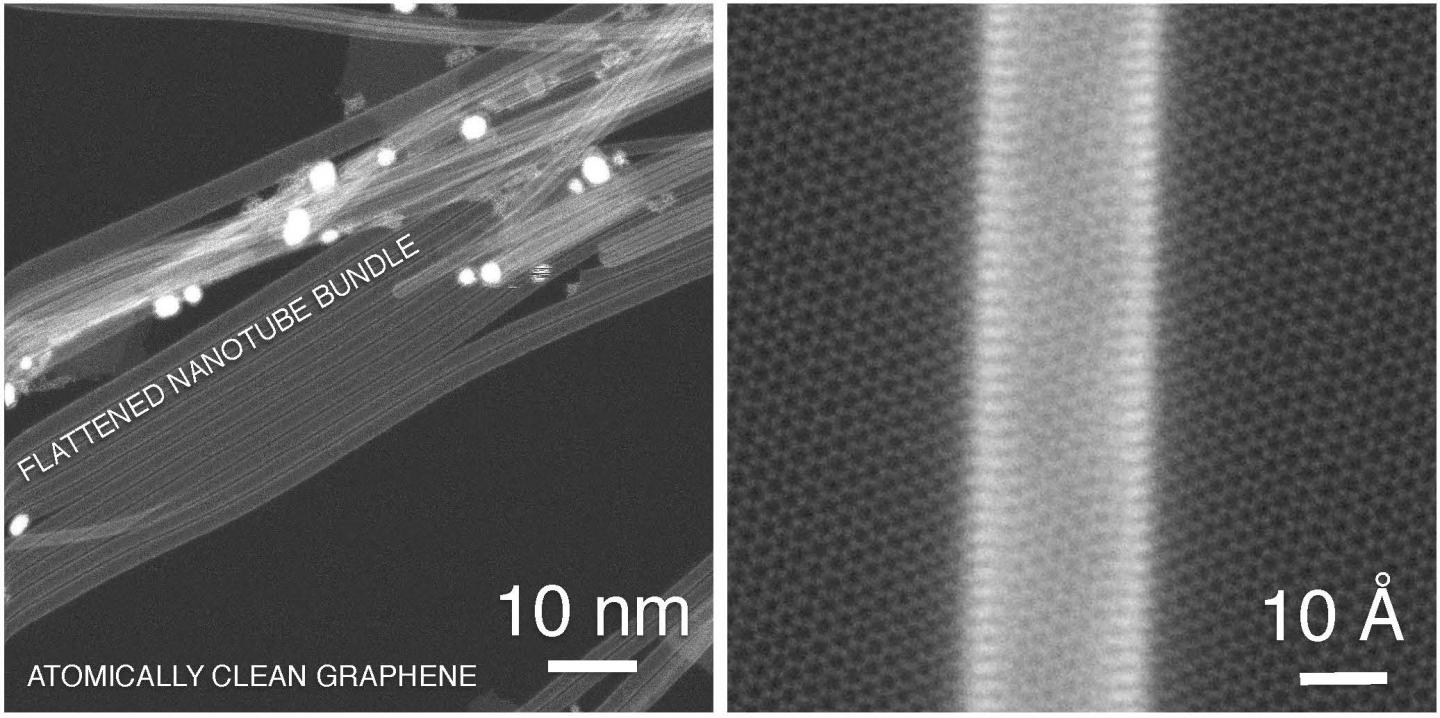
Scientists at Aalto University, Finland, and the University of Vienna, Austria, have combined graphene and single-walled carbon nanotubes into a transparent hybrid material with conductivity higher than either component exhibits separately
IMAGE

Credit: Kimmo Mustonen / Jani Kotakoski, University of Vienna

Transparent conductive films (TCFs) have many applications in touch screens, organic light emitting diodes and solar cells. These applications need materials that are strong, energy efficient and stable, which is why companies and researchers are interested in carbon-based materials. This applies especially to networks of single-walled carbon nanotubes, which are expected to replace the metal-oxide films that are currently used.

Graphene is the thinnest imaginable material, it is just one atomic layer of carbon atoms. Rolling this into a cylinder makes a carbon nanotube, which is better suited to carrying electricity in real-world applications. In an article published in ACS Nano, scientists at Aalto University and the University of Vienna introduce a hybrid material made by combining carbon nanotubes and graphene, which improves the conductivity of the film beyond what is possible when using each of these component structures separately.

Professor Kauppinen’s group at Aalto has years of experience in making carbon nanotubes for TCFs. This new work applies the techniques they have developed to place densely-packed and clean random nanotube networks on graphene. “This is another application of the technologies we have developed over the past decades. Put simply, this work is about how the two materials are put together without solvents,” Kauppinen explains.

In the study, the scientists used a process called thermophoresis to deposit nanotubes on prefabricated graphene electrodes. The hybrid films’ conductivities were roughly twice as high as predicted.

The experiments conducted by the team at the University of Vienna, led by Jani Kotakoski, showed that the strong electrical interactions of graphene enhanced the flow of electrons between the nanotubes by encouraging charge-tunneling. The team used a scanning transmission electron microscope to look at the material on the scale of individual atoms, and saw that the van der Waals interaction between the graphene and nanotubes was strong enough to collapse the circular nanotube bundles into flat ribbons.

The lead scientist from the Vienna group, Kimmo Mustonen, explains: “This is really an ingenious approach. The charge transport in nanomaterials is very sensitive to any external factors. What you really want is to avoid unnecessary processing steps if your goal is to make the ideal conductive film.” Mustonen adds, “It actually is quite remarkable. We of course knew that the interaction is quite strong. For instance, think of graphite; it is just a large number of graphene layers bound together by the same mechanism. Yet we did not expect that it has such a strong impact on conductivity.”

The results provide opportunities to improve the conductivity of similar hybrid nanomaterials. The article was published in “ACS Nano” in September 2019.

###

Media Contact
Esko Kauppinen
[email protected]
358-405-098-064

Related Journal Article

http://dx.doi.org/10.1021/acsnano.9b05049

Tags: Chemistry/Physics/Materials SciencesElectrical Engineering/ElectronicsIndustrial Engineering/ChemistryMaterialsNanotechnology/MicromachinesResearch/DevelopmentSuperconductors/SemiconductorsTechnology/Engineering/Computer Science
Share12Tweet8Share2ShareShareShare2

Related Posts

Earth-Abundant CFTS Solar Cells Simulated to Reach 25.52% Efficiency

Earth-Abundant CFTS Solar Cells Simulated to Reach 25.52% Efficiency

October 5, 2026
Waste Polyamide Becomes Tunable Light-Emitting Carbon Dots, Saitama Team Reports

Waste Polyamide Becomes Tunable Light-Emitting Carbon Dots, Saitama Team Reports

October 5, 2026

Cigarette Filters Reborn as Green Sorbents to Catch Pesticides in Vegetables

October 5, 2026

Microbial Succession Drives the Aroma of Traditional Mould-Fermented Sufu, Study Finds

October 5, 2026
Please login to join discussion

POPULAR NEWS

  • Alloys That Shrink Their Own Grains: New PIX Mechanism Refines Metals With Heat Alone

    Alloys That Shrink Their Own Grains: New PIX Mechanism Refines Metals With Heat Alone

    29 shares
    Share 12 Tweet 7
  • Endurance Exercise Reshapes the Liver in Males and Females Through Distinct Molecular Routes

    29 shares
    Share 12 Tweet 7
  • Single Transcription Factor PU.1 Rapidly Converts Fibroblasts into Macrophage-Lineage Cells

    29 shares
    Share 12 Tweet 7
  • New Scale Measures How Ready Nurse Educators Really Are for the AI Era

    29 shares
    Share 12 Tweet 7

About

We bring you the latest biotechnology news from best research centers and universities around the world. Check our website.

Follow us

Recent News

Alloys That Shrink Their Own Grains: New PIX Mechanism Refines Metals With Heat Alone

Endurance Exercise Reshapes the Liver in Males and Females Through Distinct Molecular Routes

Single Transcription Factor PU.1 Rapidly Converts Fibroblasts into Macrophage-Lineage Cells

Subscribe to Blog via Email

Success! An email was just sent to confirm your subscription. Please find the email now and click 'Confirm' to start subscribing.

Join 85 other subscribers
  • Contact Us

Bioengineer.org © Copyright 2023 All Rights Reserved.

Welcome Back!

Login to your account below

Forgotten Password?

Retrieve your password

Please enter your username or email address to reset your password.

Log In
No Result
View All Result
  • Homepages
    • Home Page 1
    • Home Page 2
  • News
  • National
  • Business
  • Health
  • Lifestyle
  • Science

Bioengineer.org © Copyright 2023 All Rights Reserved.