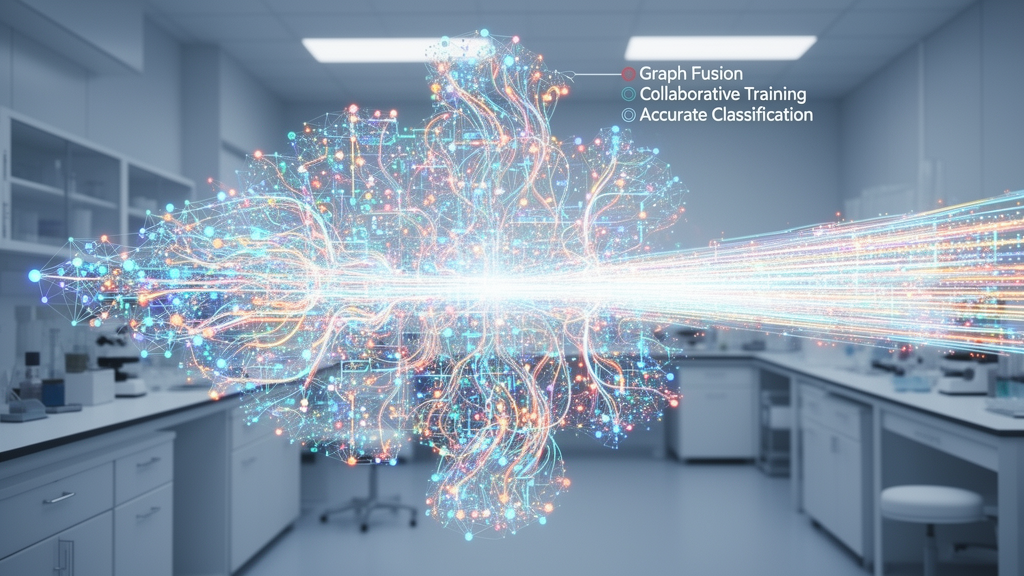
Health data is messy by nature: electronic health records mix free text with lab values, gene expression matrices are vast and sparse, and almost everything that would make supervised learning easy—clean labels—is in short supply. A study published in Discover Artificial Intelligence on 27 October 2026 by Bo Zhao tackles exactly this bottleneck, proposing a two-part framework that fuses attribute features with graph structure information and then turns clustering results into classification decisions through collaborative training. The reported results are striking: on the MIMIC-III clinical dataset, with only 10% of samples annotated, the classification model reached an accuracy of 0.724, a relative improvement of 18.3% over a support vector machine baseline.
The first component, called the Graph Structure Fusion Clustering Algorithm (GSFCA), is designed to extract valuable information from both the feature space and the graph structure space of health data simultaneously. It pairs two complementary encoders: an autoencoder (AE) that compresses and reconstructs attribute features by minimizing mean squared reconstruction error, and a graph autoencoder (GAE) that runs multi-layer graph convolutions over an adjacency matrix and learns to reconstruct the graph’s connectivity through an inner-product decoder. Rather than simply concatenating the two representations, an adaptive fusion network transforms each layer’s output through fully connected layers and blends them with a learned weight between zero and one, computed by a small neural network that takes both transformed features as inputs. This lets the model dynamically adjust how much attribute versus structural information flows through at each layer, correcting the rigidity of fixed-weight fusion that the author identifies as a weakness of existing graph clustering methods.
On top of this fusion architecture sits a joint self-supervision mechanism. The intermediate outputs of both the AE and GAE are clustered, soft assignment distributions between samples and cluster centers are computed, and target distributions are derived by sharpening those assignments. Kullback-Leibler divergence then constrains the clustering distributions to approach the target distributions, and the same constraint is applied to the output of the adaptive fusion network. The total loss combines the AE reconstruction loss, the GAE graph reconstruction loss, and the KL divergence term weighted by a balance coefficient, all optimized end to end. The author argues this closes a gap in prior deep graph clustering work, where graph autoencoders and clustering losses were optimized sequentially without hierarchical interaction, and where self-supervised clustering was mostly applied to images rather than jointly trained with graph structure.
The second component, the Health Big Data Classification Model (HBDCM), converts clustering output into classification decisions. The clustering assignment labels provide an initial class prior distribution for unlabeled samples, serving as pseudo-label candidates. The labeled data is randomly split into training subsets, each of which trains a support vector machine base classifier—five in total, with radial basis kernels and a penalty parameter selected by grid search. Unlabeled samples are then scored by class probability, base classifiers are weighted by their validation accuracy, and only samples above a confidence threshold of 0.8 are promoted into the labeled pool each iteration, with a maximum of ten rounds. Classification is finalized by voting among the base classifiers. The confidence screening is the safety valve: by admitting only high-confidence pseudo-labels, the framework suppresses the accumulation of labeling errors that plagues naive self-training.
The experiments ran on Python 3.8 with PyTorch 1.12 and PyTorch Geometric, on an Intel Core i7-12700K CPU with an NVIDIA RTX 3090 GPU. Three public datasets were used: MIMIC-III, from which 5,000 structured medical records were extracted with 150-dimensional clinical features and 5 disease labels, with the graph built from patient comorbidity relationships; TCGA-BRCA, covering gene expression profiles and pathological staging labels for 1,219 patients, with the graph built from gene co-expression networks using a Pearson correlation threshold of |r| > 0.6; and Cochrane, comprising 2,000 medical literature abstracts vectorized by TF-IDF into 800-dimensional features across four clinical outcome categories, structured by their citation network. Notably, all graph structures were constructed solely from training-set samples, without test data or disease labels, to prevent leakage. Data was split 7:2:1 with stratified sampling, five-fold cross-validation was applied on the training set, and each experiment was run five times with averaged results.
The clustering results show consistent gains across all three data types. On MIMIC-III, GSFCA achieved a clustering accuracy of 0.789, normalized mutual information of 0.762, and an adjusted Rand index of 0.735, beating K-means, DBSCAN, an attention-based graph clustering algorithm, and deep graph clustering; its accuracy was 4.8% higher than the runner-up. On TCGA-BRCA, accuracy reached 0.776, far above K-means at 0.591 and DBSCAN at 0.567, and 0.038 higher than the best competing method. On the Cochrane text data, accuracy hit 0.793, 4.5% above the suboptimal algorithm. Ablation experiments on MIMIC-III confirmed that every component matters: removing the AE encoder dropped accuracy to 0.745, removing the GAE encoder to 0.761, removing adaptive fusion to 0.742, and removing the self-supervised loss to 0.758, with adaptive fusion showing a slightly larger impact than self-supervision.
The classification results track the annotation rate in an informative way. At 10% annotation on MIMIC-III, HBDCM scored 0.724 accuracy, 0.701 precision, 0.715 recall, and 0.708 F1, against SVM at 0.612 accuracy, Co Training at 0.678, and Self Training at 0.661. At 30% annotation on TCGA-BRCA, HBDCM reached 0.791 accuracy and 0.777 F1. At 50% annotation on the Cochrane texts, accuracy climbed to 0.834, with recall 14.1% higher than SVM. The author’s analysis of these gradients is that structured, graph-correlated data like clinical records and citation-linked texts benefit most from collaborative training at low annotation rates, because the unlabeled structure carries rich information, whereas high-dimensional, sparse gene expression data still leans more heavily on annotated samples.
The framework is not without costs. Training time for GSFCA was the highest of all compared methods—31.2 seconds per epoch on MIMIC-III, 50.3 on TCGA-BRCA, and 35.8 on Cochrane—reflecting the added complexity of bidirectional fusion, multi-branch computation, and joint self-supervision. Inference, however, stayed under 50 milliseconds per sample on the test hardware, which the author says meets real-time requirements for clinical workstations or server-side deployment. A sensitivity analysis also showed the chosen defaults are robust: the loss balance coefficient of 0.1, graph neighborhood size of 20, and confidence threshold of 0.8 each produced a unimodal performance peak, with deviations either starving the self-supervised constraint or introducing noisy edges and false pseudo-labels.
Against four recently proposed advanced graph clustering baselines on MIMIC-III—including structure-preserving contrastive clustering, higher-order contrastive augmentation, fast self-supervised discrete clustering, and a controlled clustering expert network—GSFCA still led on every metric, with a clustering accuracy of 0.789 ± 0.005 that was 1.3% higher than the best baseline, statistically significant at p < 0.05 under paired t-tests. The discussion also situates the work relative to random-walk-based graph collaborative filtering and high-order noisy-graph contrastive learning frameworks, arguing that GSFCA’s adaptive layer-wise fusion and confidence-thresholded pseudo-labeling address robustness from a complementary angle.
The author is candid about the limits. The model’s complex structure and large parameter count create overfitting risk when annotated samples are scarce; only static graph structures were tested, leaving applicability to time-series monitoring data unclear; and cross-institutional generalization is constrained by distributional differences between medical centers, meaning real deployment would need domain adaptation or meta-learning. Privacy in practice would require federated learning or differential privacy on top of the de-identified public data used here. The discussion also sketches clinical interpretability angles—mapping clusters to comorbidity patterns in MIMIC-III and noting that high-confidence clusters in TCGA-BRCA correspond to differentially expressed genes enriched in the PI3K/AKT pathway—though these are presented as interpretive observations rather than validated clinical findings, and the author notes that auxiliary diagnostic value would need to be verified through prospective clinical trials. Future work points toward model compression, cross-center validation, and dynamic graph modeling of temporal health data, with pruning, knowledge distillation, or early stopping proposed to trim computational overhead at inference time.
Subject of Research: A graph structure fusion clustering algorithm and collaborative training classification model for health big data
Article Title: Health big data classification application based on collaborative training optimization algorithm
Article References: Zhao, B. (2026). Health big data classification application based on collaborative training optimization algorithm. Discover Artificial Intelligence, 6(1), Article 1666. https://doi.org/10.1007/s44163-026-02529-w
Image Credits: AI Generated
DOI: 10.1007/s44163-026-02529-w
Keywords: health big data, graph autoencoder, collaborative training, semi-supervised learning, MIMIC-III, TCGA-BRCA, clustering, self-supervised learning, adaptive feature fusion, support vector machine, medical classification, pseudo-labeling
News Source: Denise Maddox. (October 28, 2026). Graph Fusion and Collaborative Training Lift Health Big Data Classification Accuracy. Scienmag.