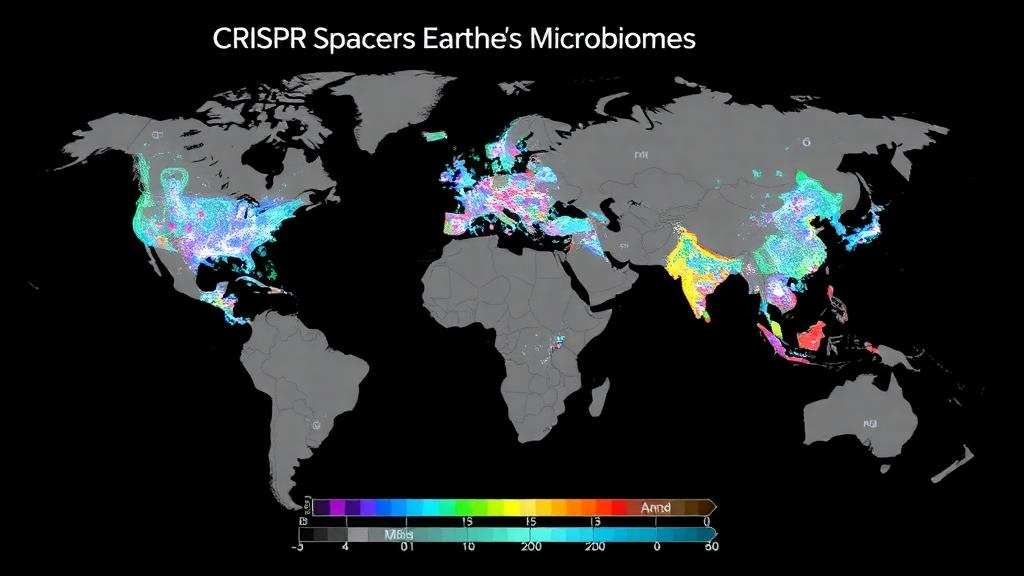
A computational sweep of nearly half a million public metagenomes has yielded one of the largest collections of CRISPR spacers ever assembled, offering a planetary-scale view of how microorganisms and their mobile genetic elements interact. Researchers developed a pipeline called SpacerExtractor to mine short-read sequencing data from 467,018 publicly available metagenomes in NCBI’s Sequence Read Archive. After quality control and denoising, the search produced 794,125,610 spacers, which dereplicated into roughly 410 million distinct spacers associated with 274,000 repeats across 367,609 metagenomes. Matching these spacers against databases of viruses and plasmids generated 1.18 billion hits between 41 million spacers and 2.5 million viruses and plasmids, a sixfold increase over the hits previously recorded in the virus database and a twofold increase for plasmids.
The study, published in Nature Microbiology, began with the construction of a reference database of CRISPR repeats. The team used CRISPRCasTyper to predict CRISPR arrays across 383,318 public bacterial and archaeal genomes and 33,727 metagenome assemblies. After filtering for low-complexity sequences and probable artefacts, 581,889 non-redundant CRISPR repeats were retained. Most of these repeats, 538,406, were detected exclusively in metagenome assemblies, and 82.2 percent of those sat on short contigs with little or no genomic context, meaning they typically could not be assigned a CRISPR type or a taxon. The authors interpret these as relatively rare and probably under-sampled CRISPR–Cas loci, or in some cases possibly repeat sequences that are not part of a genuine CRISPR–Cas system at all.
Repeats that could be traced to genomes spanned a remarkable breadth of microbial life: representatives from all known CRISPR types, across 159 phyla, 2,481 families and 8,418 genera of bacteria and archaea. When the SpacerExtractor pipeline was run across the metagenomic reads, 67.1 percent of the collected spacers connected to repeats that had been identified in a genome, suggesting that genome-derived repeats represent the most common CRISPR arrays across microbiomes. Over half of the metagenome-only repeats, 55.1 percent, were not associated with any spacer set, defined as at least five non-redundant spacers for a given repeat in a given sample.
After controlling for sequencing depth, the frequency of repeats with an associated spacer set varied sharply by ecosystem. Wastewater, bioreactors and hot-spring microbiomes showed the highest detection rates, while marine samples showed the lowest, a pattern the authors attribute to differences in community complexity and the frequency of CRISPR arrays in these populations. Taxonomic distributions matched expectations, with Lachnospira and Bifidobacterium repeats among the most frequently detected in human gut samples and Microcystis the most common in freshwater. The dataset is heavily skewed, however: 59 percent of the datasets that could be classified were identified as human-associated, and the authors note that the collection vastly over-represents Western-diet-fed human gut microbiomes.
Within samples, spacer diversity proved strikingly high. Most spacer sets, 52.5 percent, contained at least 20 distinct spacers, and 7.4 percent contained at least 100. Among sets with sufficient sequencing coverage, 75.7 percent showed a minority of high-abundance or common spacers alongside a larger pool of rare spacers likely present in only a subset of the population. Two-thirds of all spacers, 67.0 percent, were singletons identified on a single read, and clustering analyses suggested that 62.9 percent of these singletons were not closely related to any other spacer in the same set, indicating genuinely rare spacers rather than sequencing artefacts.
Spacer turnover between samples was equally pronounced. For 17,247 repeat sequences with high-coverage spacer sets available in at least ten samples, 86.5 percent of spacers were detected in a single sample. Yet spacers that were common within a population were far more persistent: when only samples from the same subject or location were considered, 84.7 percent of all spacers still appeared in a single sample, but 95.6 percent of common spacers were detected in multiple samples. The authors propose that new spacers are frequently acquired by individual cells, that most are quickly lost to drift, and that only a minority become prevalent, probably through direct selection or genetic hitchhiking, after which they are especially conserved within stable microbiomes. A small fraction of repeats, about 2.0 percent, showed unusually low spacer diversity and may represent so-called memory arrays.
Matching spacers to targets revealed that CRISPR targeting is rarely a one-to-one relationship. Considering alignments covering the entire spacer with no mismatches or a single mismatch, spacer hits were found for 36.1 percent of virus genomes in the IMG/VR database, including 81.8 percent of high-quality Caudoviricetes genomes, and for 59.9 percent of plasmids in IMG/PR. Among spacers with at least one hit, 60.8 percent matched two or more distinct virus genomes, and these identical matches spanned both closely related and mostly unrelated viruses. Spacers matching multiple viruses were more often associated with genes of known function, 47.9 percent versus 40.9 percent for single-target spacers, consistent with spacers preferentially targeting conserved genomic regions under arms-race dynamics. Common spacers were far more likely to have hits than rare ones, 30.5 percent versus 10.1 percent, and spacers from human-associated samples had more hits than those from other ecosystems, probably reflecting a database bias toward human microbiome material.
The analysis also uncovered evidence suggestive of a phenomenon that blurs the line between CRISPR targeting and virus–host interactions. For virus–repeat pairs with ten or more near-exact spacer hits, taxonomy of the targeting repeat and the known virus host were overwhelmingly consistent, 76.8 percent of cases, indicating that hit counts help identify true virus–host pairs. But among pairs with ten or more hits from a non-host taxon, 57.6 percent involved viruses encoding a diversity-generating retroelement, or DGR, compared with 16.8 percent for all pairs. DGRs are targeted mutagenesis mechanisms that can diversify phage receptor-binding proteins and potentially allow virions to attach to non-host cells. The authors suggest that after such attachment, the CRISPR–Cas system of the non-host cell may acquire spacers from the entering viral genome, and because no productive infection follows, no selection for viral escape mutants would be expected, which matches the observed pattern of mostly near-exact spacer hits in these non-host cases.
Broad CRISPR targeting across distantly related microbes, which has been proposed as a signature of unusually wide viral host range, turned out to be rare. Of 563,062 viruses analysed, 91.5 percent were connected by ten or more spacer hits to a single bacterial or archaeal class, and among viruses targeted by multiple classes, 80.7 percent showed one class accounting for at least 80 percent of the hits. The exceptions were informative: re-analysis of landfill and human-associated viruses previously described as targeted by multiple phyla showed that most had a dominant targeting pattern, with one taxon’s spacers covering a large fraction of the viral genome while other taxa contributed only limited coverage. One landfill virus, I49, showed relatively extensive targeting by two distinct phyla, and two additional landfill viruses showed broad spacer coverage with mismatch profiles consistent with genuine virus–host interactions, one of which encodes a DGR. Viruses targeted by multiple classes with no dominant taxon were strongly enriched for DGRs, 60.9 percent of high-quality viruses in that group.
The authors caution that CRISPR spacer targeting reflects only one step of a viral infection cycle, namely genome entry into a microbial cell, and that complementary data on later steps are needed to refine host ranges predicted from spacers alone. Horizontal transfer of CRISPR arrays and errors in taxonomic assignment could also produce signals that mimic broad targeting. Because the underlying metagenomic collection is not an even sampling of Earth’s ecosystems, additional sampling will be required to examine links between DGRs and CRISPR targeting breadth more thoroughly. The team notes that long-read sequencing, which can capture both spacer diversity and full array organization from natural populations, will be important for deepening understanding of spacer acquisition and turnover, and that connecting metagenome-derived repeats to specific CRISPR types and subtypes will improve interpretation of targeting patterns across microbiomes.
Subject of Research: Planetary-scale metagenomic analysis of CRISPR spacer diversity and targeting of viruses and plasmids across ecosystems
Article Title: Planetary-scale metagenomic analysis reveals CRISPR targeting dynamics across ecosystems
Article References: Roux, S., Neri, U., Bushnell, B., Fremin, B. J., George, N. A., Gophna, U., Hug, L. A., Camargo, A. P., Wu, D., Ivanova, N., Kyrpides, N. C., & Eloe-Fadrosh, E. A. (2026). Planetary-scale metagenomic analysis reveals CRISPR targeting dynamics across ecosystems. Nature Microbiology. https://doi.org/10.1038/s41564-026-02480-7
Image Credits: AI Generated
DOI: 10.1038/s41564-026-02480-7
Keywords: CRISPR, metagenomics, CRISPR spacers, mobile genetic elements, phages, plasmids, diversity-generating retroelements, microbiomes, virus-host interactions, SpacerExtractor, IMG/VR, ecosystems
News Source: Juliet Wilcox. (October 29, 2026). Global Metagenomic Survey Maps CRISPR Spacers Across Earth’s Microbiomes. Scienmag.