• HOME
  • NEWS
  • EXPLORE
    • CAREER
      • Companies
      • Jobs
    • EVENTS
    • iGEM
      • News
      • Team
    • PHOTOS
    • VIDEO
    • WIKI
  • BLOG
  • COMMUNITY
    • FACEBOOK
    • INSTAGRAM
    • TWITTER
Friday, June 26, 2026
BIOENGINEER.ORG
No Result
View All Result
  • Login
  • HOME
  • NEWS
  • EXPLORE
    • CAREER
      • Companies
      • Jobs
        • Lecturer
        • PhD Studentship
        • Postdoc
        • Research Assistant
    • EVENTS
    • iGEM
      • News
      • Team
    • PHOTOS
    • VIDEO
    • WIKI
  • BLOG
  • COMMUNITY
    • FACEBOOK
    • INSTAGRAM
    • TWITTER
  • HOME
  • NEWS
  • EXPLORE
    • CAREER
      • Companies
      • Jobs
        • Lecturer
        • PhD Studentship
        • Postdoc
        • Research Assistant
    • EVENTS
    • iGEM
      • News
      • Team
    • PHOTOS
    • VIDEO
    • WIKI
  • BLOG
  • COMMUNITY
    • FACEBOOK
    • INSTAGRAM
    • TWITTER
No Result
View All Result
Bioengineer.org
No Result
View All Result
Home NEWS Science News Biology

Giant Antarctic sea spiders weather warming by getting holey

Bioengineer by Bioengineer
April 10, 2019
in Biology
Reading Time: 2 mins read
0
IMAGE
Share on FacebookShare on TwitterShare on LinkedinShare on RedditShare on Telegram

IMAGE

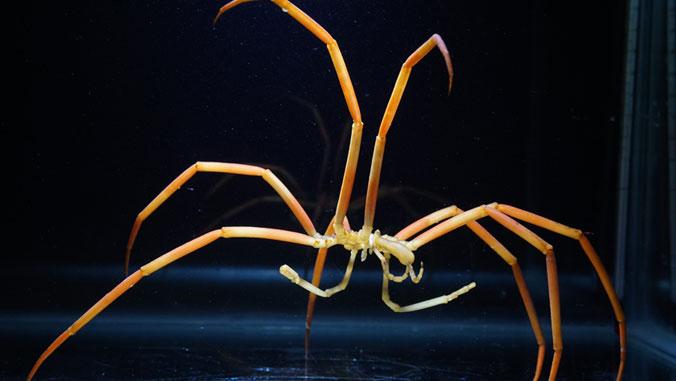
Credit: Photo by Tim Dwyer, courtesy of ARCUS.

Scientists have wondered for decades why marine animals that live in the polar oceans and the deep sea can reach giant sizes there, but nowhere else. University of Hawai’i at Manoa zoology PhD student Caitlin Shishido, with UH researcher Amy Moran and colleagues at the University of Montana, went to Antarctica to test the prevailing theory-the ‘oxygen-temperature hypothesis’-that animals living in extreme cold can grow to giant sizes because their metabolisms are very slow. The animals they studied were sea spiders, marine relatives of land spiders that breathe through their legs.

The study, published in the April 10 issue of Proceedings of the Royal Society of London, was performed at McMurdo Station, Antarctica, and at UH. “The idea is, it’s a lot of work for animals to capture oxygen and bring it all the way to their cells,” said Shishido. “It’s a much bigger job for large animals than for small ones. If cold temperatures make you need less oxygen, you can grow to a larger size.”

To test whether giant spiders were more affected by warming than small ones, the researchers exercised the spiders to exhaustion by flipping them upside-down and counting the number of times they were able to right themselves at a range of temperatures, from their normal -1.8°C all the way up to 9°C. Counter to predictions, giant animals kept up with smaller ones at every temperature.

“We were amazed that not only could the giant animals survive at much higher temperatures than they usually see, but they dealt with warm temperatures just like the smaller ones,” Shishido said. “That’s not supposed to happen; larger animals should exhaust their oxygen supply and run out of gas much sooner than small ones.” This should be especially true for sea spiders, which are ‘skin breathers’ – they have no gills or lungs to help get oxygen, but have to rely on diffusion across the surfaces of their legs.

How do giant sea spiders appear to get around the laws of physics? This was a mystery, until Shishido and Aaron Toh, a UH undergraduate student, used microscopes to look closely at their legs. The legs of sea spiders are covered with pores, and the researchers found that as the sea spiders grow, their exoskeletons become more and more porous. “The exoskeletons of the really big ones look almost like Swiss cheese,” said Shishido.

The researchers cautioned that these were short-term experiments and the long-term effects of warming on giant animals are not yet understood. However, it appears that, thanks to their holey cuticles, these giant polar animals may not be as vulnerable to warming oceans as previously thought.

###

This work was funded by grants from the Division of Polar Programs at the National Science Foundation.

Media Contact
Amy Moran
[email protected]

Related Journal Article

http://dx.doi.org/10.1098/rspb.2019.0124

Tags: BiologyMarine/Freshwater BiologyZoology/Veterinary Science
Share12Tweet8Share2ShareShareShare2

Related Posts

Natural Hallucinogens: Evolution’s Ecological Tools, Not Mere Chemical Byproducts

June 25, 2026

This Famous Butterfly Revealed: Three Distinct Species Hidden in One

June 25, 2026

Scientists Attack Soybean Cyst Nematode by Starving Its Food Source

June 25, 2026

Decoding the Secret Code of a Crucial Immune Sensor

June 24, 2026
Please login to join discussion

POPULAR NEWS

  • Saying Goodbye to PGY-6: Pediatric Fellowship Realities

    103 shares
    Share 41 Tweet 26
  • Multi-Hospital Study Reveals Long Covid Burden Is Twice as High as Current Estimates

    92 shares
    Share 36 Tweet 23
  • Detection of EDCs in Breast Milk and Infant Urine Up to Six Months Highlights Early Exposure Risks

    77 shares
    Share 31 Tweet 19
  • New Drug Candidate Developed at McMaster Shows Potential for Treating Brain Cancer

    58 shares
    Share 23 Tweet 15

About

We bring you the latest biotechnology news from best research centers and universities around the world. Check our website.

Follow us

Recent News

Tracking Lanthanide-Labeled Microplastics in Plants

POSTECH Researchers Slash Cost of Reconstituted Cell-Free Systems by 95%

AI and Physics Collaborate to Design Advanced Hydrogen Storage Materials

Subscribe to Blog via Email

Success! An email was just sent to confirm your subscription. Please find the email now and click 'Confirm' to start subscribing.

Join 82 other subscribers
  • Contact Us

Bioengineer.org © Copyright 2023 All Rights Reserved.

Welcome Back!

Login to your account below

Forgotten Password?

Retrieve your password

Please enter your username or email address to reset your password.

Log In
No Result
View All Result
  • Homepages
    • Home Page 1
    • Home Page 2
  • News
  • National
  • Business
  • Health
  • Lifestyle
  • Science

Bioengineer.org © Copyright 2023 All Rights Reserved.