• HOME
  • NEWS
  • EXPLORE
    • CAREER
      • Companies
      • Jobs
    • EVENTS
    • iGEM
      • News
      • Team
    • PHOTOS
    • VIDEO
    • WIKI
  • BLOG
  • COMMUNITY
    • FACEBOOK
    • INSTAGRAM
    • TWITTER
Saturday, May 16, 2026
BIOENGINEER.ORG
No Result
View All Result
  • Login
  • HOME
  • NEWS
  • EXPLORE
    • CAREER
      • Companies
      • Jobs
        • Lecturer
        • PhD Studentship
        • Postdoc
        • Research Assistant
    • EVENTS
    • iGEM
      • News
      • Team
    • PHOTOS
    • VIDEO
    • WIKI
  • BLOG
  • COMMUNITY
    • FACEBOOK
    • INSTAGRAM
    • TWITTER
  • HOME
  • NEWS
  • EXPLORE
    • CAREER
      • Companies
      • Jobs
        • Lecturer
        • PhD Studentship
        • Postdoc
        • Research Assistant
    • EVENTS
    • iGEM
      • News
      • Team
    • PHOTOS
    • VIDEO
    • WIKI
  • BLOG
  • COMMUNITY
    • FACEBOOK
    • INSTAGRAM
    • TWITTER
No Result
View All Result
Bioengineer.org
No Result
View All Result
Home NEWS Science News Cancer

Getting things under control: New mouse model aids study of immunomodulation

Bioengineer by Bioengineer
November 19, 2018
in Cancer
Reading Time: 2 mins read
0
Share on FacebookShare on TwitterShare on LinkedinShare on RedditShare on Telegram
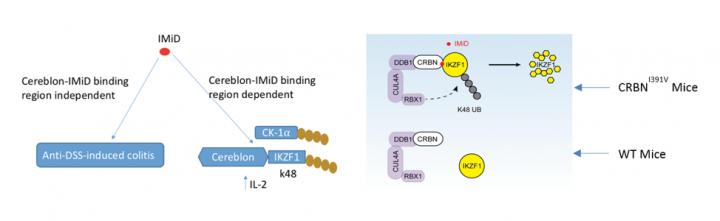
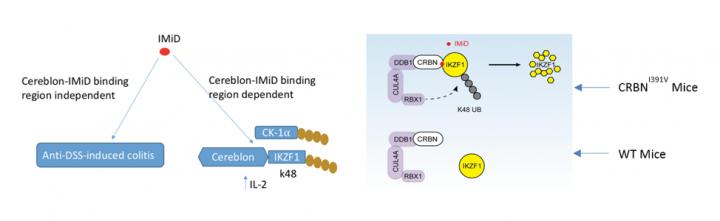
IMAGE

Credit: Osaka University

Osaka, Japan-Because mice do not respond to immunomodulatory drugs (IMiDs), preclinical therapeutic and safety studies of the effects of IMiDs have not been possible in existing types of mice. This has led to an inability to accurately assess the mechanism of these drugs in mice. This in turn has led to several notable worldwide medical scandals, such as the one involving thalidomide in the late 1950s and early 1960s, wherein thousands of children suffered birth deformities not indicated in the tested mice. Since then, many studies have attempted to understand and overcome this limitation in assessment of IMiDs; none have been successful, until now.

In a new study published in the Proceedings of the National Academy of Sciences of the United States of America (PNAS), a research team led by experts from Osaka University generated a new type of mouse with a humanized cereblon receptor, which is the primary protein that interacts with IMiDs, and found that these new mice respond to IMiD treatment.

"In our study, we found that treatment with a novel IMiD resulted in a degradation of Cullin4A/BCRBN E3 ligase substrates that involves in various cellular regulations, some of which are a transcription factors that regulates T and B cells," says the corresponding author Tadamitsu Kishimoto. "Moreover, this new IMiD upregulates IL-2 production in a CRBN-IMiD binding region dependent pathway, which may further aid in the regulation of T cell activity."

The researchers used dextran sodium sulfate to induce colitis in the new mice and in wild-type mice to test the therapeutic effects of IMiDs in colitis. The results suggested that IMiDs had similar effects in both types of 1mice.

"Our analyses revealed that lenalidomide and pomalidomide, two IMiDs used for cancer treatment provide an anti-colitis therapeutic benefit," says the lead author Yohannes Gemechu. "This benefit is mediated through a pathway that is independent of Cereblon-IMiD binding region, which suggests that our new mouse model may help to identify drugs that can be tested in wild-type mice." He emphasized, "the study in wild type mice needs extra-caution because these mice are resistant to majority of toxic and therapeutic effects of IMiDs as opposed to our new mice."

In addition to potentially enabling the study of a range of IMiDs in mice, this new model allows assessment of therapeutic effects of drugs that may be toxic to humans. If effective, these drugs could potentially be modified to a non-toxic form, thus providing new immunomodulatory therapies.

###

The article, "Humanized cereblon mice revealed two distinct therapeutic pathways of immunomodulatory drugs," was published in PNAS at DOI: https://doi.org/10.1073/pnas.1814446115

Media Contact

Saori Obayashi
[email protected]
81-661-055-886
@osaka_univ_e

http://www.osaka-u.ac.jp/en

Original Source

https://resou.osaka-u.ac.jp/en/research/2018/20181119_e http://dx.doi.org/10.1073/pnas.1814446115

Share12Tweet8Share2ShareShareShare2

Related Posts

Revolutionizing Gastro-Oesophageal Adenocarcinoma Treatment: Progress and Prospects

May 15, 2026

Cancer-Linked Protein Plays Key Role in Tumor DNA Repair

May 15, 2026

Deadly Urothelial Cancer Linked to MYC Overexpression

May 15, 2026

New Targeted Radiopharmaceutical Therapy Achieves Remission in Pancreatic Cancer Model

May 15, 2026
Please login to join discussion

POPULAR NEWS

  • Research Indicates Potential Connection Between Prenatal Medication Exposure and Elevated Autism Risk

    843 shares
    Share 337 Tweet 211
  • New Study Reveals Plants Can Detect the Sound of Rain

    730 shares
    Share 291 Tweet 182
  • Salmonella Haem Blocks Macrophages, Boosts Infection

    62 shares
    Share 25 Tweet 16
  • Breastmilk Balances E. coli and Beneficial Bacteria in Infant Gut Microbiomes

    58 shares
    Share 23 Tweet 15

About

We bring you the latest biotechnology news from best research centers and universities around the world. Check our website.

Follow us

Recent News

rAAV8 HMR-001 Boosts Liver Gene Therapy in Hemophilia

Pembrolizumab and Lenvatinib Trial for Mucosal Melanoma

Carboplatin ± Nivolumab in Metastatic TNBC Trial

Subscribe to Blog via Email

Enter your email address to subscribe to this blog and receive notifications of new posts by email.

Join 82 other subscribers
  • Contact Us

Bioengineer.org © Copyright 2023 All Rights Reserved.

Welcome Back!

Login to your account below

Forgotten Password?

Retrieve your password

Please enter your username or email address to reset your password.

Log In
No Result
View All Result
  • Homepages
    • Home Page 1
    • Home Page 2
  • News
  • National
  • Business
  • Health
  • Lifestyle
  • Science

Bioengineer.org © Copyright 2023 All Rights Reserved.