Researchers have developed a biodegradable packaging film that combines chitosan, a polyvinyl alcohol-polyethylene glycol graft copolymer, and the natural crosslinker genipin, and shown that the material can slow the deterioration of fresh-cut pear slices over three days of ambient storage. The work, published in the Journal of Agriculture and Food Research, reports that the optimized film reduced weight loss in stored pear slices to 27.6 percent, compared with 43.9 percent for uncovered control samples, while also preserving color, pH and visual appearance better than conventional polyethylene wrapping or a chitosan blend without genipin.
The study was motivated by two converging problems. Conventional food packaging relies heavily on non-biodegradable petroleum-derived plastics such as polyethylene, polypropylene and polystyrene, which resist natural degradation, add to ecological burden and can shed microplastics into food. At the same time, fresh-cut fruits remain difficult to preserve because postharvest metabolism continues after slicing, accelerating moisture loss, softening, browning and quality deterioration, while microbial contamination during storage and transport shortens marketable shelf life and contributes to food waste.
Its protonated amino groups interact with negatively charged microbial cell membranes, disrupting them and inhibiting microbial growth. But neat chitosan films are brittle and highly sensitive to moisture, which limits their mechanical strength and barrier performance under humid storage conditions. The research team addressed these weaknesses with two strategies: blending and crosslinking.
For the blend, the researchers used a polyvinyl alcohol-polyethylene glycol graft copolymer, known commercially as Kollicoat IR. Because the polyethylene glycol chains are integrated into the polymer itself, the copolymer acts as an intrinsic plasticizer, improving flexibility without the separate step of adding external plasticizers such as glycerol or sorbitol. For crosslinking, they chose genipin, a naturally derived compound that forms stable covalent bonds with amino groups and is regarded as a safer alternative to conventional chemical crosslinkers that raise toxicity concerns.
The films were made by solvent casting. Chitosan was dissolved in a 3 percent citric acid solution at 60 degrees Celsius, the copolymer was dissolved separately, and the two solutions were mixed in equal volumes before genipin was added at 2, 4 or 8 percent of total polymer weight. Mechanical testing following ASTM D882 and water contact angle measurements identified the 4 percent formulation, designated CPG 4, as the best performer. It reached a tensile strength of 28.6 megapascals, compared with 17.1 megapascals for the uncrosslinked blend, along with improved elongation at break and the highest water contact angle of 74.1 degrees, indicating reduced surface affinity for water. Higher genipin loading proved counterproductive: the 8 percent film lost both strength and flexibility, and its contact angle fell to 46.9 degrees, likely because excessive crosslinking created microstructural irregularities and left unreacted genipin exposing hydrophilic groups.
Detailed characterization supported the picture of a denser, more homogeneous network. Scanning electron microscopy and 3D optical profilometry showed increased surface roughness in the crosslinked film, consistent with restricted polymer chain mobility during drying. Fourier-transform infrared spectroscopy revealed new amide bands at 1623.2 and 1559.8 wavenumbers, evidence that genipin had chemically modified chitosan amino groups through a nucleophilic ring-opening reaction. X-ray diffraction showed that the semi-crystalline starting polymers became a predominantly amorphous network, with no residual crystalline genipin peaks, indicating molecular dispersion or crosslinking rather than a separate crystalline phase. Thermogravimetric analysis demonstrated delayed onset of degradation in the crosslinked film, attributed to the crosslinked network restricting chain mobility.
Barrier performance improved markedly. Water vapor permeability fell from 3.3 to 2.4 times ten to the minus eight grams per millimeter per square meter per second per pascal, and oxygen permeability dropped from 15.7 to 7.06 times ten to the minus six grams per millimeter per square meter per second in the crosslinked film, which the authors attribute to the compact network reducing free volume and restricting polymer chain movement. Water solubility declined from 36.1 to 25.8 percent. The researchers note that their oxygen permeability was measured with an indirect gravimetric method using an iron powder oxygen scavenger, which differs from standardized oxygen transmission rate testing, so the values should be read as a comparative assessment between the developed films rather than a direct benchmark against commercial packaging.
The functional assays showed that genipin also brought antioxidant and antibacterial activity. In a DPPH radical scavenging test, the crosslinked film extract reached 96.9 percent scavenging at a concentration of 50 micrograms per milliliter, up from 21.4 percent for the uncrosslinked blend. Against both Staphylococcus aureus and Escherichia coli, the crosslinked film significantly reduced optical density growth curves and produced zones of inhibition of 2.6 and 1.8 centimeters respectively, while viable colony counts dropped substantially relative to controls. Accelerated migration testing over ten days at 40 degrees Celsius in water, 3 percent acetic acid and 95 percent ethanol found genipin release of 3.8, 5.6 and 8.2 percent respectively, below the regulatory limit of 10 milligrams per square decimeter, although the authors caution that only genipin-specific migration was assessed and total migration of all film substances still requires investigation.
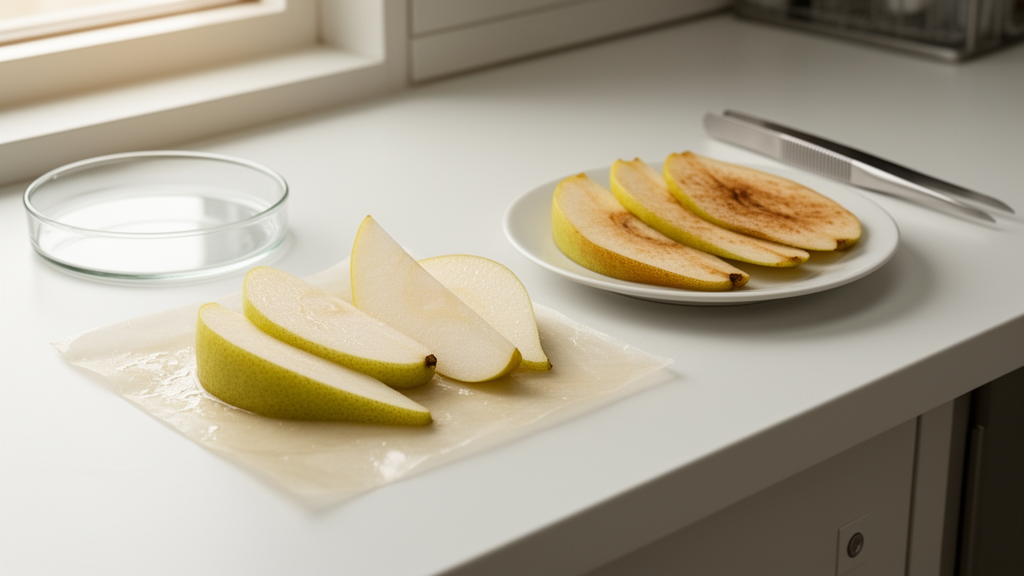
In the pear preservation trial, freshly sliced pears were stored for three days at 25 degrees Celsius in a non-contact configuration, with films covering containers rather than touching the fruit, because the films are intended as alternatives to plastic wraps. Uncovered controls lost 43.9 percent of their weight and showed marked dehydration, tissue softening and browning, while polyethylene wrapping and the uncrosslinked chitosan blend offered only partial protection with weight losses of 40.0 and 42.0 percent. The crosslinked film cut weight loss to 27.6 percent, retained higher lightness values, slowed shifts toward brownish and yellowish tones, kept the lowest browning index throughout storage, and preserved a lower pH of 4.4, which the authors interpret as better retention of organic acids through suppressed metabolic activity.
Safety and end-of-life assessments rounded out the evaluation. In cytocompatibility screening with L929 mouse fibroblast cells, both the uncrosslinked and crosslinked films maintained cell viability above 90 percent across concentrations from 5 to 100 micrograms per milliliter, and live-dead staining confirmed predominantly viable cells, supporting genipin’s reputation as a safer crosslinker for food-related applications. In a soil burial test over 42 days, both films progressively disintegrated, with only 6.3 percent of the uncrosslinked and 9.8 percent of the crosslinked film area remaining at the end, indicating environmentally favorable fragmentation after disposal. The authors emphasize that the films are designed as non-edible packaging and that further work is needed on comprehensive crosslinking characterization, scale-up manufacturing, time-dependent antioxidant performance, comparison with commercial packaging systems, and validation under real storage, transport and distribution conditions in both contact and non-contact modes.
Subject of Research: Development and testing of genipin-crosslinked chitosan composite films for biodegradable packaging and fresh-cut pear preservation
Article Title: Chitosan films engineered with intrinsically plasticized PVA and genipin: Influence on physicochemical, barrier and functional properties towards fresh-cut pear preservation
Article References: Ruchika, Arora, D., Rana, N., Yadav, S. K., & Saneja, A. (2026). Chitosan films engineered with intrinsically plasticized PVA and genipin: Influence on physicochemical, barrier and functional properties towards fresh-cut pear preservation. Journal of Agriculture and Food Research, 32, Article 103395. https://doi.org/10.1016/j.jafr.2026.103395
Image Credits: AI Generated
DOI: 10.1016/j.jafr.2026.103395
Keywords: chitosan, genipin, biodegradable packaging, fresh-cut fruit, pear preservation, food packaging, antimicrobial films, barrier properties, crosslinking, postharvest quality, soil biodegradation, PVA-PEG copolymer
News Source: Alan Morgan. (October 28, 2026). Genipin-crosslinked chitosan films keep fresh-cut pears fresher for longer. Scienmag.