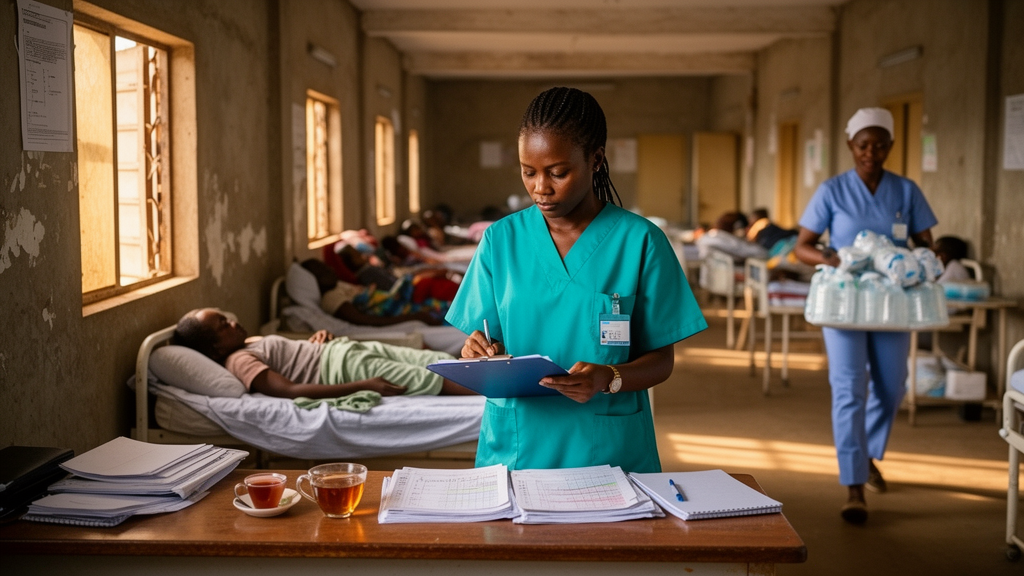
Nurses in the Buea Health District of Cameroon are carrying a burden that goes far beyond the wards they staff. A qualitative study published in BMC Public Health has documented what these nurses themselves identify as the main drivers of their occupational stress, alongside the personal strategies they use to keep going. The findings paint a picture of a workforce stretched thin by heavy workloads, staff shortages, inadequate equipment, poor infrastructure, the emotional weight of patient care, and limited support from institutions and leadership.
The research team, led by Akah Thelma Eni and colleagues, conducted a qualitative descriptive study among nurses working across the district. Rather than measuring stress with surveys or physiological markers, the researchers asked nurses directly to describe their experiences, using established theoretical frameworks to organize what they heard. The study drew on the Transactional Model of Stress and Coping and the Job Demands–Resources framework, two widely used models that frame stress as the product of demands placed on workers and the resources available to meet them.
Recruitment followed a structured design. Five of the district's seven health areas were selected through simple random sampling, and eligible nurses were then recruited purposively with predefined quotas of eight nurses per selected health area. In total, forty nurses took part in four focus group discussions: three groups of non-supervisory nurses and one group of supervisors.
The discussions were audio-recorded, transcribed verbatim, and analyzed thematically using ATLAS.ti software, with both inductive and deductive coding applied. Data collection continued until thematic saturation was reached, and the researchers report that no substantially new themes emerged during the fourth focus group. The participant profile reflects a young workforce.
Most respondents were female, accounting for 32 of the 40 participants, or 80 percent. Nineteen nurses, or 47.5 percent, were aged 24 to 29 years, and 28 participants, or 70 percent, were single. Twenty-five nurses, or 62.5 percent, reported between one and three years of work experience, meaning the perspectives captured lean toward early- and mid-career professionals rather than the most senior staff.
What the nurses described as sources of stress clustered around structural and organizational conditions. Heavy workloads featured prominently, compounded by inadequate staffing levels and shortages of essential equipment. Poor infrastructure added a further layer of difficulty, and nurses reported emotional strain arising directly from patient care.
Perhaps most strikingly, participants pointed to limited institutional and leadership support, suggesting that the burden was not only physical and emotional but also administrative, with nurses feeling left to manage systemic gaps largely on their own. Against these pressures, the nurses described a repertoire of coping strategies. Peer support and collaboration with colleagues emerged as central, offering both practical help and emotional relief.
Spiritual practices featured strongly, alongside rest and self-care, humor, and leisure activities. Some nurses drew on professional motivation, a sense of purpose in their work, to sustain them through difficult shifts. Others reported emotional withdrawal, distancing themselves psychologically from the demands they faced.
The authors are careful about what these coping strategies can and cannot achieve. In their conclusion, they note that although the strategies helped nurses manage immediate stress, they did not address the structural and organizational conditions generating occupational stress in the first place. The study's findings point, the researchers argue, to the need for targeted organizational and policy interventions.
In low-resource settings such as Cameroon, where nurses face the combined pressures of high demand and constrained supply, the implication is that improving working conditions, staffing levels, equipment availability, and institutional support would address the root causes of stress rather than its symptoms. The study is published as open access, and the version shared early is citable and carries a permanent DOI, though it remains subject to further edits before the final Version of Record replaces it. As a qualitative descriptive study of forty nurses in a single health district, the research offers depth rather than breadth: it captures the lived experiences and perceptions of nurses in Buea, not a statistical estimate of stress prevalence across Cameroon or elsewhere.
Its demographic composition, dominated by young, female, relatively early-career nurses, also frames whose voices are represented. Within those limits, the study provides a grounded account of the daily realities shaping nursing in the district, and a clear argument that the solutions to nurses' stress lie as much in management and policy as in the coping skills of the nurses themselves.
Subject of Research: Occupational stress drivers and coping strategies among nurses in the Buea Health District, Cameroon
Article Title: Exploring perceived drivers of occupational stress and coping strategies among nurses in the Buea Health District, Cameroon: a qualitative study
Article References: Eni, A. T., Takang, K. T., Kibu, O. D., Ketum, T. C., & Nicholas, T. (2026). Exploring perceived drivers of occupational stress and coping strategies among nurses in the Buea Health District, Cameroon: a qualitative study. BMC Public Health. https://doi.org/10.1186/s12889-026-29629-7
Image Credits: AI Generated
DOI: 10.1186/s12889-026-29629-7
Keywords: occupational stress, nurses, Cameroon, Buea Health District, qualitative study, coping strategies, workload, staff shortages, BMC Public Health, focus groups, health workforce, low-resource settings
News Source: Ophelia Keating. (October 28, 2026). Nurses in Cameroon’s Buea Health District describe heavy workloads and lean coping strategies. Scienmag.