John William Murray, one of the leading micropalaeontologists of the twentieth century and a globally celebrated authority on benthic foraminifera, died at his home near Southampton on 25 October 2021. An emeritus professor of geology in the School of Ocean and Earth Sciences at the University of Southampton, Murray devoted a career spanning more than six decades to the tiny, shelled protists that blanket the seafloor from sheltered estuaries to the deep ocean. His death, colleagues write in a new special issue editorial in the Journal of Micropalaeontology, cost the United Kingdom not only an authority on foraminifera but, in their words, a true gentleman.
The editorial, authored by Malcolm B. Hart of the University of Plymouth, Irina Polovodova Asteman of the University of Gothenburg, Andrew J. Gooday of the National Oceanography Centre, Babette Hoogakker of Heriot-Watt University and Christopher W. Smart of Plymouth, introduces a collection of papers approved for the special issue “Advances and challenges in modern and benthic foraminifera”. The issue arose from a dedicated session at the FORAMS meeting in Perugia, where the scientific community marked Murray’s immense contribution to micropalaeontology. The papers gathered there cover many of the interests he held dear throughout his life, from foraminiferal ecology and biomonitoring to taxonomy and the emerging use of artificial intelligence in species identification.
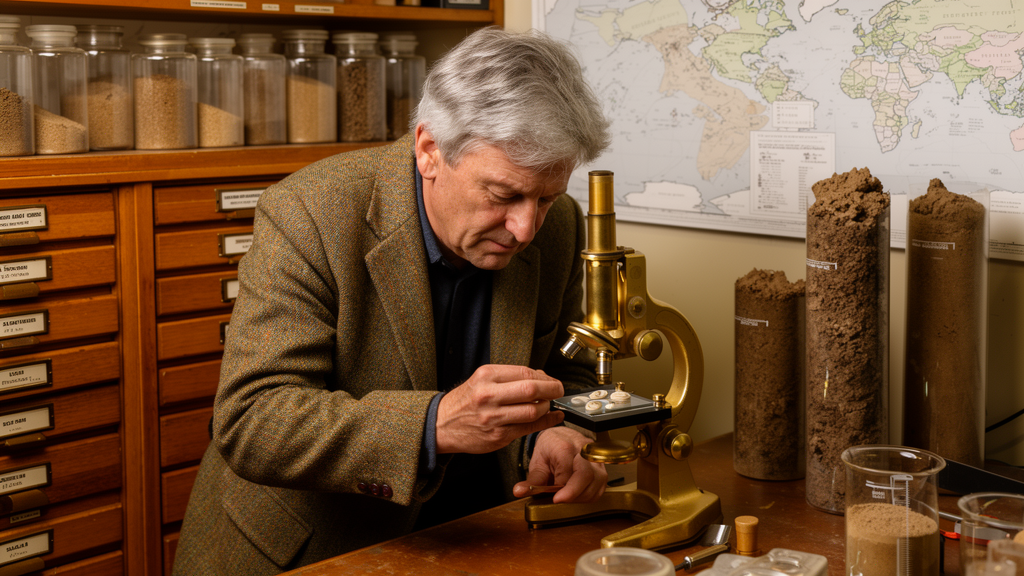
Murray was born in London in 1937 and, like many children of that era, was evacuated to the north of England during the Second World War. In the post-war years the family lived in Worthing, West Sussex, and the first sign of his future vocation came on his sixteenth birthday, when he asked his parents for a biological microscope. With that instrument he developed a passion for biological and geological microscopy that never left him. He went on to read geology as an undergraduate at Imperial College, London University, where in his first year he was introduced to the world of foraminifera by David Carter, the supervisor who would shape the first phase of his research career.
That first phase was strikingly practical. In 1958 and 1959, still an undergraduate, Murray undertook a small research project on planktic foraminifera from one of the new boreholes drilled for the Channel Tunnel Site Investigation, the micropalaeontology of which was being led by Carter. His PhD research, carried out between 1959 and 1961 and also supervised by Carter, took him to Christchurch Harbour in Dorset, where he studied the benthic foraminifera of an estuarine environment. The work demanded regular sampling of the sediments, staining the foraminifera to separate the living assemblage from the dead assemblage, and taking suites of physico-chemical readings including temperature, salinity and pH. This research generated a life-long passion for benthic foraminifera and, despite never holding a university biological qualification, gave him a deep understanding of their biology and ecology.
A brief post-doctoral scholarship at the Laboratory of the Marine Biological Association of the UK in Plymouth followed in 1961 and 1962, where he produced important papers on the foraminifera of Plymouth Sound and the English Channel. The position ended prematurely when he was appointed to a lecturing position at the University of Bristol, where he stayed from 1962 to 1975. From there he moved to a professorship and the headship of the geology department at the University of Exeter, serving from 1975 to 1989, before joining the School of Ocean and Earth Sciences at the University of Southampton in 1989. From 2003 he was an emeritus professor there, as well as a long-term visitor to the Natural History Museum in London. Benthic foraminifera remained his primary research focus through every one of those moves.
It was in the late 1960s, when scanning electron microscopes began to appear in British universities, that Murray seized the new imaging technology to produce his Atlas of British Recent Foraminiferids in 1971. Two years later came the first of his landmark books on the ecology of benthic foraminifera, Distribution and Ecology of Living Benthic Foraminiferids. In 2006 he published another landmark volume, Ecology and Applications of Benthic Foraminifera, a monumental undertaking that summarized all then-available knowledge on foraminifera on a global scale, from intertidal regions to the deep sea. The book was not merely an update of the 1973 publication; it incorporated all available data on the distribution of living benthic foraminifera, which Murray entered personally into spreadsheets, all of which are available on the Cambridge University Press website. While compiling it he approached many authors of recently published papers asking them to send their data files, occasionally upsetting them by asking why the sums of their percentages were not 100. He learned the software himself, created all of his own figures, and his global database approach was leading-edge research in the early 2000s.
These much valued and highly cited books established Murray as the leading authority on foraminifera from modern estuarine and near-shore environments, a position recognized by a string of honours: the Wollaston Fund of the Geological Society in 1981, the T. N. George Medal of the Glasgow Geological Society in 1991, the Joseph A. Cushman Award in 2001 and the Coke Medal of the Geological Society in 2007. He was also the first recipient of the Brady Medal of The Micropalaeontological Society in 2007. Alongside his research he carried a heavy load of scientific service, serving as editor of Palaeontology from 1974 to 1979, associate editor of the Journal of Foraminiferal Research from 1976 to 1984, vice-president and then president of the Palaeontological Association from 1990 to 1992, chairman of The Micropalaeontological Society from 1978 to 1980, editor-in-chief of the Journal of Micropalaeontology from 1993 to 1997, and a council member and honorary secretary of the Geological Society of London from 1989 to 1992.
His interests were never confined to living assemblages. While based at Bristol, W. F. Whittard involved him in the investigation of seafloor samples from the English Channel, which generated an interest in Cenozoic foraminifera. Together with his PhD student Chris Wright, Murray studied the Paleogene foraminifera of the Isle of Wight and adjacent areas of Europe, and their 1974 Special Paper in Palaeontology provided much of the information that appeared in the 1981 and 1989 volumes of the Stratigraphical Atlas of Fossil Foraminifera, which he edited with D. Graham Jenkins. The 1989 edition of the Atlas remains a benchmark publication, although some colleagues argue it is in need of revision to incorporate more than thirty years of progress in stratigraphical micropalaeontology. In 1981 Murray served as shipboard micropalaeontologist on the Glomar Challenger during Leg 81 in the North Atlantic Ocean, a cruise not blessed with the best of weather, from which a series of significant papers emerged, including considered accounts of Bolboforma. In the 1990s and early 2000s he collaborated extensively with Elisabeth Alve, now professor emerita at the University of Oslo, exploring the distribution, ecology and taphonomy of modern benthic foraminifera in the Skagerrak and writing a series of papers on the origin and importance of modern agglutinated assemblages. Their later research on the benthic foraminiferal biogeography of northwestern European fjords presented a much-needed baseline for assessing future changes in changing coastal seas. Murray also declared that the monthly sampling of the Hamble Estuary and the subsequent processing and microscope work brought him to his physical limits.
The special issue that now honours him reflects the breadth of that legacy. Habura and colleagues used morphological and molecular surveys to determine the presence or absence of the extremely endemic notodendroid species Notodendrodes antarctikos in McMurdo Sound, Antarctica, while Francescangeli and colleagues and Choquel and colleagues studied seasonal variability in living benthic foraminifera across intertidal areas of the eastern English Channel and the Bay of Bourgneuf on the French Atlantic coast, the latter linking mudflat foraminiferal dynamics to diatom species and traits. Spatial distribution along environmental gradients is reported for the Ras Mohamed Nature Reserve in the Egyptian Red Sea and for the Brazilian continental shelf. Applications in biomonitoring feature prominently: Bouchet and colleagues present the first attempt to determine indicator values of benthic foraminiferal species in Brazilian transitional waters using a regionally adapted species list to explore the Foram-AMBI biotic index, while Plakolm and colleagues investigate the impact of metal pollution from the former ILVA steel plant in Bagnoli, in the Gulf of Naples, on recent benthic foraminifera and their shell chemistry. Experimental contributions include Lintner and colleagues testing the effects of three commonly used antibiotics on feeding-related metabolism in the putatively invasive species Nonionella sp. T1, Doutrelant and colleagues using a three-dimensional sensor to map sediment microtopography and quantify foraminiferal contribution to bioturbation, and Gfatter and colleagues examining culturing setups based on the adsorption of the trace metal molybdenum, with implications for palaeoproxy calibration experiments.
Invasive species and new technology also feature. McGann and colleagues provide an exhaustive synthesis, based on a thirty-year study of literature data and surface and core samples combined with molecular data, of the spread of the non-indigenous foraminifer Trochammina hadai, a native of Asia, along the western seaboard of North America, combined with a survey of occurrences in Europe, Brazil and Australia and a discussion of possible introduction vectors. Polovodova Asteman and colleagues report the previously unstudied benthic foraminiferal communities of a small-boat leisure harbour in Gothenburg, Sweden, recording two non-indigenous species, Trochammina hadai and Ammonia confertitesta, together with high levels of metals in surface sediments. On the computational frontier, Plavetic and colleagues test how well the YOLO v7 deep-learning model recognizes recent benthic foraminiferal species from the Skagerrak and Swedish fjords, Walla and colleagues apply convolutional neural networks to automatically identify living, Rose Bengal stained and dead benthic foraminifera from French Atlantic and Mediterranean intertidal mudflats, and Hayat and colleagues train such networks to identify fossil benthic foraminifera in two sediment cores from offshore Peru covering the last 18,000 years. Finally, Hart and colleagues describe the lower and mid-Eocene foraminifera of the Anglo-Paris Basin, presenting a foraminiferal zonation for the London Clay Formation for the first time, echoing the comprehensive work Murray and Wright published in the 1970s. In his last decade Murray set down his picking brush and returned to his other passion, painting, producing watercolours of the Devon coast, gannets of Bass Rock and puffins of the Isle of May, more than a hundred of which were displayed at the celebration of his life in November 2021.
Subject of Research: A memorial editorial reviewing the life, research career and scientific legacy of foraminiferal ecologist John W. Murray and the special issue honouring him.
Article Title: The life and research interests of John W. Murray
Article References: Hart, M. B., Asteman, I. P., Gooday, A. J., Hoogakker, B., & Smart, C. W. (2026). The life and research interests of John W. Murray. Journal of Micropalaeontology, 45(2), 717-723. https://doi.org/10.5194/jm-45-717-2026
Image Credits: AI Generated
Keywords: John W. Murray, foraminifera, benthic ecology, micropalaeontology, Journal of Micropalaeontology, special issue, estuarine foraminifera, taxonomy, biomonitoring, deep learning, Paleogene, University of Southampton
News Source: Alan Morgan. (October 28, 2026). John W. Murray: the micropalaeontologist who mapped the world’s benthic foraminifera. Scienmag.