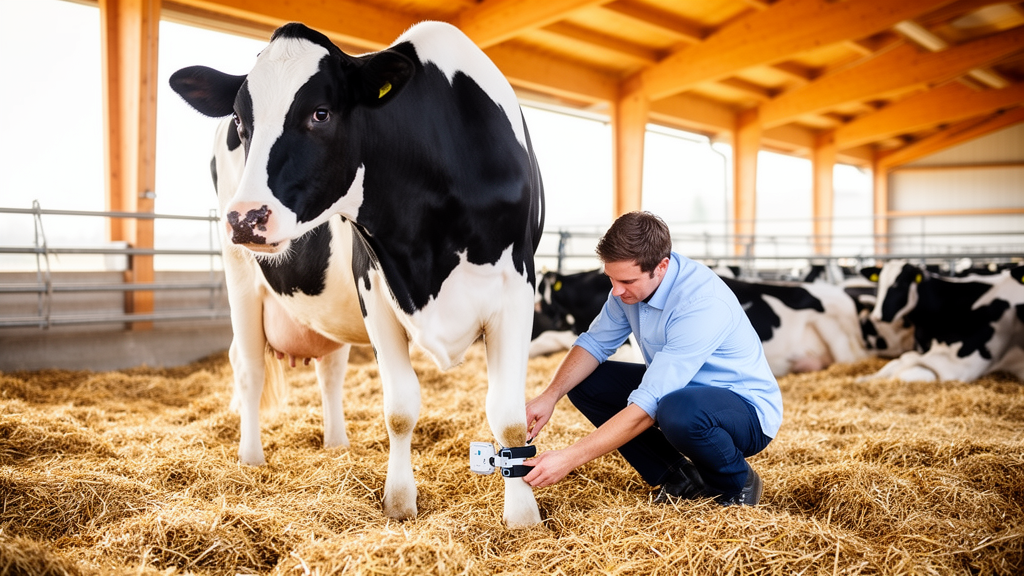
Dairy farmers already strap accelerometers onto their cows’ ankles to detect oestrus and lameness. A new study suggests those same devices could do something far more ambitious: automatically tell whether the animals are feeling good.
Conventional welfare audits typically focus on the absence of negative indicators such as lameness or dirty animals, but the absence of bad welfare is not the same as the presence of good welfare. Qualitative Behaviour Assessment, or QBA, captures positive states by asking a trained observer to score an animal’s body language against descriptive terms such as happy, relaxed, fearful or bored. The problem is that QBA requires trained personnel and considerable time, a serious constraint for a sector facing chronic labour shortages.
The team enrolled sixteen farms that already used activity monitoring technology, but only one sensor company, Peacock Technologies, could provide sufficiently detailed raw data for analysis. That left four farms, one in northern England and three in southern and western Scotland, contributing sensor records from 107 adult lactating cows of Holstein, Friesian or Holstein-Friesian breeding. Fifty of the animals were housed in free-stall barns with bedded mattresses and fifty-seven were at pasture. The IceTag sensors recorded mean standing and lying durations, bout frequencies and durations, maximum bout durations and step counts, all derived from the same kind of data farmers already collect for oestrus detection.
On each farm, a single trained researcher carried out QBA once during the housing period in February 2022 and once at pasture in June 2022, always immediately after morning milking. Twenty cows were randomly selected per visit, watched for five minutes and scored against twenty descriptive terms from the Welfare Quality protocol on a 12.5-centimetre visual analogue scale. Animals being treated for poor health were excluded, though mild lameness was not a disqualifier. The researchers also verified that their samples were representative: repeated random subsamples of cows and days produced mean lying times and step counts that were statistically indistinguishable from the full herd distributions.
The analysis relied on two principal component analyses, one on the twenty QBA terms and one on nine sensor variables, each animal being assigned to a quadrant in the resulting score plots. For the QBA data, the first principal component explained 28.39 percent of the variance and was dominated by mood-related terms such as happy, content and calmless, while the second component explained 19.34 percent and tracked activity-related terms such as lively, playful and active. For the sensor data, the first two components together explained 85.49 percent of the variance, with standing bout frequency and duration dominating the first component and lying-related variables the second.
The crucial test was whether the two independent pictures of the same animals agreed. A confusion matrix comparing the quadrants from the QBA-based and sensor-based analyses showed that 61 percent of animals classified as negative-mood by QBA were placed in the corresponding negative-mood quadrants by the sensor data alone. A Mantel test confirmed a significant positive correlation between the behavioural and sensor distance matrices, and several individual variables stood out. Step count correlated positively with the QBA term happy, while mean standing bout frequency and mean standing duration correlated negatively with it, suggesting that cows that walk more and stand less tend to be judged happier by human observers.
The correlations differed by location. Among pasture-based cows, mean step count correlated positively with playful, sociable, active, lively and irritable scores, and the QBA term happy correlated negatively with standing bout frequency. Among housed cows, calm correlated positively with standing and lying bout frequency but negatively with maximum standing bout duration, and relaxed correlated negatively with maximum lying bout duration. The authors interpret the combination of increased step count with longer maximum standing bouts, observed in housed cattle, as a potential indicator of positive welfare, though they caution that the housing quality on the four study farms was similar and that farms with a wider range of housing conditions are needed to test the pattern more rigorously.
The study also quantified a striking location effect. Based on the QBA-derived principal components, 70.7 percent of pasture-based cows fell into quadrants associated with positive mood, compared with 32.7 percent of housed cows, a highly significant difference. Sensor data told a parallel story: mean standing duration, standing bout duration, maximum standing bout duration, maximum lying bout duration and step count were all significantly higher at pasture, while standing bout frequency, lying duration and lying bout frequency were higher during housing. Housed cows actually lay down longer, 11.5 hours per day versus 10.2 hours at pasture, which the authors attribute partly to grazing taking up more of the day outdoors and partly to the possibility that longer lying can reflect discomfort or lameness rather than comfort.
One of the more intriguing findings concerns behavioural synchrony, the tendency of animals to perform the same behaviour at the same time, which is considered a marker of positive welfare in semi-natural cattle herds. The researchers found that skewed distributions of sensor data from cows at pasture were an accurate indicator of synchrony. At pasture, QBA mood scores and standing times were skewed, meaning more cows displayed positive behaviours and had more similar standing times. Step count, by contrast, was skewed when cows were housed, which the authors suggest may reflect behavioural constraint indoors and a greater range of possible movement outdoors, though they note that more granular time data is needed to confirm whether these distributions truly reflect synchrony or are artefacts of grazing patterns and walking distance to the milking parlour.
The authors are careful about the limits of the work. This was a feasibility study on four farms using a single sensor brand, because only one provider could supply data in sufficient detail; a follow-on study with fifteen farms is underway. Weather and management practices could have influenced QBA scores, so visits were grouped by week, rescheduled in extreme conditions, and always conducted after morning milking to standardise the cows’ daily stage. Lying behaviour proved inconclusive as a welfare indicator in this dataset, likely because the farms’ housing standards were uniformly similar. Even so, the central message stands: pedometers bought for oestrus detection can be repurposed, at no extra hardware cost, to give farmers an automated, objective and non-invasive window into whether their cows are not merely free of problems but genuinely doing well, with correlations between step count, standing bouts and positive mood offering a practical starting point for on-farm welfare monitoring.
Subject of Research: Using ankle-mounted accelerometer data to assess positive welfare in dairy cattle
Article Title: Use of animal-mounted accelerometers to identify positive welfare in dairy cattle
Article References: Ferguson, H. J., Davison, C., Lima, J., Haskell, M. J., Dewhurst, R. J., Michie, C., Andonovic, I., Tachtatzis, C., Swan, A., Brooking, M., Truelove, L., & Carter, L. S. (2025). Use of animal-mounted accelerometers to identify positive welfare in dairy cattle. Dairy Science and Management, 2(1), Article 15. https://doi.org/10.1186/s44363-025-00018-6
Image Credits: AI Generated
DOI: 10.1186/s44363-025-00018-6
Keywords: dairy cattle, animal welfare, accelerometers, precision livestock farming, Qualitative Behaviour Assessment, pasture, housing, behavioural synchrony, step count, lying behaviour, sensor technology, Holstein-Friesian
News Source: William Thompson. (October 29, 2026). Ankle Sensors on Dairy Cows Show Promise for Measuring Positive Welfare. Scienmag.