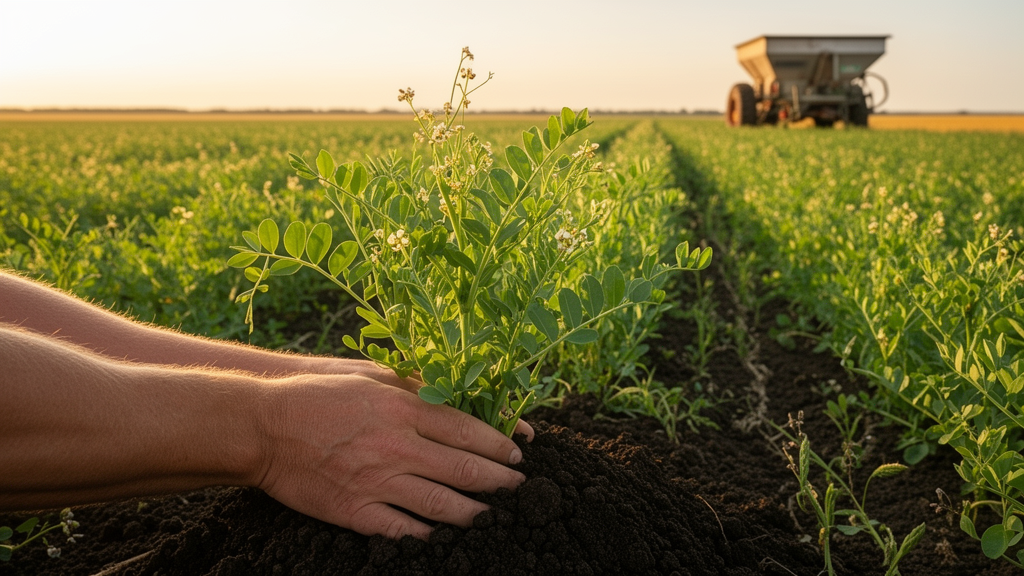
Lentils grown alongside cereal companions in southern Germany drew the overwhelming majority of their nitrogen from the atmosphere, and the nitrogen they left behind could, in principle, displace enough synthetic fertilizer to avoid up to roughly 400 kilograms of carbon dioxide equivalent per hectare.
The stakes are considerable. Agriculture accounts for roughly 10 to 13 percent of total global anthropogenic greenhouse gas emissions, and nitrous oxide is the standout problem within that share. With a global warming potential 298 times that of carbon dioxide over a 100-year horizon, nitrous oxide is also the dominant agricultural contributor to stratospheric ozone depletion. Farming is responsible for 58 to 84 percent of global anthropogenic nitrous oxide emissions, and the application of synthetic nitrogen fertilizer is the primary driver, because it floods the soil with ammonium and nitrate that feed nitrifying and denitrifying microbes. Manufacturing that fertilizer through the energy-intensive Haber-Bosch process adds a further 1.6 to 6.4 kilograms of CO2-equivalent per kilogram of nitrogen produced, a cost incurred before a single granule reaches a field.
Legumes offer a way around part of this problem. Through symbiosis with rhizobia bacteria, they can fix atmospheric nitrogen biologically, meeting part or all of their own nitrogen needs without external fertilizer. A meta-analysis of 83 studies across nine legume species reported that, on average, about 0.84 kilograms of nitrogen are fixed aboveground for every kilogram of total aboveground plant nitrogen. Lentils are particularly strong performers, with previous reports of up to 70 percent of their nitrogen derived from fixation in dryland systems, and cereals grown after lentil have been shown to need substantially less nitrogen fertilizer. Wheat seeded into lentil residue has even produced seed yields up to 25 percent higher than wheat seeded into wheat residue, a benefit attributed partly to the rapid mineralization of lentil residues.
At each site, lentil was sown together with a companion cereal, spring barley at Ihinger Hof and oats at Bad Windsheim, the classic arrangement that gives the lodging-prone, weak-stemmed lentil mechanical support and weed suppression. Weather diverged sharply between the sites, with Ihinger Hof receiving substantially more precipitation and an exceptionally wet May in 2024, while Bad Windsheim saw rainfall fall below the historical baseline during critical reproductive stages in 2025.
To measure fixation, the team used the 15N natural abundance method, one of the most robust field approaches available. It exploits the natural difference in 15N isotopic composition between soil-derived and atmospheric nitrogen: by comparing the 15N signature of the nitrogen-fixing lentil against that of a non-fixing reference plant, here the companion cereal growing in the same soil, researchers can calculate the proportion of the legume’s nitrogen that came from the air. The companion cereal is an ideal reference because it shares the legume’s growing season and access to the same soil nitrogen pool. Belowground nitrogen, which direct measurement makes extremely difficult, was estimated by applying a species-specific conversion factor from prior synthesis work, scaling total aboveground fixed nitrogen by a factor of 1.36 for lentil.
The results revealed a striking site contrast. At Ihinger Hof, lentils relied heavily on biological fixation in both years, deriving 95.2 percent of grain nitrogen from the atmosphere in 2024 and 92.6 percent in 2025, with shoot fractions approaching or reaching 100 percent. At Bad Windsheim, reliance on fixation was substantially lower and more variable, at 70.8 to 79.6 percent in grain and 56.9 to 75.0 percent in shoots, suggesting greater uptake of soil mineral nitrogen. Absolute fixation in grain ranged from 19.5 kilograms of nitrogen per hectare at Bad Windsheim in 2024 to 103.6 kilograms at Ihinger Hof in 2024, the latter reflecting the combination of very high fixation percentage and the site’s best yield, 2.31 tonnes per hectare. Estimated belowground fixation added a further 17.9 to 53.3 kilograms per hectare.
Yields and grain quality told their own story. Lentil grain yield at Ihinger Hof fell from 2.31 tonnes per hectare in 2024 to 1.08 tonnes in 2025, while the companion barley yield moved in the opposite direction, from 0.87 to 3.31 tonnes per hectare. The authors attribute this seesaw to the delayed 2024 sowing date, which was timed to the lentil and suppressed the cereal’s yield and competitiveness, allowing the legume to dominate that year. At Bad Windsheim, both components remained low in both years, with lentil at 0.60 and 0.93 tonnes per hectare and oats at just 0.35 and 0.23 tonnes. Grain protein content, by contrast, was remarkably stable, varying by only about 3 percentage points, from 26.3 to 29.5 percent, across all four site-year combinations despite yield differences of more than threefold, a buffering capacity the authors note is relevant to lentil’s role in addressing Europe’s plant protein deficit.
Translating fixation into climate terms, the team applied the IPCC Tier 1 methodology, using the default emission factor of 1 percent for direct nitrous oxide emissions from applied nitrogen, a global warming potential of 265 for nitrous oxide, and the molecular weight conversion from N2O-N to N2O. This yields roughly 4.3 kilograms of CO2-equivalent avoided per kilogram of fertilizer nitrogen replaced. Because grain nitrogen is removed at harvest, only the nitrogen fixed in shoot residues and estimated belowground biomass was counted as potentially available to the following crop. On that basis, combined potential savings ranged from 166 kilograms of CO2-equivalent per hectare at Bad Windsheim in 2025 to 407 kilograms at Ihinger Hof in 2024. The partial nitrogen balance, fixed aboveground nitrogen minus nitrogen exported in seed, was positive at every site-year, from 11.9 kilograms per hectare at Bad Windsheim in 2025 to 39.1 at Ihinger Hof in 2024, meaning the lentil replenished more soil nitrogen than the grain removed in all conditions tested.
The authors are unusually candid about the caveats, and they matter. The IPCC Tier 1 emission factor is a global default that may overestimate actual emissions under temperate European conditions, where factors of 0.5 to 0.8 percent have been reported. The savings estimates count only avoided direct soil nitrous oxide emissions and exclude the considerable Haber-Bosch manufacturing emissions, so including those would raise the benefit, but they also assume that all fixed residue nitrogen becomes available to the next crop, which is likely optimistic, since typically less than 30 percent of legume residue nitrogen is recovered by the following crop. Root nitrogen was estimated, not measured, and the true belowground contribution is probably smaller than the conversion-factor figures suggest. Statistically, plot-level replication existed only at Ihinger Hof, so comparisons involving Bad Windsheim, where three sampling frames in a single large field stood in for replication, are explicitly labeled exploratory.
With only two sites and two seasons, no sole-crop lentil treatment, and no direct assessment of residue availability to the next crop, the authors frame their numbers as an initial, site-specific reference point rather than a general prescription. Even at the low end, however, grain fixation percentages stayed above 70 percent, the nitrogen balance remained positive, and estimated savings exceeded 150 kilograms of CO2-equivalent per hectare. Within the sampled conditions, the magnitude of the benefit varied with site and season, but its direction did not. As European policy pursues climate neutrality by 2050 while confronting a deep protein production deficit, the study suggests that lentil-cereal intercrops can deliver nitrogen inputs and potential climate benefits simultaneously, though confirming how large those benefits are across broader soils, climates, and cropping sequences remains the task of future work.
Subject of Research: Biological nitrogen fixation and estimated greenhouse gas savings in lentil-cereal intercropping in southern Germany
Article Title: Biological nitrogen fixation and its potential to reduce greenhouse gas emissions in a lentil-cereal intercropping system in southern Germany
Article References: Fernandes, A. F. D., Capezzone, F., & Graef-Hönninger, S. (2026). Biological nitrogen fixation and its potential to reduce greenhouse gas emissions in a lentil-cereal intercropping system in southern Germany. Journal of Agriculture and Food Research, 32, Article 103396. https://doi.org/10.1016/j.jafr.2026.103396
Image Credits: AI Generated
DOI: 10.1016/j.jafr.2026.103396
Keywords: lentil, biological nitrogen fixation, intercropping, greenhouse gas emissions, nitrous oxide, 15N natural abundance, IPCC Tier 1, fertilizer substitution, southern Germany, grain legumes, soil nitrogen balance, sustainable agriculture
News Source: Alan Morgan. (October 29, 2026). Lentil intercrops fix most of their own nitrogen and cut fertilizer emissions. Scienmag.