Approach may lead to new treatment approach for osteoarthritis, obesity
Credit: Mike Worful
Exercise and physical therapy often are recommended to help people who have arthritis. Both can strengthen muscle — a benefit that also can reduce joint pain. But building muscle mass and strength can take many months and be difficult in the face of joint pain from osteoarthritis, particularly for older people who are overweight. A new study in mice at Washington University School of Medicine in St. Louis, however, suggests gene therapy one day may help those patients.
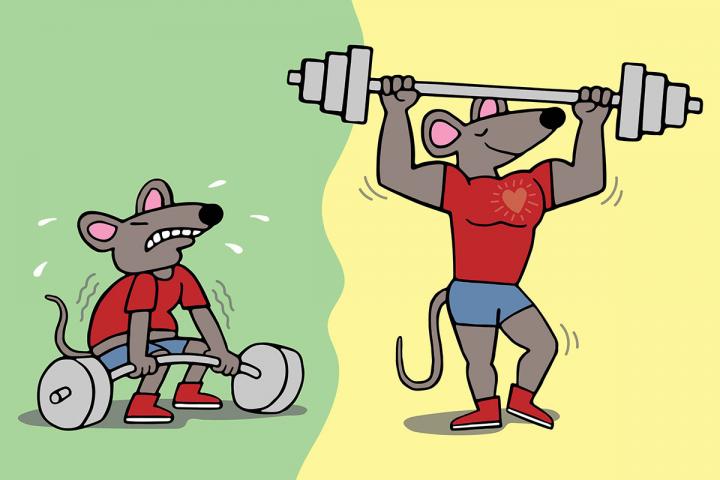
The research shows that gene therapy helped build significant muscle mass quickly and reduced the severity of osteoarthritis in the mice, even though they didn’t exercise more. The therapy also staved off obesity, even when the mice ate an extremely high-fat diet.
The study is published online May 8 in the journal Science Advances.
“Obesity is the most common risk factor for osteoarthritis,” said senior investigator Farshid Guilak, PhD, the Mildred B. Simon Research Professor of Orthopaedic Surgery and director of research at Shriners Hospitals for Children — St. Louis. “Being overweight can hinder a person’s ability to exercise and benefit fully from physical therapy. We’ve identified here a way to use gene therapy to build muscle quickly. It had a profound effect in the mice and kept their weight in check, suggesting a similar approach may be effective against arthritis, particularly in cases of morbid obesity.”
With the paper’s first author, Ruhang Tang, PhD, a senior scientist in Guilak’s laboratory, Guilak and his research team gave 8-week-old mice a single injection each of a virus carrying a gene called follistatin. The gene works to block the activity of a protein in muscle that keeps muscle growth in check. This enabled the mice to gain significant muscle mass without exercising more than usual.
Even without additional exercise, and while continuing to eat a high-fat diet, the muscle mass of these “super mice” more than doubled, and their strength nearly doubled, too. The mice also had less cartilage damage related to osteoarthritis, lower numbers of inflammatory cells and proteins in their joints, fewer metabolic problems, and healthier hearts and blood vessels than littermates that did not receive the gene therapy. The mice also were significantly less sensitive to pain.
One worry was that some of the muscle growth prompted by the gene therapy might turn out to be harmful. The heart, for example, is a muscle, and a condition called cardiac hypertrophy, in which the heart’s walls thicken, is not a good thing. But in these mice, heart function actually improved, as did cardiovascular health in general.
Longer-term studies will be needed to determine the safety of this type of gene therapy. But, if safe, the strategy could be particularly beneficial for patients with conditions such as muscular dystrophy that make it difficult to build new muscle.
In the meantime, Guilak, who also co-directs the Washington University Center for Regenerative Medicine and is a professor of biomedical engineering and of developmental biology, said more traditional methods of muscle strengthening, such as lifting weights or physical therapy, remain the first line of treatment for patients with osteoarthritis.
“Something like this could take years to develop, but we’re excited about its prospects for reducing joint damage related to osteoarthritis, as well as possibly being useful in extreme cases of obesity,” he said.
###
Tang R, Harasymowicz NS, Wu CL, Collins KH, Choi YR, Oswald SJ, Guilak F. Gene therapy for follistatin mitigates systemic metabolic inflammation and post-traumatic arthritis in high-fat diet-induced obesity. Science Advances, published online May 8, 2020.
This work was supported by the Shriners’ Hospitals for Children, the National Institute of Arthritis and Musculoskeletal and Skin Diseases, the National Institute on Aging and the Office of the Director of the National Institutes of Health (NIH). Grant numbers AR50245, AR48852, AG15768, AR48182, AG 46927, AR073752, OD10707, AR060719, AR057235. Additional funding was provided by the Arthritis Foundation and the Nancy Taylor Foundation for Chronic Diseases.
Washington University School of Medicine’s 1,500 faculty physicians also are the medical staff of Barnes-Jewish and St. Louis Children’s hospitals. The School of Medicine is a leader in medical research, teaching and patient care, ranking among the top 10 medical schools in the nation by U.S. News & World Report. Through its affiliations with Barnes-Jewish and St. Louis Children’s hospitals, the School of Medicine is linked to BJC HealthCare.
Media Contact
Jim Dryden
[email protected]
Original Source
https:/