


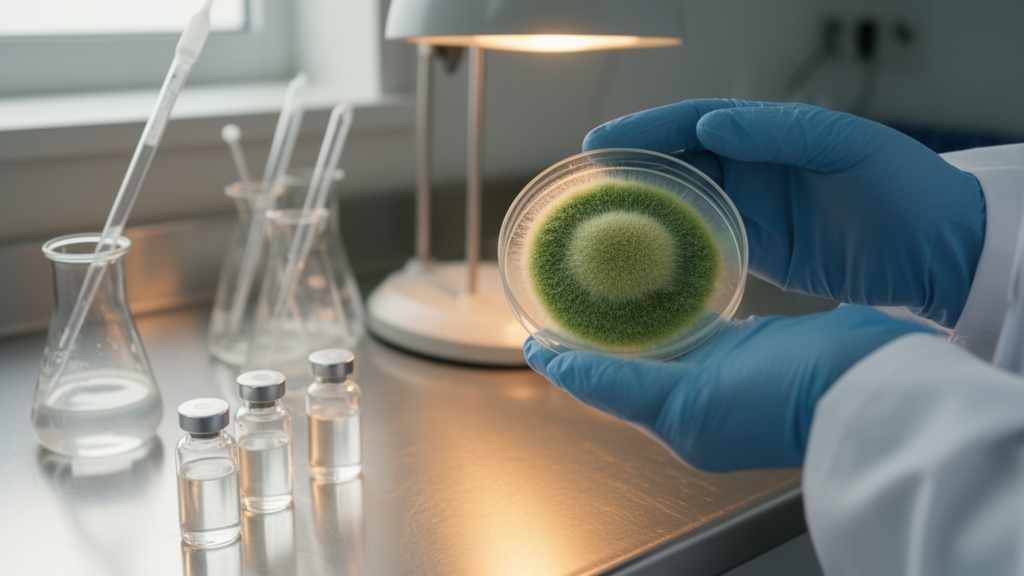
Salicylic acid is best known as a plant hormone that orchestrates immune defences, but fungi make it too, and a new study shows that the way Trichoderma fungi produce it appears fundamentally different from the pathways plants use. Researchers set out to identify the genes behind salicylic acid biosynthesis in the fungus Trichoderma virens, and while their gene deletion experiments came up empty-handed, the work delivered unexpected insights into how these beneficial fungi respond to the hormone in their environment and how a plant host can influence its release.
The study, published in the journal Fungal Biology and Biotechnology, was led by Siebe Pierson and colleagues working with Susanne Zeilinger’s group. The team tested four Trichoderma strains alongside two fungal plant pathogens, Fusarium oxysporum and Rhizoctonia solani, growing them on medium containing salicylic acid at concentrations ranging from 25 micrograms per millilitre up to 1000 micrograms per millilitre. The results revealed striking species- and strain-dependent differences in how the fungi responded to the compound.
Trichoderma atroviride strain P1 increased its colony growth radius when exposed to salicylic acid concentrations between 25 and 100 micrograms per millilitre, while T. virens showed a similar growth boost only at 50 micrograms per millilitre. In sharp contrast, T. atroviride strain IMI 206040 grew less at the two lower concentrations, and T. asperellum was largely unaffected except for a decrease at 100 micrograms per millilitre. Among the pathogens, R. solani showed a stepwise decline in growth at 50 and 100 micrograms per millilitre, whereas F. oxysporum was essentially unaffected. At the highest concentration of 1000 micrograms per millilitre, growth was completely inhibited in every fungal species tested, although colony morphology remained unchanged throughout the assay at all other concentrations.
The researchers then quantified how much salicylic acid the fungi actually released into solid growth medium, using ultra-high performance liquid chromatography-tandem mass spectrometry. All four Trichoderma strains produced extracellular salicylic acid, but T. virens released roughly three times more than the other strains. Notably, the two T. atroviride strains, P1 and IMI 206040, released significantly different amounts despite belonging to the same species, underscoring the importance of careful strain selection in experimental design.
Perhaps the most intriguing finding came from the cultivation setups. The team grew the fungi in three configurations: alone, in physical co-culture with Arabidopsis thaliana seedlings, and in a split-dish arrangement where the fungus and plant shared an atmosphere but never touched, allowing only volatile organic compounds to pass between them. For T. atroviride IMI 206040 and T. asperellum, exposure to plant volatiles significantly increased salicylic acid release, and the other strains showed a clear upward trend that fell short of statistical significance. This suggests that volatile signals from a plant host can trigger fungal hormone production before any physical contact occurs, hinting at a role for salicylic acid in the earliest stages of plant-fungus interaction.
To investigate the genetic basis of salicylic acid biosynthesis, the researchers searched the genomes of four Trichoderma species for orthologues of plant genes known to participate in salicylic acid production. Plants synthesize the hormone through two main routes: the isochorismate pathway, which dominates in Arabidopsis, and the phenylalanine ammonia-lyase pathway, which predominates in rice. The search revealed telling gaps. No orthologues of EDS5 or PBS3, genes essential for the isochorismate pathway in plants, were found in any Trichoderma species. Furthermore, T. harzianum and T. asperellum lack a PAL orthologue entirely, even though T. asperellum is capable of producing salicylic acid, which alone suggests the plant-style PAL pathway cannot be the whole story.
Phylogenetic and protein domain analyses added further doubt. The fungal PAL-like sequences showed only partial similarity to the characteristic plant lyase domain, and the candidates from T. virens lacked conserved residues within the predicted active site. The EPS1-like proteins were broadly classified as transferases, but the authors noted that these results do not permit conclusions about substrate specificity. Nevertheless, the team selected two candidate genes in T. virens, dubbed virPAL and virEPS1, for functional testing through gene deletion.
The deletions were achieved using an optimized CRISPR/Cas9-based transformation approach that had recently been adapted for T. atroviride. Rather than replacing a gene with a resistance marker through homologous recombination, the method uses Cas9 ribonucleoprotein complexes to cut out the target gene directly, while a telomere-bearing plasmid called pTEL provides transient hygromycin B resistance and can be lost again under non-selective conditions, allowing the marker to be recycled for repeated deletions. The team compared two Cas9 quantities and found that 6 micrograms yielded a higher proportion of successful deletion mutants than 1 microgram: 38 percent versus 9 percent for virPAL, and 53 percent versus 8 percent for virEPS1. All selected mutants eliminated the pTEL vector within one to three cycles of cultivation on non-selective medium.
When the researchers compared salicylic acid release by the deletion mutants with wild-type T. virens, no significant differences emerged. Deleting either candidate gene did not reduce the fungus’s salicylic acid production, providing evidence that salicylic acid biosynthesis in T. virens is distinct from the canonical plant pathways. The authors caution that redundancy between a PAL-type and an isochorismate-type route cannot be fully excluded without a double knockout, and they suggest that future work should look instead toward bacterial-style chorismate-derived pathways, such as those involving isochorismate-pyruvate lyase or single-enzyme salicylate synthases, which bacteria use to make salicylic acid as a siderophore precursor.
Beyond the negative genetic result, the study delivers practical advances. The team developed a solid-culture method for quantifying phytohormones produced by Trichoderma, which better reflects the fungus’s natural soil environment than the liquid cultures used in earlier studies and permits co-cultivation experiments with plants. They also proved that the enhanced transformation approach works in T. virens, opening the door to faster and cheaper generation of fungal gene deletion mutants. The broader significance lies in the unresolved biology: salicylic acid produced by the plant appears to limit how extensively Trichoderma colonizes its host, so the ability of the fungus to produce the same molecule remains puzzling. Whether fungal salicylic acid participates in chemical dialogue with plants, contributes to iron acquisition, or serves an entirely different physiological purpose in the fungus itself remains an open question that these tools are now positioned to answer.
Subject of Research: Salicylic acid biosynthesis and physiological roles in Trichoderma fungi investigated through gene deletion and plant co-culture experiments
Article Title: Exploring salicylic acid biosynthesis in Trichoderma spp. using an enhanced transformation approach
Article References: Pierson, S., Arc, E., Roach, T., Baldin, C., Gründlinger, M., Mick, M., Herzog, P., Kranner, I., & Zeilinger, S. (2026). Exploring salicylic acid biosynthesis in Trichoderma spp. using an enhanced transformation approach. Fungal Biology and Biotechnology, 13(1), Article 3. https://doi.org/10.1186/s40694-026-00208-0
Image Credits: AI Generated
DOI: 10.1186/s40694-026-00208-0
Keywords: Trichoderma, salicylic acid, phytohormones, CRISPR/Cas9, gene deletion, T. virens, plant-fungus interaction, volatile organic compounds, fungal biotechnology, plant immunity, biosynthesis, Exploring
News Source: Juliet Wilcox. (October 30, 2026). Fungal gene deletions fail to crack salicylic acid mystery in Trichoderma. Scienmag.



