• HOME
  • NEWS
  • EXPLORE
    • CAREER
      • Companies
      • Jobs
    • EVENTS
    • iGEM
      • News
      • Team
    • PHOTOS
    • VIDEO
    • WIKI
  • BLOG
  • COMMUNITY
    • FACEBOOK
    • INSTAGRAM
    • TWITTER
Monday, May 18, 2026
BIOENGINEER.ORG
No Result
View All Result
  • Login
  • HOME
  • NEWS
  • EXPLORE
    • CAREER
      • Companies
      • Jobs
        • Lecturer
        • PhD Studentship
        • Postdoc
        • Research Assistant
    • EVENTS
    • iGEM
      • News
      • Team
    • PHOTOS
    • VIDEO
    • WIKI
  • BLOG
  • COMMUNITY
    • FACEBOOK
    • INSTAGRAM
    • TWITTER
  • HOME
  • NEWS
  • EXPLORE
    • CAREER
      • Companies
      • Jobs
        • Lecturer
        • PhD Studentship
        • Postdoc
        • Research Assistant
    • EVENTS
    • iGEM
      • News
      • Team
    • PHOTOS
    • VIDEO
    • WIKI
  • BLOG
  • COMMUNITY
    • FACEBOOK
    • INSTAGRAM
    • TWITTER
No Result
View All Result
Bioengineer.org
No Result
View All Result
Home NEWS Science News Biology

FSU researchers discover a novel protein degradation pathway

Bioengineer by Bioengineer
March 12, 2019
in Biology
Reading Time: 2 mins read
0
IMAGE
Share on FacebookShare on TwitterShare on LinkedinShare on RedditShare on Telegram

Findings may lead to better understanding of muscular dystrophy, other diseases
IMAGE

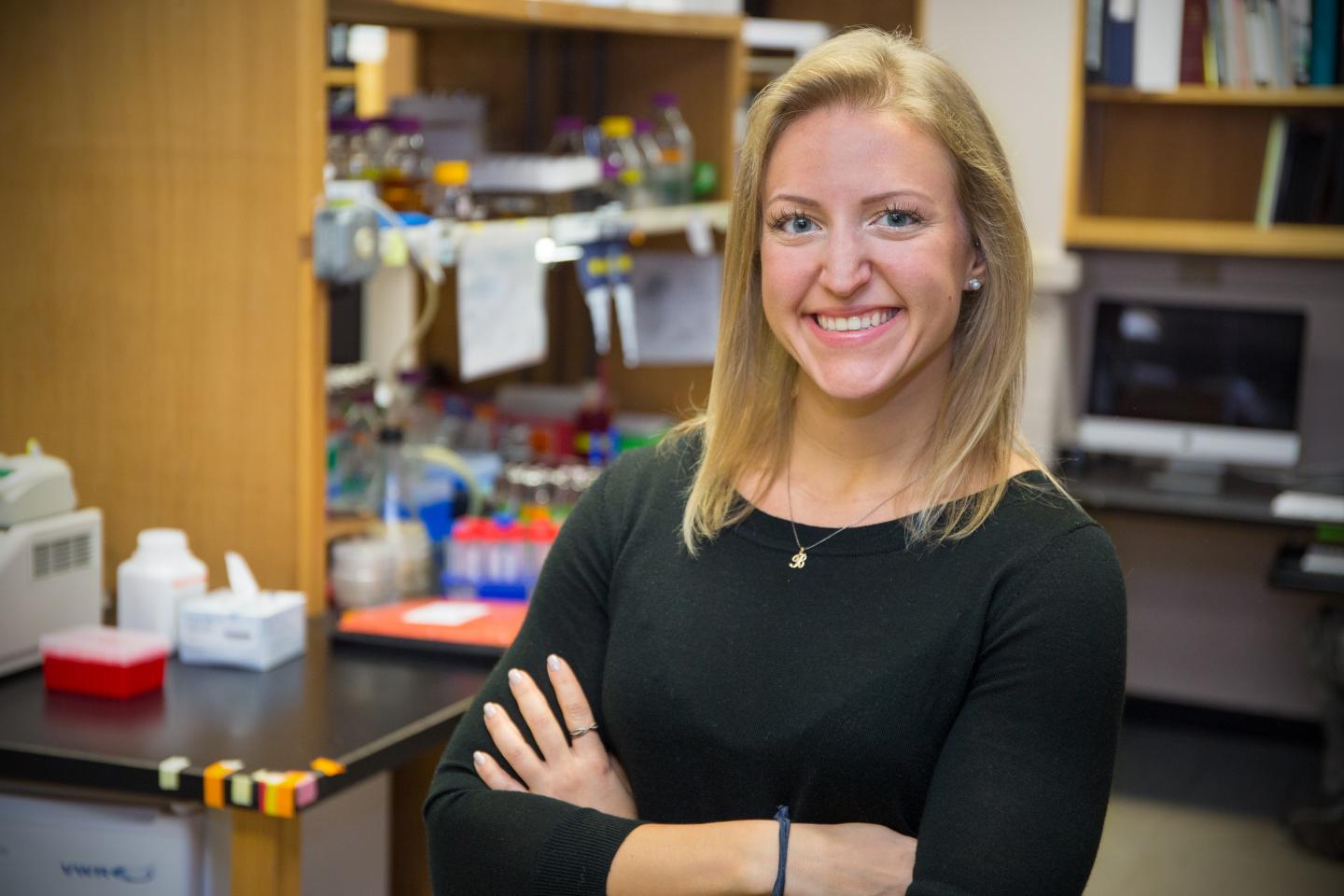
Credit: Bill Lax/FSU Photography Services

TALLAHASSEE, Fla. — The nucleus is a treasure trove of biological information that keeps the cell — and thus living organisms — ticking. But many processes within the nucleus remain a mystery to scientists.

A Florida State University research team has uncovered one such mystery — how a type of protein that is embedded in the inner nuclear membrane clears out of the system once it has served its purpose. Understanding that process may have implications for a class of human diseases including muscular dystrophy.

FSU graduate student Bailey Koch, working in the lab of Associate Professor of Biological Science Hong-Guo Yu, led the work.

“This research is like a puzzle,” said Koch, who also worked for Yu as an undergraduate. “This study is a small piece, but it’s a piece that we and others can build on going forward.”

Koch and Yu examined the build-up of proteins around the nuclear membrane. These proteins are vital to a number of biological functions, but researchers were searching for clues about how old proteins were cleared out once they ceased to function.

The answer is published in the Journal of Cell Biology. Koch and Yu found that a type of enzyme that typically regulates cell cycle progression is responsible for the breakdown of the protein Mps3, an integral inner nuclear membrane protein that is an essential component linking the nucleoskeleton to the cytoskeleton.

Koch, who presented the research at the American Society of Cell Biology/European Molecular Biology Organization 2018 meeting, compares the cell to a park with the nucleus being the swimming pool and people serving as the proteins. When too many people crowd around the pool, it is difficult for parents to see their children, she said, so there needs to be a way to clear the non-parents from the side of the pool.

The enzyme is the lifeguard that clears proteins away.

Yu and Koch’s work is the first to shed light on this protein turnover pathway. They ran their experiments in yeast, a good model organism that often mimics human cellular processes, and conducted sophisticated genetic and biochemical analyses of their samples.

The protein the researchers studied is essential to cellular processes, such as cell-cycle progression, and also plays a role in a class of diseases that includes muscular dystrophy and a premature aging syndrome called progeria. Obtaining a better understand of how the protein is regulated could open doors to further understanding of how these diseases work.

“Many diseases associated with the nuclear membrane are due to protein issues,” Yu said. “That’s why there is so much of a focus on how they work.”

###

Assistant Professor of Biomedical Sciences Robert Tomko contributed to this study. This work is funded by the National Institutes of Health.

Media Contact
Kathleen Haughney
[email protected]

Related Journal Article

http://dx.doi.org/10.1083/jcb.201808024

Tags: BiologyCell Biology
Share12Tweet8Share2ShareShareShare2

Related Posts

PKU Researchers Pioneer First-in-Class Drug Candidate Targeting Cholestatic Itch — Biology

PKU Researchers Pioneer First-in-Class Drug Candidate Targeting Cholestatic Itch

May 18, 2026
Economic Impact Report Highlights the Value of Open Biodata Infrastructure — Biology

Economic Impact Report Highlights the Value of Open Biodata Infrastructure

May 18, 2026

How Diet Shapes Evolution: The Science Behind What You Eat

May 18, 2026

In-Depth Analysis Reveals Advances in Multiple Sclerosis Research Models

May 18, 2026
Please login to join discussion

POPULAR NEWS

  • Research Indicates Potential Connection Between Prenatal Medication Exposure and Elevated Autism Risk

    845 shares
    Share 338 Tweet 211
  • New Study Reveals Plants Can Detect the Sound of Rain

    731 shares
    Share 292 Tweet 182
  • Salmonella Haem Blocks Macrophages, Boosts Infection

    62 shares
    Share 25 Tweet 16
  • Breastmilk Balances E. coli and Beneficial Bacteria in Infant Gut Microbiomes

    58 shares
    Share 23 Tweet 15

About

We bring you the latest biotechnology news from best research centers and universities around the world. Check our website.

Follow us

Recent News

NUS Team Unveils Open-Access Tool to Decode DNA Mutation Patterns in Breast Cancer

PKU Researchers Pioneer First-in-Class Drug Candidate Targeting Cholestatic Itch

Living and Dying as a Cyborg: Exploring the Boundaries of Human and Machine

Subscribe to Blog via Email

Enter your email address to subscribe to this blog and receive notifications of new posts by email.

Join 82 other subscribers
  • Contact Us

Bioengineer.org © Copyright 2023 All Rights Reserved.

Welcome Back!

Login to your account below

Forgotten Password?

Retrieve your password

Please enter your username or email address to reset your password.

Log In
No Result
View All Result
  • Homepages
    • Home Page 1
    • Home Page 2
  • News
  • National
  • Business
  • Health
  • Lifestyle
  • Science

Bioengineer.org © Copyright 2023 All Rights Reserved.