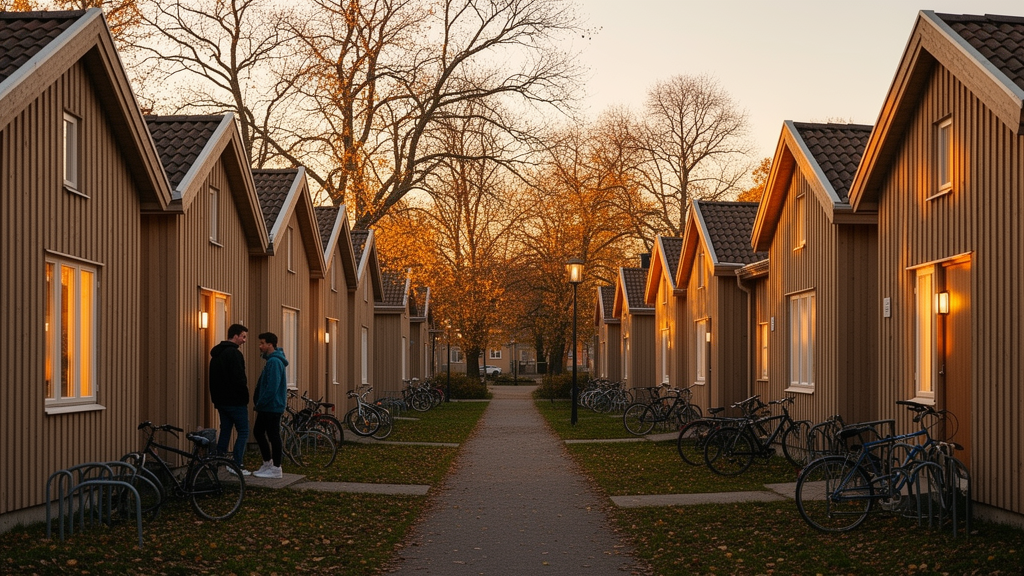
Student housing is one of the most overlooked building types in architectural history, yet a growing share of the population passes through it, if only briefly. A new open-access study in the journal City, Territory and Architecture maps, for the first time on a national level, how Swedish student housing emerged and crystallised as a building type between 1870 and 1970.
The Swedish case is unusual. Swedish universities were crown and, later, state institutions rather than church- or guild-based foundations in the tradition of Paris, Bologna or Oxford, and they rarely concerned themselves with where students lived before the twentieth century. The authors place Sweden closer to what historian Adelman called the ‘German anti-residence tradition’. Unlike Denmark, where student housing had been a royal concern since the 1600s, Sweden had no pre-established forms of student housing before 1870. Everything that followed had to be invented—and the people doing the inventing were not the universities, which are conspicuously absent from the historical record, but philanthropists, free churches, popular movements, student unions, municipalities and, eventually, the welfare state.
Before institutionalisation began in the last decades of the nineteenth century, student accommodation was considered a private matter. As university enrolment grew, specialised landlords repurposed attics to cram in as many students as possible for profit. These lodgings, known as studentkaserner or student barracks, appeared in Lund and Uppsala and became notorious. Rooms were spartan and cold in winter; residents needed up to four keys to reach the outhouse toilets; external, unsupervised staircases fed legends of squalor and debauchery. One Uppsala barracks of literary fame was nicknamed ‘The Seven Vents of Hell’. Because each rented cell had a window, the buildings were identifiable from the street by their disproportionately windowed attics. In 1860s Lund, up to a third of enrolled students lived in such conditions, according to the study.
The negative attention these barracks attracted triggered the first dedicated institutional apparatus: the student home. The first ‘Swedish’ student home was actually built abroad—Studenterhjemmet in Kristiania, now Oslo, inaugurated in 1876—and public interest surged in the years that followed. Student homes were founded by philanthropic benefactors seeking to alleviate poverty among students, and later in a second wave by free churches and popular movements. Their purpose was explicitly moral as well as material: to select deserving students of few means and give them a study environment protected from ‘moral dangers’. At Norrbyhus in Uppsala, founded in 1880 for students of theology, daily life was run by a Mater who maintained order and organised weekday prayers, complemented by an absent Pater responsible for finances and Sunday worship, both answering to a board of churchmen and city notables. Students lived as the ‘children’ of this arrangement, provided for but surveilled, with kitchens and laundry off-limits.
To trace how the very concept of student housing shifted, the researchers ran a quantitative study using the Royal Library’s database of Swedish newspapers, tracking when terms entered public discourse, when they were replaced, and when they returned. Five main conceptual constructs emerged: student barracks, student home, building with student rooms, student residential housing, and student city. Public concern first surfaced in the late 1870s, peaked in the 1890s and faded by 1910. After 1945 discussion exploded again, peaking around 1967 before declining. Crucially, the newspaper record suggests a neat succession of concepts—one replacing the next—but the authors’ qualitative study of the actual buildings shows the opposite: older types persisted and multiplied in the shadow of newer ones.
The interwar period brought a decisive shift from the individual student to the student population. In the acute housing shortage of the early 1920s, the Uppsala student union announced a wildly ambitious 1924 competition for a combined union building and student home with hundreds of rooms and a 650-seat auditorium—a brief even the jury considered excessive. When a building finally rose on the site in 1930, designed by competition winners Rolf Engströmer and Erik Högström, every social space had been stripped out, leaving a purely residential block of 58 student rooms. The union’s next project pushed austerity further: Eskil Sundahl’s 1937 building on Skolgatan in Uppsala, in the spirit of 1930s functionalism, contained no kitchens or dining rooms at all, only atomised student rooms—each, remarkably, with its own water closet and shower, a luxury that earned it the nickname ‘The Water Closet Palace’.
The state entered the picture in the 1930s. A 1937 government inquiry concluded that the cost of student life deterred able minds from university study and proposed ‘student-social actions’ to broaden recruitment. In 1950 the government began subsidising student housing construction, attaching spatial conditions to the money: rooms of up to 14 square metres with soundproofing, one toilet per five rooms, a shower or bath per ten, and at least 20 square metres of collective space per 20 rooms. Tying subsidies to specific spatial relations made institutionalisation concrete—student housing now meant a certified standard of living, catering to new groups including female students and married couples with children. The 1957 reform replaced percentage subsidies with a fixed sum per room, and a 1961 inquiry, ‘Fit-for-purpose student housing’, hunted for savings in corridor widths and building depths rather than room sizes, which investigators judged could not shrink below 12 square metres.
Cost-cutting produced some of the period’s most extreme experiments, including architect Hans Westman’s patented Fyrklöverhus, or four-leafed clover house, in Lund: a quadratic service core with four protruding room-and-kitchenette units, each with its own entrance, eliminating all collective and circulation space. Yet the same era also produced Sparta in Lund, completed around 1970, where architect Bengt Edman—inspired by Team X and Giancarlo de Carlo—built a beton brut megastructure of 585 student rooms wrapped around restaurants, lecture halls and an assembly hall for 2,500 spectators, an attempt to compress the entire student city into one building. The boom ended abruptly: a 1970 inquiry found a surplus of student housing, recommended converting stock to youth housing, and production stopped immediately.
The deeper finding of the study is that none of the earlier types actually died. Improved versions of student barracks appeared in Lund attics into the 1950s and some still operate as originally intended. Student homes kept being built throughout the twentieth century—Rotary’s International Student House in Lund in the late 1950s let every second room to an international student, and the Temperance movement’s Tempus in Stockholm in 1968 aimed to keep students sober—while originals like Norrbyska in Uppsala and Thomanders in Lund still run on adapted versions of their original statutes. Student cities, first imagined in a 1946 Uppsala competition won by Artur von Schmalensee, continued to be produced alongside new university foundations. The authors conclude that Swedish student housing should be understood not as a single type defined by shared form or function, but as a field of interrelated, overlapping sub-types whose continuous proliferation—checked but never erased by state standardisation—is precisely what gives the building type its vitality and stability.
Subject of Research: The institutionalisation of Swedish student housing as a building type from 1870 to 1970
Article Title: Modern Swedish student housing: the institutionalisation of a building type 1870–1970
Article References: Torisson, F., & Kärrholm, M. (2026). Modern Swedish student housing: the institutionalisation of a building type 1870–1970. City, Territory and Architecture, 13(1), Article 18. https://doi.org/10.1186/s40410-026-00319-6
Image Credits: AI Generated
DOI: 10.1186/s40410-026-00319-6
Keywords: student housing, architectural history, Sweden, institutionalisation, building types, welfare state, student barracks, student homes, housing subsidies, Lund, Uppsala, urban history
News Source: Denise Maddox. (October 30, 2026). From student barracks to student cities: how Sweden invented a housing type. Scienmag.