


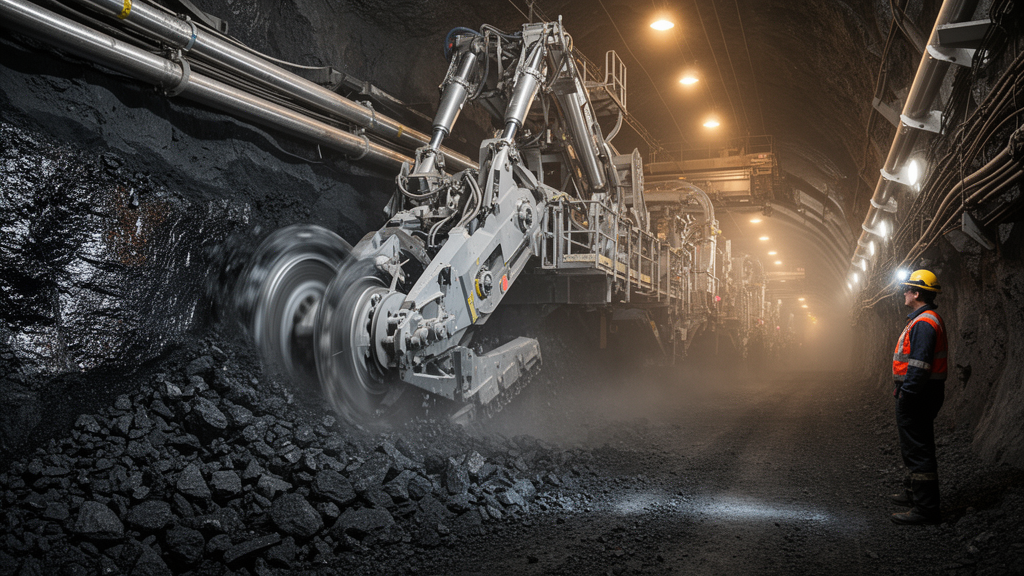
China has built the world’s largest system for researching, developing and manufacturing coal mining technologies and equipment, according to a comprehensive review published in GeoEnergy Communications. The paper, led by Hongpu Kang of the China Coal Technology & Engineering Group, traces more than 70 years of development across geological prospecting, open-pit mining, underground mining, roadway excavation and disaster prevention, and sets out future directions for safe, green and intelligent mining under deep and complex conditions. In 2023, China’s raw coal production reached 4.71 billion tons, a year-on-year increase of 3.4 percent and a historical record, while coal consumption, converted to 3.163 billion tons of standard coal, rose 5.6 percent and accounted for 55.3 percent of total primary energy consumption.
The scale of the industry’s transformation is striking. In 2014, China had 10,683 coal mines, of which 9,278 produced less than 300,000 tons annually, and the mechanization rate was only 13 percent. Mines with an annual output below 90,000 tons made up 71 percent of the total. By 2023, the number of coal mines had fallen to 4,300, with mines producing over 1.2 million tons annually accounting for more than 85 percent of total production. There were 1,146 safe and efficient mines contributing over 70 percent of national output, with an average production capacity of 2.73 million tons per year. Safety has improved alongside consolidation: coal mine accident fatalities dropped from a peak of 6,995 in 2002 to 443 in 2023, a reduction of 93.7 percent, and the fatality rate per million tons of coal fell from 5.71 to 0.094.
Underground mining dominates in China because coal deposits are diverse and often deeply buried. Underground mines account for 92.6 percent of the total number of mines and 75 percent of total coal production, in contrast to many countries where simple geology favors open-pit operations. Accessing deep seams increasingly relies on vertical shafts, and Chinese engineers have refined a specialized construction system built around three methods—drilling, freezing and grouting—plus mechanized shaft construction equipment. Vertical shaft drilling has evolved from four-stage drilling to single-pass completion, achieving a maximum drilling depth of 660 meters; in western rock formations the maximum depth reached is 511 meters with a maximum diameter of 8.5 meters, which the authors describe as at the forefront globally.
The freezing method, applied in China since 1955 to stabilize unstable strata and counter water inrush, has advanced rapidly despite a late start. By the late 1980s, Chinese teams had overcome the challenges of freezing thick alluvial layers at depths of 375 and 435 meters. Freezing depths for shafts have since successively reached 500, 600 and 700 meters, and by 2022 nearly 1,000 meters. Over roughly 70 years, approximately 1,250 shafts have been constructed using the freezing method, with a cumulative freezing length of 330 kilometers. Grouting technology has kept pace: more than 200 coal mine shafts have used ground pre-grouting for water sealing and reinforcement, with depths progressing from less than 500 meters in the 1980s to 1,355 meters today, and working face pre-grouting was used to build the main inclined shaft of Hetaoyu Coal Mine, the longest inclined shaft in China at 5,875 meters.
Roadway excavation remains a bottleneck. More than 90 percent of excavation workfaces now rely on fully mechanized methods using boom-type roadheaders, continuous miners and bolter miners, yet support work is the most labor-intensive and time-consuming part of the process, with resin bolt installation involving six separate steps that are difficult to automate. Chinese researchers have compressed that sequence dramatically. The Coal Mining Research Institute developed an integrated drilling and bolting system and a one-button bolt installation system that reduces the traditional six-step process to a single step. In July 2022, a complete set of integrated rapid excavation equipment—a bolter miner, a bolt transfer machine and a crawler-mounted self-propelled tail machine—was deployed in a super-large section roadway measuring 6.5 by 5.5 meters at Caojiatan Coal Mine, achieving a cumulative excavation length of 5,980 meters with a maximum daily advance of 63 meters. In rock roadways, full-face tunnel boring machines developed with Huainan Mining Group in diameters of 2.5 to 5.5 meters have increased tunneling efficiency more than sixfold compared with drill-and-blast, with a 4.5-meter machine setting a record monthly advance of 736 meters.
The most eye-catching figures come from working-face equipment. Over 40 years, China has pushed mining heights through breakthroughs of 5, 6, 7, 8 and now 10 meters. The ZYA29000/45/100D two-leg hydraulic shield in use at Caojiatan Coal Mine holds records for the largest working resistance, the widest width at 2,400 millimeters and the highest support height among two-leg shields. A complete equipment set for 10-meter ultra-high mining, including the MG1200/3350-WD shearer and an SGZ1600/3×2000 scraper conveyor with a transport capacity of 8,000 tons per hour, passed surface testing in July 2023 and began underground trial production that September. By December 31, 2024, the system had advanced 4,750 meters, produced 16 million tons of coal, and recorded a peak daily output of 71,800 tons and a peak monthly output of 1.55 million tons.
Ultra-thick seams are also being mined by top-coal caving, in which a lower slice is cut mechanically and the coal above is broken and drawn through a rear opening in the shield. A research and development project on seams 14 to 20 meters thick, completed between 2009 and 2012 by China Coal Technology & Engineering Group and Datong Coal Mine Group, established a method with a 5-meter cutting height and a 15-meter top-coal caving height, supported by a structural mechanical model of overlying strata termed the cantilever beam–articulated rock beam. At the No. 8105 face of Tashan coal mine, the associated equipment achieved an average equipment usage of 92.1 percent, a coal recovery rate at the face of up to 88.9 percent, and production of 10.85 million tons per year. For medium-thick seams, a 450-meter super-long working face model pioneered at Xiaobaodang No. 2 Mine has been deployed on five faces, reaching a maximum daily production of 52,000 tons, a peak monthly production of 1.15 million tons and an annual capacity exceeding 13 million tons for seams 2 to 3 meters thick.
Intelligence is the newest frontier. Since 2020, intelligent mining has developed rapidly around three elements—intelligent perception, intelligent decision-making and intelligent control—with perception as the foundation. High-end shearers now carry contact and non-contact tilt sensors, redundant communication networks built on onboard 5G, Wi-Fi and wired links, memory cutting and automated inclined cutting, and multi-source data-driven algorithms that generate optimized cutting trajectories from a cutting template database. Hydraulic shields monitor position and force state in real time, and a three-level coordinated control strategy of single-support, group and cluster control enables zonal coordination of support strength, stiffness and stability. The authors are candid that decision-making lags the other two elements: monitoring centers largely observe and report, with decisions still made by operators, although the 10-meter ultra-high face at Caojiatan has begun applying an intelligent collaborative mining system that monitors surrounding rock stability, autonomously plans cutting operations and dynamically adjusts conveyor speeds.
Disaster prevention underpins the safety record. Gas explosions can occur when underground methane concentrations reach 5.5 to 16 percent in the presence of an ignition source, so Chinese teams developed hydraulic fracturing for directional long boreholes in roofs, achieving operation lengths over 800 meters, fracturing radii exceeding 50 meters, a more than 100 percent increase in extraction efficiency and a reduction in borehole project volume of over 40 percent. Surface well coalbed methane extraction in the Jincheng demonstration area delivered a well integrity rate above 93 percent, daily extraction volumes surpassing 10,000 cubic meters and methane concentrations of 86 percent, cutting face gas concentrations by about 30 percent. Water hazards are managed through hydrogeological evaluation, regional grouting of floor aquifers, controlled water mining of roof aquifers and curtain grouting; fire prevention benefits from spectral tube-bundle systems that analyze nine key gases indicative of spontaneous combustion in real time; and rock burst control combines microseismic, acoustic emission and stress monitoring with regional fracturing, precision roof cutting and anti-impact prestressed roadway support.
The review closes with a sober assessment of what remains. Current intelligent mining technologies still rely heavily on manual operation, with limited self-regulation and adaptability, and the lack of a foundational theoretical framework hinders resolution of key challenges. As mining extends deeper and westward, eastern kilometer-deep mines face high stress, high temperatures and compound hazards such as rock bursts, while high-intensity mining in the west produces distinct stress and strata-movement patterns. The authors propose spatiotemporal dynamic sensing for person-equipment-environment systems, big data-based decision-making frameworks, cloud-edge-terminal integrated disaster monitoring, mine inspection robots, and region-specific green mining models that integrate subsidence control, water-conserving mining, multi-resource co-mining and carbon sequestration. The concept of green mining, first proposed by Qian Minggao in 2003, now spans water-conserving mining, coal and gas co-mining, waste rock reduction, subsidence control and environmental restoration, including backfill materials that both mitigate solid waste and achieve carbon sequestration goals.
Subject of Research: Coal mining science and technology in China, covering geological prospecting, open-pit and underground mining, intelligent equipment, and disaster prevention
Article Title: Current status and prospects of coal mining science and technology in China
Article References: Kang, H., Wang, B., Gao, F., Zhang, Y., Fan, Z., Li, S., Xu, X., & Chen, P. (2025). Current status and prospects of coal mining science and technology in China. GeoEnergy Communications, 1(1), Article 3. https://doi.org/10.1007/s44421-025-00002-5
Image Credits: AI Generated
DOI: 10.1007/s44421-025-00002-5
Keywords: coal mining, China, geological prospecting, open-pit mining, underground mining, shaft construction, intelligent mining, top-coal caving, hydraulic shields, disaster prevention, green mining, roadway excavation
News Source: Violet Maxwell. (October 30, 2026). China’s coal mining technology reaches record depths and heights. Scienmag.



