


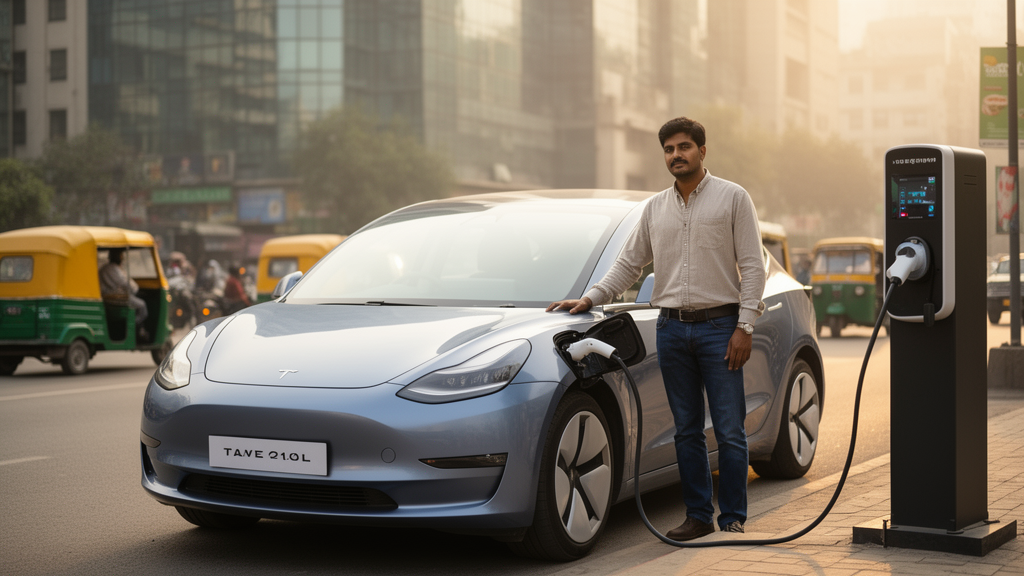
A widely used psychological model for explaining how people come to adopt electric vehicles may be measuring a single fused mindset rather than three distinct stages, according to a re-analysis of survey data from 1,123 urban Indian consumers. The study, published in Discover Vehicles, applied partial least squares structural equation modelling to the Knowledge–Attitude–Practice framework, a structure that has been applied extensively in electric vehicle adoption research. Its central result is psychometric rather than behavioural: heterotrait–monotrait ratios, a standard test of whether survey constructs are empirically separable, exceeded 0.90 for every pair of constructs, well above the liberal 0.90 threshold and the stricter 0.85 benchmark. Under current criteria, that means knowledge, attitude and practice toward electric vehicles could not be reliably told apart in this sample.
The finding matters because most prior studies in this field have assumed the three dimensions are distinct and then estimated sequential links between them. The authors argue that positive associations along the knowledge-to-attitude-to-practice chain are theoretically predictable, so confirming them again adds little. Demonstrating that the dimensions are not empirically separable in a market where consumer familiarity with electric vehicles is still nascent is, they contend, the more consequential result. In such a market, consumers may not yet have developed differentiated cognitive, evaluative and behavioural orientations toward the technology, so knowledge, attitude and practice co-emerge from limited but consistent information exposure rather than forming psychologically distinct stages.
The data came from an open-source survey of Indian consumers, with 1,123 authentic responses and no synthetic augmentation. The instrument comprised 15 items across the three constructs, five each for knowledge, attitude and practice, rated on a five-point agreement scale. Knowledge items addressed technology awareness and policy familiarity, attitude items captured evaluative responses toward adoption, and practice items recorded self-reported engagement such as information seeking and purchase consideration. Descriptive averages sat slightly above the scale midpoint: knowledge at 3.19, attitude at 3.15 and practice at 2.91, each with standard deviations around 1.4 to 1.5, consistent with an early-adopter market with wide individual variability.
The measurement results were strikingly uniform. All 15 indicator loadings fell between 0.89 and 0.94, composite reliability exceeded 0.90 and average variance extracted exceeded 0.50 for every construct. Cronbach’s alpha surpassed 0.95 for all three constructs, a level the authors flag as a warning sign, because such values can indicate item redundancy rather than comprehensive construct coverage. An inter-item correlation heatmap showed near-uniform high correlations, above 0.85, across all item pairs regardless of which construct an item nominally belonged to. The Fornell–Larcker criterion was marginally satisfied for knowledge only, with the square root of average variance extracted at 0.916 against a correlation of 0.891, a margin the authors describe as negligible and insufficient to offset the heterotrait–monotrait evidence.
Specifically, the heterotrait–monotrait ratios were 0.921 for knowledge with attitude, 0.897 for knowledge with practice and 0.913 for attitude with practice. Because these exceeded both thresholds, discriminant validity was not confirmed under the three-factor reflective model. The authors still proceeded to structural estimation within the composite-based framework, which does not require separable constructs as a precondition, and they are explicit that every resulting coefficient is a composite-level association rather than an effect of a distinct latent variable. Alternative model comparisons gave the three-factor composite model a slightly better standardised root mean square residual of 0.063, against 0.071 for a single-factor model and an intermediate value for a higher-order model, so the data remained statistically consistent with a unidimensional electric vehicle orientation structure.
The structural estimates were large. The knowledge-to-attitude association was 0.847, with a 95 percent bootstrap confidence interval of 0.821 to 0.871, and the attitude-to-practice association was 0.761, with an interval of 0.728 to 0.793, based on 5,000 bootstrap replications. The direct knowledge-to-practice association, controlling for attitude, was 0.192, with an interval of 0.161 to 0.224. The indirect pathway through attitude accounted for 71.3 percent of the total knowledge-to-practice association of 0.905, which the authors interpret as partial mediation at the composite level rather than sequential causal mediation. Variance explained was high, at 0.717 for attitude and 0.841 for practice, but the authors caution that these figures reflect the substantial shared variance already documented and should not be read as evidence of outstanding model performance or causal predictive power.
Robustness checks supported the stability of these estimates. Re-estimation on a random 80 percent subsample of 898 respondents left all path coefficients within 0.012 of the full-sample values. A reverse-causality model, in which practice leads to attitude and attitude to knowledge, produced a standardised root mean square residual of 0.089, above the 0.08 threshold, compared with 0.063 for the primary model. The authors treat this as tentative evidence that the theorised direction fits the data better, while stressing that the difference is modest and that a cross-sectional design cannot establish temporal order. Reverse causality remains plausible, since engaging in test drives or peer conversations could itself raise knowledge and shape attitudes, and omitted variables such as environmental concern, technology readiness, income and charging infrastructure access could drive all three dimensions simultaneously.
Common method variance, a potential artefact when all constructs are measured from the same respondents at one time point, was assessed with three diagnostics. Harman’s single-factor test put 58.7 percent of total variance on the first unrotated factor, exceeding the 50 percent threshold and suggesting method variance may be present. Full-collinearity variance inflation factors ranged from 3.21 to 4.87, below the 5.0 threshold, providing partial reassurance. A marker-variable approach was not feasible with the secondary dataset. The authors conclude that method variance is a contributing factor that cannot be excluded but is unlikely to be the sole explanation for the high inter-construct correlations, with genuine construct overlap being the more parsimonious account.
Segmentation analysis using the Pathmox algorithm split the sample on prior electric vehicle exposure and found the theoretically predicted crossover pattern. Among 742 respondents without prior exposure, 66.1 percent of the sample, the knowledge-to-attitude association was stronger at 0.863 than the 0.791 observed among 381 exposed respondents, who made up 33.9 percent. The attitude-to-practice association ran the other way, at 0.849 for exposed respondents against 0.714 for the unexposed. Between-segment differences were significant for all three paths, with F-statistics between 8.47 and 14.62 and p-values below 0.001. The authors ground this pattern in psychological distance theory, which holds that technologies never directly experienced are represented abstractly, and consumer learning theory, which predicts that direct experience supplies experiential knowledge that substitutes for declarative knowledge while providing concrete action templates that ease attitude-to-behaviour translation.
The authors attach several qualifications to these results. Exposed respondents were significantly younger and more educated than unexposed respondents, so the segmentation partially conflates exposure with demographic effects, and matched-sample or propensity-score designs are needed to isolate the experience mechanism. The practice construct captures self-reported engagement rather than actual adoption decisions, purchase intention or ownership, and associations with stronger outcomes may differ substantially. The dataset was not designed for this study’s theoretical objectives, and item wording and sampling documentation are not fully available. The sample comprises urban Indian consumers, so generalisation to rural populations, other emerging markets or developed electric vehicle markets with much higher familiarity should be made cautiously. The policy suggestions offered, such as pairing informational campaigns with test-drive events for unexposed consumers and targeting practical barriers for exposed ones, are framed as tentative directional ideas requiring experimental validation rather than causal prescriptions. The study’s broader implication is that instruments must be redesigned with facet-specific items before the sequential knowledge-attitude-practice logic can be tested as a genuine causal model in markets where the technology is still unfamiliar.
Subject of Research: Psychometric re-evaluation of the Knowledge–Attitude–Practice framework for electric vehicle adoption among urban Indian consumers using PLS-SEM
Article Title: Consumer knowledge, attitude, and practice toward electric vehicle adoption: a psychometric re-evaluation of the KAP framework with PLS-SEM analysis
Article References: Desai, J. P., & Mehta, M. H. (2026). Consumer knowledge, attitude, and practice toward electric vehicle adoption: a psychometric re-evaluation of the KAP framework with PLS-SEM analysis. Discover Vehicles, 2(1), Article 27. https://doi.org/10.1007/s44465-026-00030-3
Image Credits: AI Generated
DOI: 10.1007/s44465-026-00030-3
Keywords: electric vehicles, KAP framework, PLS-SEM, discriminant validity, HTMT, India, consumer psychology, construct fusion, Pathmox segmentation, survey research, attitude formation, EV adoption
News Source: Denise Maddox. (October 30, 2026). Electric vehicle knowledge, attitude and practice may be one fused mindset, Indian survey suggests. Scienmag.



