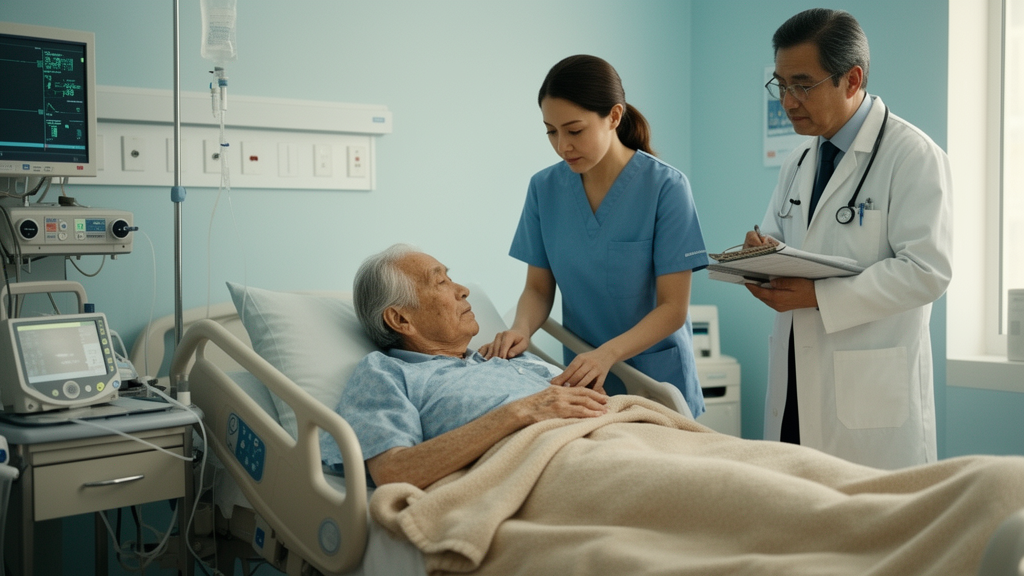
More than half of older patients with colorectal cancer who end up in the intensive care unit after surgery already carry a measurable burden of frailty before they reach the operating table, according to a new retrospective cohort study from a tertiary hospital in Ningxia, China. Among 308 patients aged 60 and older who underwent radical resection for colorectal cancer and were admitted to the ICU postoperatively between June 2023 and March 2026, 55.52 percent screened positive for preoperative frailty risk using the five-item modified Frailty Index, a simple checklist of comorbidities and functional independence. That figure is strikingly higher than the 35.1 to 45.1 percent frailty prevalence previously reported in broader populations of older colorectal cancer patients, and the study’s authors argue it signals an urgent, unmet need for frailty screening in the highest-risk slice of the surgical cancer population.
The research, published in Frontiers in Oncology, is the first investigation to focus specifically on preoperative frailty risk in older colorectal cancer patients who require postoperative ICU admission. The team, led by Yongqin Wang and Guifang Li of Ningxia Medical University and the General Hospital of Ningxia Medical University, drew on a pool of roughly 2,013 patients who underwent radical resection for colorectal cancer during the study window, of whom about 1,233 were aged 60 or older. Nearly one in five of all resected patients, 396 individuals or approximately 19.67 percent, were admitted to the ICU after surgery, reflecting a standardized institutional pathway in which surgeons plan ICU admission for patients judged at high risk of postoperative deterioration, while unplanned admissions follow intraoperative events such as hemodynamic instability, major bleeding, or clinical decline on the ward.
Frailty itself is a geriatric syndrome characterized by multisystem dysregulation and diminished physiological reserve, leaving patients less able to withstand the stress of major surgery. The five-item modified Frailty Index, or mFI-5, scores five components, each worth one point: diabetes mellitus, congestive heart failure, chronic obstructive pulmonary disease, hypertension requiring medication, and non-independent functional status, defined as needing partial or complete help with activities of daily living. A score of two or more classifies a patient as having frailty risk. In this cohort, the most common component was non-independent functional status, present in 79.87 percent of all patients, followed by hypertension requiring medication at 53.25 percent and diabetes at 20.78 percent. Notably, 75.91 percent of patients in the non-frail group scored one point, suggesting many were already in a prefrailty state one step away from crossing the threshold.
Beyond counting who was frail, the researchers dug into which clinical and laboratory characteristics traveled with frailty risk. In multivariable logistic regression adjusted for age and other factors, higher serum albumin emerged as a protective factor, with each unit increase associated with roughly 10 percent lower odds of frailty risk, an odds ratio of 0.896. Albumin reflects both nutritional reserves and inflammatory status, and the authors point to cancer-related chronic inflammation, reduced appetite, and limited physical activity as forces that erode muscle quality and physical function in older colorectal cancer patients. On the risk side, higher preoperative blood glucose carried an odds ratio of 1.476, and a higher neutrophil-to-lymphocyte ratio, a marker of systemic inflammation and immune dysregulation, carried an odds ratio of 1.139, suggesting that metabolic disturbance and low-grade inflammation are woven into the frailty phenotype in this population.
Body composition and everyday clinical assessments also proved telling. Patients with a body mass index of 26.9 kilograms per square meter or higher, the overweight and obesity cutoff used in the Chinese Dietary Guidelines for older adults, had nearly four times the odds of frailty risk compared with those in the normal range, an odds ratio of 3.948, possibly reflecting adipose-driven production of pro-inflammatory cytokines that impair cardiovascular, immune, and muscular function. Polypharmacy, defined as concurrent use of five or more medications, raised the odds more than fivefold at 5.854. The presence of pain tripled the odds at 3.082, consistent with mechanisms in which persistent pain impairs mobility, reduces nutritional intake, and disrupts sleep. Most dramatic of all, high fall risk on the Chinese version of the Morse Fall Scale carried an odds ratio of 6.976, with 87.13 percent of the frailty risk group classified as high fall risk compared with 35.77 percent of the non-frail group. The authors caution, however, that polypharmacy and fall risk may partially overlap with the comorbidity and functional status components of the mFI-5 itself, so these associations deserve careful interpretation.
The consequences of preoperative frailty risk were unmistakable in the hospital outcomes data. Overall postoperative complications struck 60.82 percent of the frailty risk group versus 33.58 percent of the non-frail group. Severe complications, graded at Clavien-Dindo level III or higher, occurred in 29.82 percent of frail patients against 13.14 percent of non-frail patients, and the gap extended to specific complication types, including gastrointestinal, respiratory, thromboembolic, and infectious events. After adjustment for age, ASA classification, surgical type, intraoperative blood transfusion, operative time, TNM stage, and nutritional risk, frailty risk remained an independent predictor of overall complications with an odds ratio of 3.016 and of severe complications with an odds ratio of 2.627. In-hospital mortality, recorded in three frail patients and no non-frail patients, and ICU readmission did not differ significantly between groups, likely because event rates were too low for the study to detect a difference.
Frailty also left its mark on resource use. Generalized linear models, adjusted for the same confounders, showed that frailty risk was associated with a longer total hospital stay, an exponentiated coefficient of 1.184, a longer ICU stay at 1.323, and higher total hospitalization costs at 1.115. In raw numbers, the frailty risk group spent a median of 18 days in the hospital compared with 16 days for the non-frail group, and incurred median costs of 11.82 ten-thousand RMB against 9.94. Sensitivity analyses reinforced the picture: when the mFI-5 was modeled as a continuous variable, each one-point increase raised the odds of overall complications by 60.5 percent and severe complications by 49.4 percent, and the core findings held after excluding patients aged 80 and older and after excluding the 27 patients with unplanned ICU admissions.
One of the study’s most consequential observations concerns what frailty screening does that traditional tools do not. In the adjusted models, chronological age was independently associated with severe complications but not with overall complications, and ASA classification, the anesthesiologists’ standard fitness grade, was associated with neither outcome. Frailty risk, by contrast, predicted both. The authors argue this reflects the mFI-5’s ability to capture multidimensional functional deficits that age and ASA miss, and they cite a survey by the International Society of Geriatric Oncology finding that although 90 percent of surgical oncologists in the United States and Europe routinely use preoperative risk assessment tools, fewer than one-quarter use frailty assessment instruments. Comprehensive geriatric assessment remains the gold standard for frailty identification, but its time and resource demands limit widespread use, whereas the mFI-5 can be derived rapidly from routine medical history and existing nursing assessments such as the Barthel Index.
The clinical stakes extend beyond prediction to intervention. Frailty is described in the source literature as a reversible and preventable condition, and both the Society for Perioperative Assessment and Quality Improvement and the American Society of Colon and Rectal Surgeons recommend incorporating frailty assessment into preoperative evaluation of older surgical patients. The factors identified here, including polypharmacy, pain, and high fall risk, map onto concrete prehabilitation targets: simplifying medication regimens, stepwise pain management, dynamic glucose monitoring, individualized nutritional support for patients with low albumin, and balance training with fall prevention education. The authors also cite a preoperative frailty screening initiative covering 9,153 surgical patients in which flagged patients were communicated to surgical, anesthesiology, and critical care teams and perioperative plans were adjusted, an approach associated with lower 30-day, 6-month, and 1-year mortality, with the most pronounced benefits among frail patients.
The study’s limitations temper the enthusiasm appropriately. It was conducted at a single center whose relatively liberal ICU admission policy, nearly 20 percent of all resected patients, may not generalize to hospitals with different admission criteria, and the retrospective design leaves open the influence of unmeasured variables such as resection status, lymph node yield, and post-ICU treatments. The mFI-5 does not capture cognition or nutrition and is best regarded as a screening tool, and functional status was retrospectively assessed in a way that may have overestimated dependence. Outcomes were confined to the in-hospital period, with no follow-up of post-discharge recovery. Still, for a population that will only grow as surgical oncology ages with its patients, the message is clear: a five-point checklist administered before surgery, supplemented by routine labs like albumin, glucose, and the neutrophil-to-lymphocyte ratio, may identify the patients most likely to land in trouble after the operation, in time to do something about it.
Subject of Research: Preoperative frailty risk and in-hospital outcomes in older colorectal cancer patients admitted to the ICU after surgery
Article Title: Preoperative frailty risk in older patients with colorectal cancer admitted to the ICU after surgery: prevalence, associated factors, and association with in-hospital outcomes
Article References: Wang, Y., Li, G., Yang, Q., Yin, M., Yang, X., & Li, J. (2026). Preoperative frailty risk in older patients with colorectal cancer admitted to the ICU after surgery: prevalence, associated factors, and association with in-hospital outcomes. Frontiers in Oncology, 16, Article 1948607. https://doi.org/10.3389/fonc.2026.1948607
Image Credits: AI Generated
DOI: 10.3389/fonc.2026.1948607
Keywords: frailty, colorectal cancer, intensive care unit, older adults, postoperative complications, mFI-5, retrospective cohort study, prehabilitation, albumin, neutrophil-to-lymphocyte ratio, hospital length of stay, perioperative risk stratification
News Source: Ophelia Keating. (October 26, 2026). Frailty Found in Over Half of Older Colorectal Cancer Patients Heading to the ICU After Surgery. Scienmag.