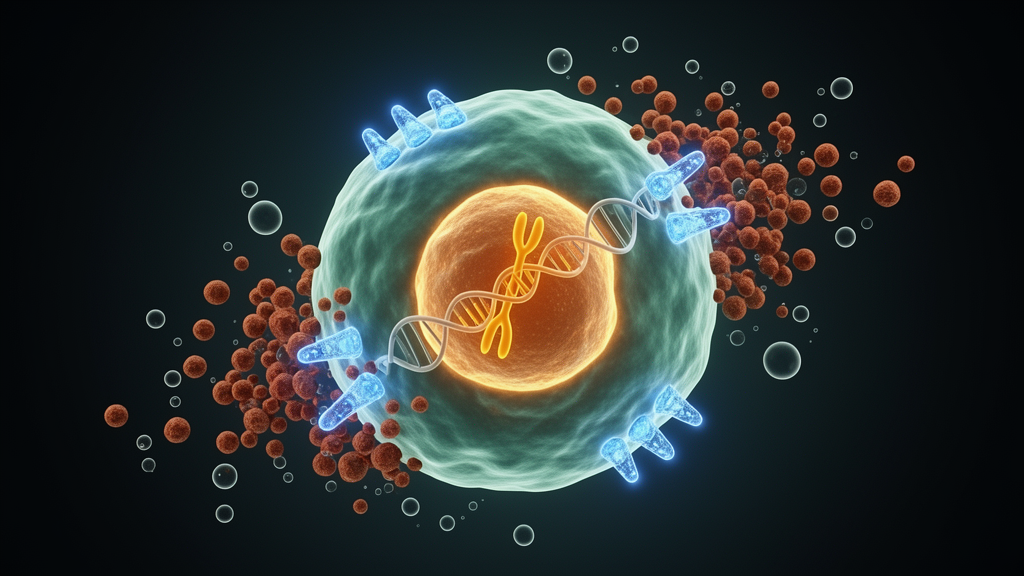
Researchers report that the transcription factor FOXA1 acts as a brake on ferroptosis, an iron-dependent form of cell death, in cervical cancer cells. According to a study published in Cell Division, FOXA1 is overexpressed in cervical tumors, and when the team reduced its activity in cervical cancer cell lines, the cells became less able to proliferate, more prone to apoptosis, and more susceptible to ferroptotic death. The mechanism, the authors say, runs through SLC7A11, a cystine transporter gene that FOXA1 directly switches on. The work, with Fei Gao as first author among a larger author team, combines patient tissue analysis, experiments in C33A and HeLa cells, and xenograft studies in mice.
The study began with expression data. Using the GEPIA 2 database to profile the TCGA cervical squamous cell carcinoma dataset, the researchers found FOXA1 significantly upregulated in cervical tumors compared with neighboring normal cervical samples. They then validated this in their own cohort: 35 patients with cervical cancer provided tumor tissue and paired adjacent healthy cervical samples, along with blood serum collected before and after surgery. Quantitative real-time PCR confirmed higher FOXA1 mRNA in tumors than in healthy neighboring tissue, and immunoblotting and immunohistochemistry showed the same pattern at the protein level. In serum specimens taken 21 days after surgery, FOXA1 levels dropped markedly compared with pre-operation samples.
The clinical data also suggested diagnostic and prognostic relevance. In the patient cohort, FOXA1 showed an area under the curve of 0.8224 for detecting cervical cancer, which the authors interpret as favorable diagnostic performance based on sensitivity and specificity. When patients were split into high and low FOXA1 expression groups by the median level, those with low FOXA1 expression survived longer than those with high expression over the five-year follow-up.
To test what FOXA1 does functionally, the team used lentiviral short hairpin RNA to knock down FOXA1 in C33A and HeLa cervical cancer cells. Depletion of FOXA1 substantially reduced colony formation and EdU-measured proliferation in both cell lines. Flow cytometry with Annexin V-FITC and PI staining showed that FOXA1 downregulation increased apoptosis, and immunoblotting revealed the expected molecular shift: Bax levels rose while Bcl-2 levels fell in the knockdown cells. These results align with earlier reports that FOXA1 promotes cervical tumor development by enhancing proliferation and impeding apoptosis, in part through activation of the oncogenic factor SIX4.
The central new finding concerns ferroptosis. Because ferroptosis is embedded in lipid metabolism, and FOXA1 had previously been characterized as a lipid metabolic control factor, the researchers measured a panel of ferroptosis-related markers after FOXA1 knockdown. In both cell lines, reduced FOXA1 led to lower superoxide dismutase activity, higher malondialdehyde levels, and decreased glutathione content, a biochemical signature consistent with ferroptotic stress. The cells also accumulated more reactive oxygen species, measured with DCFH-DA probes, and more ferrous iron, measured with a colorimetric assay kit. Together, the authors argue, these changes show that FOXA1 normally represses ferroptosis in cervical cancer cells.
The next question was how FOXA1 exerts this repression. The team focused on SLC7A11, a cystine transporter known to protect cancer cells from ferroptosis and previously implicated as a pro-tumorigenic factor in cervical cancer. In their 35-patient cohort, SLC7A11 mRNA was strikingly upregulated in tumors relative to adjacent healthy tissue, and its expression correlated positively with FOXA1 expression by Pearson correlation analysis. SLC7A11 protein was also elevated in tumors and in the C33A and HeLa cell lines compared with the HPV-immortalized H8 cervical cell line.
Chromatin immunoprecipitation followed by qPCR in C33A and HeLa cells showed that the promoter fragment containing the S2 site, but not the S1 fragment, was enriched in anti-FOXA1 immunoprecipitates, indicating direct binding through the sequence TATTTACTTTG. To confirm that this binding drives transcription, the team cloned the S2-containing promoter fragment into a pGL3-basic luciferase reporter, alongside a mutant version in which TATTTACTTTG was changed to ATAAATGAAAC. Overexpressing FOXA1 from a pcDNA-FOXA1 plasmid significantly boosted luciferase activity from the wild-type reporter but not the mutant, and knocking FOXA1 down with shRNA reduced SLC7A11 protein in both cell lines.
Rescue experiments then tested whether the FOXA1-SLC7A11 axis is functionally responsible for the observed phenotypes. When the researchers restored SLC7A11 expression with a plasmid in FOXA1-downregulated cells, the suppression of colony formation and proliferation was reversed, and the increase in apoptosis was blunted, along with the Bax increase and Bcl-2 decrease. The ferroptosis signature also reversed: compared with FOXA1-knockdown cells receiving an empty control plasmid, cells co-transfected with the SLC7A11 plasmid showed higher SOD, lower MDA, more GSH, and reduced ROS and Fe2+ content. The authors conclude that FOXA1 affects cervical cancer cell growth, apoptosis and ferroptosis through SLC7A11.
Finally, the team extended the work to animals. In female athymic BALB/c mice, subcutaneous xenografts formed by C33A cells transduced with sh-FOXA1 lentivirus grew to smaller volumes and weights than xenografts from cells transduced with a non-targeting control, with five mice per group. Immunoblotting and immunohistochemistry of the harvested xenografts confirmed FOXA1 downregulation and showed that SLC7A11 protein was also reduced when FOXA1 was depleted. The authors interpret this as evidence that FOXA1 depletion hinders in vivo tumorigenesis of C33A cells, at least in part through its regulation of SLC7A11, although they note that the xenograft model used a single cell line and does not capture the full complexity of human cervical cancer.
The study has limitations the authors themselves acknowledge. The functional analysis relied on only two cervical cancer cell lines, C33A and HeLa, and the clinical cohort comprised 35 patients from a single center, with human and animal work approved by the Third Hospital of Mianyang research ethics committees. The authors state that FOXA1 downregulation-mediated suppression of cervical cancer will need to be defined further in different cellular and animal models. They also frame the therapeutic implication cautiously: because FOXA1 represses ferroptosis through SLC7A11, designing inhibitors of FOXA1 is, in their view, a promising avenue for harnessing ferroptosis in cervical cancer treatment. That proposal remains a hypothesis for future work rather than a demonstrated therapy, since the present study did not test any FOXA1 inhibitor. What the results do establish is a specific molecular circuit, FOXA1 binding the SLC7A11 promoter at the TATTTACTTTG site to sustain SLC7A11 transcription, that links a transcription factor long associated with cervical tumor growth to the ferroptosis machinery, and that may offer a target for future drug development.
Subject of Research: The role of the transcription factor FOXA1 in repressing ferroptosis of cervical cancer cells through transcriptional activation of SLC7A11
Article Title: Transcription factor FOXA1 suppresses ferroptosis of cervical cancer cells by upregulating SLC7A11 expression
Article References: Gao, F., Zeng, Y., Jia, L., He, J., & He, H. (2026). Transcription factor FOXA1 suppresses ferroptosis of cervical cancer cells by upregulating SLC7A11 expression. Cell Division, 21(1), Article 21. https://doi.org/10.1186/s13008-026-00182-4
Image Credits: AI Generated
DOI: 10.1186/s13008-026-00182-4
Keywords: FOXA1, SLC7A11, ferroptosis, cervical cancer, transcription factor, cystine transporter, apoptosis, xenograft, ChIP-qPCR, Cell Division, tumor metabolism, shRNA knockdown
News Source: Nathaniel Bowman. (October 28, 2026). FOXA1 Keeps Cervical Cancer Cells Alive by Blocking Ferroptosis Through SLC7A11. Scienmag.