


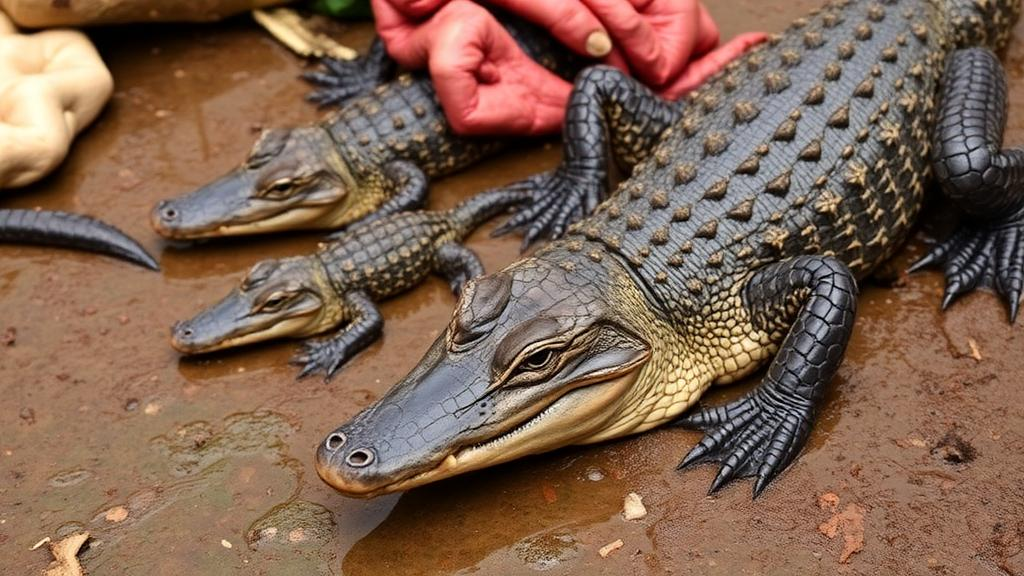
In the crowded bushmeat markets of Nigeria’s Niger Delta, one of Africa’s smallest and most elusive crocodilians is being traded in numbers that researchers say should set off alarm bells. A new study has documented 158 dwarf crocodiles (Osteolaemus tetraspis) passing through just three markets over a single seven-month survey window, with the animals overwhelmingly arriving as medium-sized and large adults rather than juveniles. Because the species is globally listed as Vulnerable by the IUCN, and because the animals recorded were predominantly reproductively mature, the findings point to a harvest that could be quietly stripping wild populations of the very individuals they need to sustain themselves.
The dwarf crocodile is the smallest living member of the crocodilian family, distinguished by a short blunt snout, bony dorsal scutes and a cryptic, largely nocturnal lifestyle. Adults typically measure between 1.5 and 1.9 metres, though exceptional males may exceed 2 metres and weigh up to 80 kilograms, while females average around 40 kilograms. The species occupies tropical lowland forests, swampy wetlands, mangrove ecosystems and slow-flowing rivers across West and Central Africa, feeding opportunistically on crustaceans, mollusks, fish, amphibians and occasionally small mammals, a diet that places it in the role of a key mid-level predator in aquatic forest ecosystems. Reproductive biology remains poorly studied, but available evidence indicates clutch sizes of 10 to 20 eggs, with nests often built from vegetation mounds close to water bodies. Unlike larger crocodilians such as the Nile crocodile, dwarf crocodiles show slower growth rates and longer generational intervals, traits that make them especially vulnerable to overexploitation.
The team focused on three major markets: Uwa, situated at the hub of Benin City in Edo State; Edumanom, close to the Edumanom forest reserve a few kilometres from Okoroba in Ogbia axis between Nembe and Brass Local Government Areas of Bayelsa State; and Ogbe-Ijaw, a town near the city of Warri in Delta State. Bushmeat market surveys were conducted fortnightly between October 2021 and April 2022. Permission to carry out the work was obtained from community leaders responsible for the market areas, and within each market the researchers identified sellers who handled crocodiles. Thirty sellers in each market were randomly approached for socio-demographic interviews, producing a total of 90 monitored traders across the three sites.
Each monitored seller stall constituted an observational unit, and each seller was assigned a unique identifier nested within their market to prevent confusion between traders. Stocks of dwarf crocodiles were identified, counted and ink-marked to avoid double counting between visits. At every survey round the number of animals displayed at each stall was recorded independently, and crocodiles were measured to the nearest 30 centimetres using a tape measure, a task made possible because many of the animals were tied with rope and some were near death. Fortnightly counts for each seller were aggregated within each month to produce a monthly seller-level count, and the final analytical dataset contained 90 unique sellers and 630 seller-month observations. The researchers also calculated market-level relative abundance as the share of total records attributable to each market, and monthly relative abundance as the share of records within each market attributable to each month.
The headline result is stark. Of the 158 dwarf crocodiles recorded during the study period, Uwa accounted for 96 specimens, or 60.76 per cent of the total, followed by Edumanon with 40 specimens, or 25.32 per cent, and Ogbe-Ijaw with 22 specimens, or 13.92 per cent. Temporal patterns revealed that abundance peaked in October at 24.68 per cent and February at 18.99 per cent, while April recorded the lowest value at 4.43 per cent. Uwa exhibited relatively consistent monthly occurrences, whereas Edumanon showed intermittent records with complete absence in November and January but higher abundance of 25.00 per cent in February, March and October respectively. Ogbe-Ijaw had the lowest and most irregular records, never exceeding five individuals per month. The researchers stress that these percentages describe the composition of market records and should not be interpreted as estimates of wild population abundance, a caveat that underscores how little is known about the underlying source populations.
Size-class composition added a further layer of concern. Medium-sized and large-sized dwarf crocodiles dominated the trade, each accounting for 39.24 per cent of the total individuals recorded, whereas small-sized individuals contributed only 21.52 per cent. Within Uwa, the highest abundance fell among medium-sized and large-sized animals, contributing 38 medium-sized individuals at 39.58 per cent and 36 large-sized individuals at 37.50 per cent of that market’s total records. In Edumanon, large-sized individuals constituted the highest proportion at 47.50 per cent, followed by medium-sized at 40.00 per cent and small-sized at 12.50 per cent. In Ogbe-Ijaw, medium-sized individuals were most abundant at 36.36 per cent, while small-sized and large-sized individuals each accounted for 31.82 per cent. Taken together, medium- and large-bodied crocodiles made up 78.48 per cent of all animals recorded, a pattern the authors interpret as selective harvesting of larger crocodiles, likely driven by their greater meat yield and higher market value, and one that disproportionately targets reproductively mature individuals capable of impairing population recruitment and long-term breeding potential.
To move beyond simple counts, the team fitted a negative-binomial generalised linear mixed model to the monthly records, a statistical approach chosen because preliminary analyses indicated overdispersion in the count data, making it more appropriate than a Poisson model. Month and Market Location were included as fixed effects to assess temporal and spatial variation in abundance, while their interaction was included to determine whether seasonal patterns differed among markets. Seller Identity was incorporated as a random intercept to account for repeated observations and unexplained heterogeneity among traders sampled within markets. Market Location was treated as a fixed effect rather than a random one because only three markets were investigated and the objective was to compare these specific sites rather than infer variation from a larger population of markets. The model revealed significant effects of Month, with a chi-squared value of 19.82 on six degrees of freedom and a p-value below 0.01, and Market Location, with a chi-squared value of 10.46 on two degrees of freedom and a p-value of 0.005, as well as a significant Month by Market interaction with a chi-squared value of 23.17 on twelve degrees of freedom and a p-value of 0.018. The marginal coefficient of determination reached 0.48, indicating that fixed effects contributed substantially to variation in monthly abundance.
The socio-demographic data collected alongside the counts paint a picture of a trade that is highly gendered, age-structured and shaped by cultural and educational backgrounds. Across all three markets, trading was exclusively female-dominated, with all respondents from Uwa, Edumanom and Ogbe-Ijaw being women and no male participation reported. The majority of traders were in the 30 to 50 years age bracket, indicating that middle-aged women constitute the core of this trade. Marital status varied across the study sites, with married women with children constituting the largest proportion of traders at 60.0 per cent in Uwa, 53.3 per cent in Edumanom and 46.7 per cent in Ogbe-Ijaw. Educational background differed significantly among markets, with half of Uwa traders having only primary education, while in Ogbe-Ijaw 77.7 per cent had only primary school education. Ethnic affiliation also showed marked variation, with Edo women dominating Uwa, Ijaw traders most numerous at Edumanom and Urhobo/Isoko traders comprising nearly half of those at Ogbe-Ijaw, reflecting the cultural geography of the Niger Delta.
The seasonal rhythm of the trade appears tightly coupled with ecological and hydrological cycles. Higher records in October and February likely coincide with post-rainfall accessibility to wetlands and riverine habitats, where crocodiles are more vulnerable to hunting. The decline in April may reflect reduced hunting effort due to competing livelihood activities, seasonal depletion of stocks or environmental pollution. Dwarf crocodiles are particularly vulnerable because they are easily captured at night using torches and nets, and their small size makes them manageable to transport compared to larger crocodilian species. The researchers note that the overrepresentation of medium and large size classes signals selective harvesting pressure that may compromise population structure and reproduction if unchecked, and that the absence of crocodile supply in some months, particularly in Edumanom, could signify local population declines rather than seasonal absence. Given the species’ Vulnerable status and its listing under CITES Appendix I, these patterns underscore the urgency for seasonally informed and size-specific regulation.
The study’s authors argue that effective conservation will require a multi-pronged approach balancing ecological protection with social equity. They recommend temporal harvest regulation limiting hunting during mid-dry season peaks from October to February, geographic targeting of conservation efforts around Uwa and Edumanon, promotion of regulated crocodile farming as an alternative livelihood, monitoring of reproductive nesting timing between May and June to protect nesting sites, and strengthened law enforcement in collaboration with communities. They also emphasise the need for participatory, livelihood-sensitive approaches that harmonise species protection with socio-economic resilience, noting that blanket enforcement or trade prohibitions without viable economic alternatives risk exacerbating poverty among women traders who dominate the retail segment of the bushmeat supply chain. The researchers acknowledge that the study relied primarily on market-based monitoring, meaning harvest rates could not be directly linked to wild population resilience, and they call for future research integrating systematic field surveys with market assessments to estimate sustainable offtake thresholds, alongside investigations into consumer demand cycles, price fluctuations and cultural drivers.
Subject of Research: Trade of the vulnerable dwarf crocodile Osteolaemus tetraspis in Niger Delta bushmeat markets, Nigeria
Article Title: Relative abundance of Osteolaemus tetraspis in Uwa, Edumanom and Ogbe-Ijaw bushmeat markets in the Niger Delta region, Nigeria
Article References: Ogorode, I. O., Ito, E. E., Oriakpono, O. E., Vincent-Akpu, I. F., Babatunde, B. B., & Sikoki, F. D. (2026). Relative abundance of Osteolaemus tetraspis in Uwa, Edumanom and Ogbe-Ijaw bushmeat markets in the Niger Delta region, Nigeria. BMC Zoology, 11(1), Article 25. https://doi.org/10.1186/s40850-026-00281-3
Image Credits: AI Generated
DOI: 10.1186/s40850-026-00281-3
Keywords: dwarf crocodile, Osteolaemus tetraspis, bushmeat trade, Niger Delta, Nigeria, wildlife trafficking, IUCN Vulnerable, GLMM, seasonal harvest, conservation, bushmeat markets, selective harvesting
News Source: Margaret Porter. (October 29, 2026). Dwarf crocodiles flow through Niger Delta bushmeat markets in worrying numbers. Scienmag.



