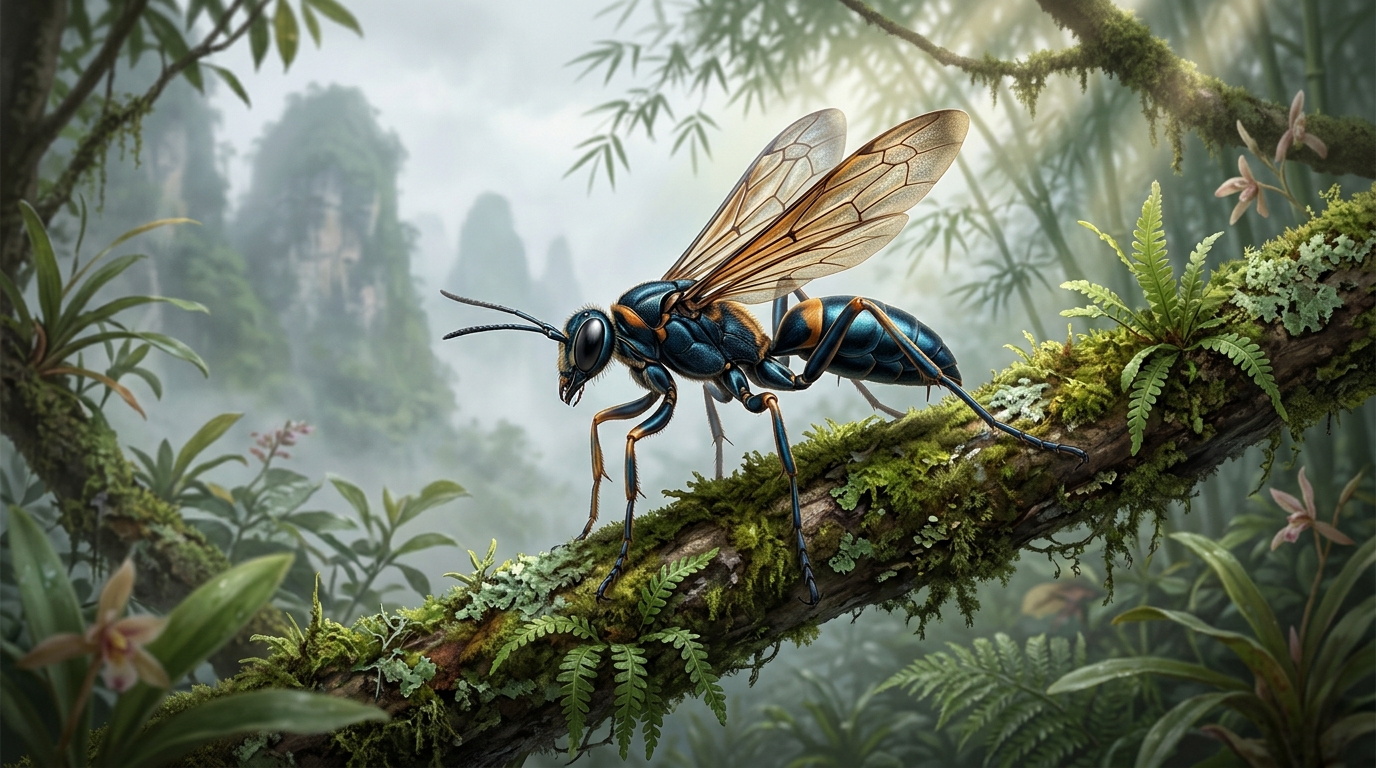
A small, little-studied group of spider-hunting wasps has just grown considerably larger. In a taxonomic review of the genus Platydialepis, a team of Chinese researchers described four species that are new to science and reported one previously known species from China for the first time. The work, published in the Journal of Hymenoptera Research, raises the number of Platydialepis species recorded from China from one to six and provides the first identification key to all Chinese members of the genus.
Platydialepis belongs to the family Pompilidae, commonly known as spider wasps. Pompilid wasps are solitary predators that hunt spiders to provision their offspring, although some species exhibit cleptoparasitic behaviour. The family is distributed across all six major zoogeographic regions, with the highest species diversity in the tropics, and comprises five subfamilies and approximately 5,000 described species worldwide. Platydialepis itself is a small genus in the subfamily Pepsinae, placed in the tribe Priocnemini. It was erected as a new genus in 1941 by Haupt, who designated Salius junctellus Cameron, 1902 as its type species. Until now, the genus comprised eight known species: seven occur in the Oriental and Palaearctic regions, and one, P. ichneumoniformis, is known from the Neotropical region.
Before this study, only a single Platydialepis species had been described from China: P. taiwaniana, recorded from Taiwan by Tsuneki in 1989. The new review changes that picture substantially. The four new species are Platydialepis bidentata, P. flavipectoralis, P. frontimaculata and P. prominula, all named by Cui, Li and Ma. In addition, P. ryoheii, originally described from Japan in 1957 and later transferred to Platydialepis, is reported from China for the first time, based on specimens from Fujian, Guangdong, Guizhou, Henan, Hubei and Shandong provinces.
The specimens behind the new species were collected in Chongqing, Guangdong, Guangxi, Henan, Hubei, Jiangxi, Sichuan, Yunnan and Zhejiang, and are deposited in the insect collections of Yunnan Agricultural University in Kunming. The species delimitation followed traditional methods of taxonomy: character states of all known species were retrieved from their original descriptions and subsequent supplementary revisions, with special attention paid to original illustrations, photographs and morphometric data. For the most relevant congener, P. taiwaniana, the researchers examined high-resolution digital images of the holotype specimen through the online type database of the National Museum of Natural History at the Smithsonian Institution, alongside collected specimens, allowing key characters to be verified with confidence.
Each of the new species is defined by a distinctive combination of morphological traits. P. bidentata, known from both sexes, takes its name from the Latin bi- and dentata, referring to the male mandibles bearing two inner teeth, one of the main recognition characters of the species. Females have a body length of 14 to 20 millimetres, a black body marked with yellow areas on the clypeus, legs and abdominal segments, and a forewing with an infuscate spot extending from the apex of the marginal cell to the middle of the third submarginal cell. Males are smaller at 10 to 15 millimetres, more slender, and carry more extensive yellow markings, including on the forelegs and the first two abdominal terga.
P. flavipectoralis, described from females only, shows the opposite colour scheme: the body is mostly yellow with black spots, including a black vertex, the apical half of most antennal flagellomeres and much of the mesoscutum. The species name combines the Latin flav-, meaning yellow, and pectoralis, meaning thoracic, referring to the yellow ground colour of the mesosoma. Females measure 13 to 16 millimetres in body length, and the forewing carries an infuscate spot covering the marginal cell and extending to the middle of the second submarginal cell. The species is known only from Yunnan province, with all type material collected in Xishuangbanna, in Menghai County.
P. frontimaculata, known from males only, is a black-bodied species distinguished by a brownish spot on the inner margin of each compound eye, silvery pubescence over the head and mesosoma, and subapical tufts of long dark brown setae on the fifth and sixth abdominal sterna. The name derives from the Latin front- and maculata, referring to the two spots on the male frons. Males measure 10 to 15 millimetres, and the species is recorded from Hubei, including Shennongjia Forestry District, and from Henan. The authors note that the male could not be confidently associated with any known female, including the females of the two other new species described in the study, and that its unique combination of characters, together with distinctly different male genitalia, justified recognising it as a separate species.
P. prominula, again described from females only, is the largest of the new species at 18 to 23 millimetres in body length. It has a black body with yellow markings, including the clypeus, an inverted V-shaped macula extending from below the antennal socket to the middle of the frontoclypeal suture, and yellow femora and tarsi. The species name, from the Latin prominula meaning slightly prominent, refers to the weakly bisinuate apical margin of the clypeus, one of its main recognition characters. It is known from Chongqing, Guangdong, Sichuan and Zhejiang, with the holotype collected on Emei Mountain in Sichuan. The diagnosis separates it from the similar P. moorei by characters including the obtusely excised posterior margin of the metapostnotum, the yellow clypeus, the absence of a white spot on the underside of the hind femur, and golden rather than silvery setae on the head and mesosoma.
The identification key accompanying the review separates the Chinese species by traits such as the number of inner teeth on the hind claw, the colour of the clypeus, the shape of the clypeal apical margin, the position where the recurrent vein meets the second submarginal cell, and the extent of the infuscate wing spot. Females of P. frontimaculata and males of P. prominula and P. flavipectoralis remain unknown, and the key flags these gaps explicitly. The biology of the genus has rarely been reported: only Japanese researchers have documented prey records, showing that P. ryoheii and P. amamiensis in Japan prey on spiders of the family Sparassidae.
The authors argue that the jump from one to six Chinese species indicates that the Chinese Oriental Region may be a significant area of distribution and a diversity centre for the genus. The material examined came mainly from the tropical and subtropical regions of southern China, which the authors describe as hotspots for biodiversity research, where complex topography and diversified habitats may have promoted the differentiation of spider wasps. Yet records from northern China in the same study suggest that higher-latitude areas may also yield more unrecorded or undescribed species. The closely related genus Malloscelis, morphologically highly similar to Platydialepis, has type specimens collected from northwestern China, and the authors call for more comprehensive collecting and comparative studies across different biogeographic regions of China, especially in the transition zone between the Palaearctic and Oriental regions, to test the boundaries and evolutionary relationships of the two genera. They also highlight an open phylogenetic question: previous morphological work suggested Platydialepis and the New World genus Priocnessus may form a sister-group relationship, but available molecular analyses place a representative of Priocnessus closer to some genera of the tribe Pepsini, and Platydialepis was not included in that study, so the molecular results cannot directly test the morphological hypothesis. Future integrative analyses combining molecular and morphological data, the authors conclude, are needed to clarify the relationships of Platydialepis and its allies.
Subject of Research: Taxonomic review of the spider wasp genus Platydialepis in China, describing four new species and a new national record
Article Title: A review of the genus Platydialepis Haupt ( Hymenoptera , Pompilidae ) of China, with description of four new species and key to the species
Article References: Cui, J., Li, Q., & Ma, L. (2026). A review of the genus Platydialepis Haupt (Hymenoptera, Pompilidae) of China, with description of four new species and key to the species. Journal of Hymenoptera Research, 99, 1215-1241. https://doi.org/10.3897/jhr.99.210992
Image Credits: AI Generated
Keywords: Platydialepis, spider wasps, Pompilidae, new species, taxonomy, China, Hymenoptera, biodiversity, Pepsinae, species key, Oriental Region, entomology
News Source: Gavin Prescott. (November 4, 2026). Four New Spider-Hunting Wasp Species Discovered in China. Scienmag.