An isolated crocodyliform tooth from the Maastrichtian Yuliangzi Formation of northeastern China has become the test case for a question that fossil-tooth modelers rarely resolve: does it matter whether enamel and dentin are treated as different materials? In a study combining high-resolution micro-computed tomography with finite element analysis, researchers compared two geometrically identical models of the same specimen, SC000903. One assigned uniform, dentin-like properties to the entire crown; the other reconstructed enamel and dentin as separate layers with distinct stiffnesses. The answer was strikingly tissue-specific. Adding a stiff enamel layer barely changed the total volume of modeled high-stress regions, but it dramatically shifted where those regions appeared, concentrating them in the enamel and relieving the dentin core.
The quantitative contrast is the heart of the result. Under a standardized apical load of 500 newtons, the composite model increased the proportion of above-threshold enamel volume by 81.48 percent relative to the homogeneous model, while the corresponding proportion in dentin fell by 21.05 percent. Doubling the load to 1000 newtons amplified the pattern: enamel above-threshold volume rose by 156.29 percent, and dentin dropped by 22.58 percent. Yet the total above-threshold volume of the whole tooth changed only modestly, by 4.35 percent at 500 newtons and 5.80 percent at 1000 newtons. In other words, tissue differentiation did not make the tooth uniformly more or less vulnerable in the models. It redistributed modeled stress from the compliant dentin core toward the stiff outer enamel shell.
The loads themselves deserve careful framing. The 500- and 1000-newton values lie close to the minimum recorded bite forces of crocodylians, but the authors explicitly state that they were chosen solely for sensitivity analysis and do not represent the actual bite force of this taxon. The doubled loading magnitude tested whether the influence of enamel-dentin differentiation remained consistent as stress increased, and it did: the direction of the tissue-specific response held under both conditions. At 500 newtons, the composite model raised above-threshold enamel from 0.81 percent to 1.47 percent of the enamel region, while dentin fell from 0.19 percent to 0.15 percent. At 1000 newtons, enamel climbed from 1.67 percent to 4.28 percent, and dentin fell from 0.62 percent to 0.48 percent. The consistency across load magnitudes suggests the modeled effect is not an artifact of a single loading scenario.
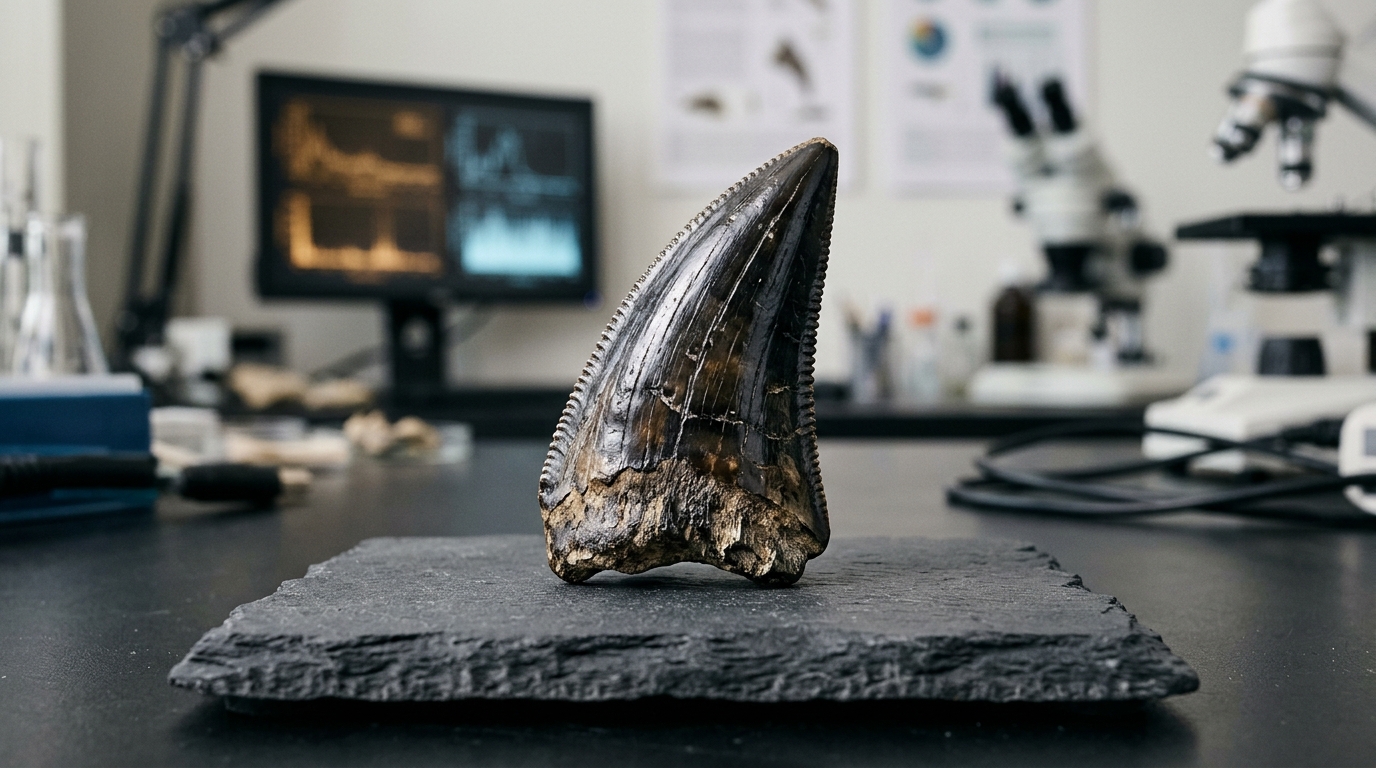
The specimen itself is a well-preserved isolated tooth comprising a complete crown and the basal portion of the root, recovered from the lower member of the Yuliangzi Formation at Longgushan, roughly 10 kilometers southwest of Jiayin County in Heilongjiang Province. It measures 10.47 millimeters in preserved length, curves lingually, shows slight labiolingual compression, and is separated from the root by a distinct cervical constriction. The crown is subconical with a smooth enamel surface lacking rugosity and ridges, and it bears distinct, unserrated carinae on its mesial and distal margins. These features, combined with the restricted and labiolingually compressed pulp chamber, support a referral to Crocodyliformes indeterminate. The authors are deliberately conservative: the individual features occur widely across crocodyliforms and vary substantially along the tooth row, within species, and between species, so without associated cranial or postcranial material, a narrower identification is not justified.
Computed tomography at a spatial resolution of 3.22168 micrometers revealed internal anatomy that external morphology alone could never show. Enamel thickness varies markedly from apex to base, averaging approximately 0.35 millimeters at the apex, 0.20 millimeters in the middle, and 0.03 millimeters at the base, with an overall range of roughly 0.03 to 0.35 millimeters and a mean of 0.18 millimeters. The enamel is thicker labially in the upper third of the crown but similar on both sides farther down. Dentin forms the main body of the crown and tapers from base to apex. The pulp-cavity system proved unexpectedly complex: a main coronal chamber with a well-defined lenticular outline in labial and lingual views, markedly constricted and labiolingually compressed in mesial and distal views, accompanied by fine branching canals approximately 15 micrometers in diameter that radiate toward the mesial and distal carinae.
Those branching canals are a discovery in their own right. Some previous micro-CT studies of crocodyliform teeth used voxel sizes exceeding 20 micrometers, larger than the diameter of the canals identified here, so comparable structures may simply have been overlooked in earlier scans. The authors suggest the regular arrangement and spatial relationship of the canals to the main pulp cavity are compatible with a pulp-related or vascular origin, possibly small vascular spaces enclosed during dentin deposition, but they caution that this interpretation remains provisional because micro-CT alone cannot determine histological identity. Some apparent discontinuities may reflect preservation, mineral infilling, or segmentation limitations. At present, the branching canals should not be treated as established diagnostic characters, and their variation within individuals, across ontogenetic stages, and among crocodyliform taxa remains unknown.
The modeling comparison carries a clear methodological message. Both model configurations identified the crown apex as the principal region of elevated stress, confirming that crown geometry and loading position dominate the broad spatial pattern. But the homogeneous model predicted substantially less above-threshold volume in the anatomical enamel region and more in the dentin region than the composite model. When researchers use localized high-stress or threshold-exceeding regions to discuss potential failure locations, feeding function, or susceptibility to dental damage, assigning uniform dentin-like properties to the entire crown may underestimate modeled stress in enamel and overestimate it in dentin. Interpretations about which tissue bears the load are therefore more sensitive to material representation than interpretations about where stress concentrates overall.
This finding does not contradict earlier work suggesting that material simplification matters little. Herbst and colleagues found that alternative representations of dental tissues produced broadly similar stress patterns at the mandibular scale, and the authors attribute the apparent difference to scale. At the mandibular level, stress transmission is influenced by many additional anatomical and material boundaries, including interfaces between teeth and supporting tissues and between jaw components, which may dilute the relative contribution of the enamel-dentin interface. Within an individual tooth, that stiffness contrast becomes far more influential, particularly when localized stress transfer is the question. Simplified models remain useful for comparing broad biomechanical differences associated with crown shape, curvature, robustness, or loading orientation, especially when identical material assumptions are applied consistently across specimens. Composite models should be preferred when tissue boundaries can be reliably reconstructed and tissue-specific behavior is central to the analysis.
The authors are careful about what the models cannot say. The analysis was designed as a controlled comparison of two material representations of the same tooth, not a reconstruction of in vivo feeding or fracture. One specimen, standardized apical loads, linearly elastic material properties, and reference strength thresholds of 300 megapascals for dentin and 370 megapascals for enamel all affect the absolute biological interpretation of the stress values. The result should not be read as direct evidence that enamel necessarily prevents fracture of the underlying dentin under living conditions. Within the assumptions of the models, however, the inclusion of a separate enamel layer consistently changed the predicted pathway of stress transfer and shifted threshold-exceeding regions toward the outer dental tissue. The labiolingual asymmetry observed in the composite model, with stress on the lingual side exceeding the labial side, may reflect the interaction between lingual crown curvature, thicker labial enamel in the upper crown, and vertical loading, though the separate contributions of these factors cannot be isolated in the present design.
Beyond biomechanics, the specimen fills a real gap in the fossil record. The Jiayin area, where the Yuliangzi Formation is exposed, was the site of China’s first dinosaur discoveries, and its vertebrate assemblage is overwhelmingly dominated by hadrosaurids, which account for more than 90 percent of the fossils. Non-dinosaurian reptiles have been poorly represented; crocodyliforms had been mentioned in faunal summaries, but no specimen from the formation had been described in sufficient detail for direct comparison. SC000903 provides the first detailed crocodyliform record from the Yuliangzi Formation. Data from the Paleobiology Database show that Maastrichtian crocodyliform localities in Asia cluster in the Russian Far East, Mongolia, central-southern India, and China’s Jiangxi and Heilongjiang provinces, with the northernmost occurrences at Jiayin and the Russian sites of Blagoveschensk and Kundur. Because none of the earlier reports from those northern sites included detailed descriptions, SC000903 stands as the northernmost formally described Maastrichtian crocodyliform fossil record in Asia to date, a modest-looking tooth that quietly extends the map of Late Cretaceous crocodyliforms while sharpening the tools used to model them.
Subject of Research: Finite element modeling of enamel-dentin stress transfer in an isolated Maastrichtian crocodyliform tooth from northeastern China
Article Title: Enamel–dentin differentiation alters modeled stress transfer in a Maastrichtian crocodyliform tooth
Article References: Xing, J.-W., Shao, S., Zhao, Y.-Q., Sui, Z.-X., Zhang, H.-G., Wu, B.-Y., Zhang, X., Shen, F.-B., & Yin, Y.-L. (2026). Enamel–dentin differentiation alters modeled stress transfer in a Maastrichtian crocodyliform tooth. Fossil Record, 29(2), 817-832. https://doi.org/10.3897/fr.29.209105
Image Credits: AI Generated
DOI: 10.3897/fr.29.209105
Keywords: crocodyliform, finite element analysis, enamel, dentin, Maastrichtian, Yuliangzi Formation, micro-computed tomography, pulp cavity, stress distribution, Jiayin, fossil tooth, biomechanics
News Source: Drew Townsend. (November 5, 2026). Fossil crocodyliform tooth reveals how enamel shifts stress away from dentin in computer models. Scienmag.