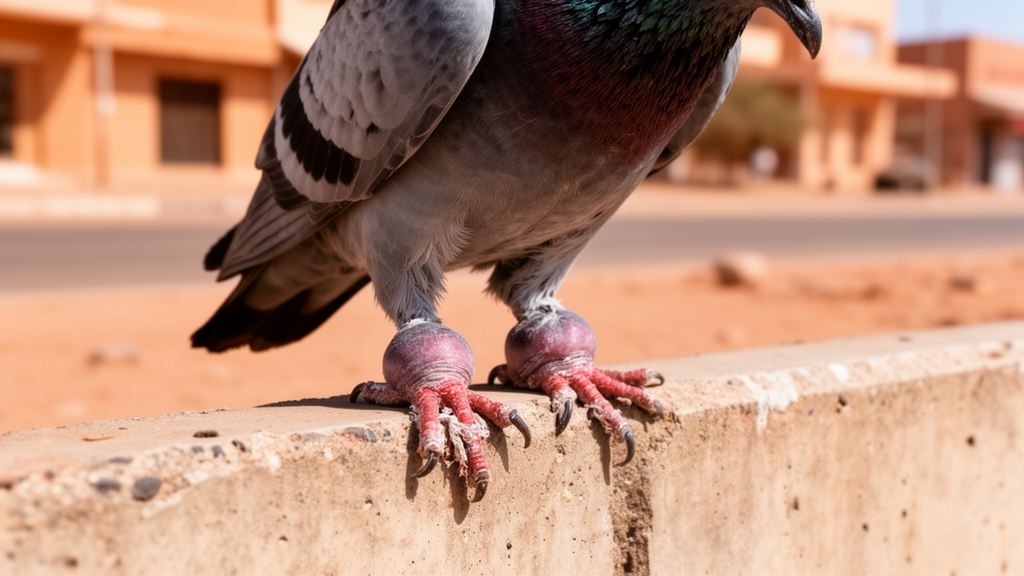
Nearly one in seven rock pigeons living in the Namibian town of Katima Mulilo shows a foot deformity, and the risk of injury depends strikingly on which part of town the birds inhabit. A new field study, published in Frontiers in Ecology and Evolution, reports that 46 of 300 pigeons visually inspected during systematic surveys — 15.3 percent — had deformed feet, with prevalence ranging from about 10 percent in market areas to more than 22 percent in residential neighborhoods.
The research, led by Michael Sinvula Lukubwe of the University of Namibia with colleagues at the University of Pretoria, focused on the rock pigeon (Columba livia), a species highly adapted to urban life. Yet the authors note that quantitative assessments of how common and how severe these deformities are across different urban land-use types have remained scarce, particularly in African cities, where most previous work on the condition has been lacking.
The team surveyed pigeons across three distinct zones of Katima Mulilo: the Central Business District (CBD), market areas and residential areas. Each bird was inspected visually, and foot deformities were recorded simply as present or absent, then classified into three severity levels: mild, moderate or severe. This straightforward observational design allowed the researchers to compare prevalence and severity across land-use categories within a single town.
The spatial pattern was clear. Residential areas recorded the highest prevalence of foot deformities at 22.5 percent, followed by the CBD at 12.4 percent, while market areas showed the lowest rate at 10.4 percent. Statistical analysis confirmed that the differences among land-use categories were significant. In a model comparing zones directly, pigeons observed in residential areas had significantly higher odds of deformities than those in the CBD, with an odds ratio of 2.05 and a p-value of 0.044 — meaning residential pigeons faced roughly double the odds of injury.
Severity followed its own hierarchy. Moderate deformities were the most common injury category, accounting for 60.9 percent of affected birds. Severe deformities made up 23.9 percent, while mild deformities were the least frequent at 15.2 percent.
The study also examined the pigeons’ surroundings for potential hazards. Fibrous wastes — materials such as threads, strings and similar human-derived debris capable of ensnaring a bird’s digits — were found to be prevalent in the environments the pigeons used. The authors identify these fibrous wastes as important potential sources of entanglement hazard, highlighting the possible role of human-derived materials in the foot health of urban pigeon populations. As an observational survey, the study documents associations between land use, environmental waste and deformity prevalence rather than directly demonstrating causation for individual birds.
The findings carry implications for how African towns manage waste. Because residential areas and the CBD showed the highest deformity rates, the researchers recommend targeted management of fibrous wastes in those zones to reduce entanglement-related foot deformities, with particular emphasis on improving local waste handling and disposal behavior.
Beyond Katima Mulilo, the study helps fill a geographic gap in urban ecology.
Subject of Research: Prevalence and severity of foot deformities in urban rock pigeons across land-use zones in Katima Mulilo, Namibia
Article Title: Prevalence, severity and factors exposing urban rock pigeons (Columba livia) to foot deformities in katima Mulilo, Namibia
Article References: Lukubwe, M. S., Madzingira, O., Abah, J., Byaruhanga, C., & Simasiku, E. K. (2026). Prevalence, severity and factors exposing urban rock pigeons (Columba livia) to foot deformities in katima Mulilo, Namibia. Frontiers in Ecology and Evolution, 14, 1964918. https://doi.org/10.3389/fevo.2026.1964918
Image Credits: AI Generated
DOI: 10.3389/fevo.2026.1964918
Keywords: rock pigeons, foot deformities, string foot, urban ecology, Katima Mulilo, Namibia, entanglement, fibrous waste, land use, wildlife health, urban birds, Prevalence
News Source: Gavin Prescott. (October 29, 2026). Foot Deformities Strike One in Seven Urban Pigeons in Namibian City. Scienmag.