


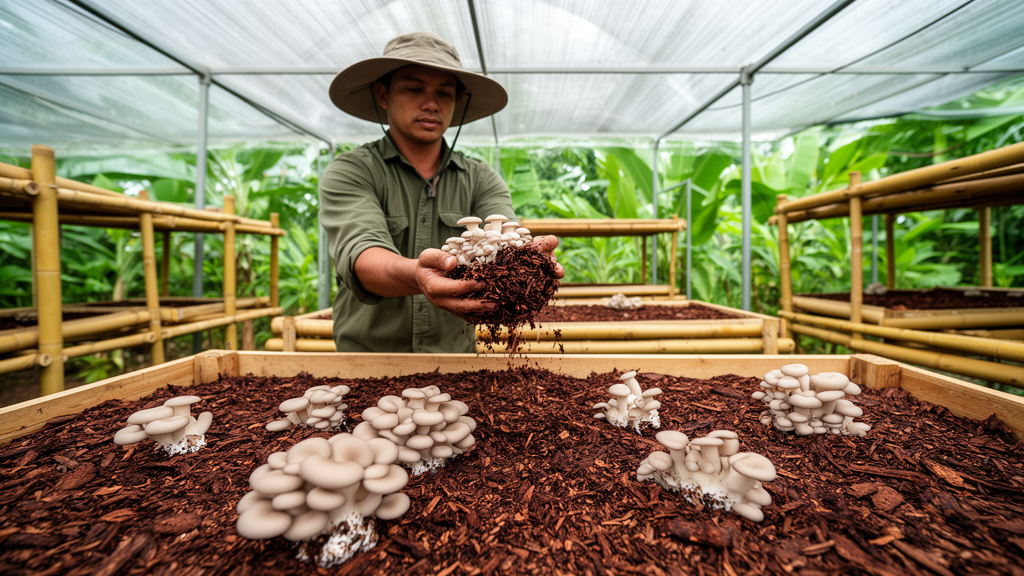
Button mushrooms are notoriously difficult to grow in the tropics, and a new study points to a surprisingly simple reason why the odds may be improvable: the substrate. Published in AMB Express on 16 September 2026, the open-access research compared two closely related Agaricus species on blends of cocoa pod husk and rice bran, and found that a straightforward three-to-one mixture of the two agricultural wastes could deliver most of the yield of commercial compost without any composting step at all.
The study, led by Kingsley I. Eñeogwe, set out to address two persistent constraints on button mushroom production in warm climates: high ambient temperatures, which the standard cultivated species Agaricus bisporus tolerates poorly, and the cost of producing compost. The researchers pitted A. bisporus against its thermotolerant congener A. bitorquis across seven substrates, ranging from unsupplemented cocoa pod husk through progressively rice-bran-enriched blends, an optimized agro-waste mix, and a straw–cow dung compost, up to a commercial compost benchmark, with three replicates per species–substrate combination.
The headline result concerns the 3:1 cocoa pod husk to rice bran blend. On this substrate, which required no composting step, the mushrooms recovered about three-quarters of the biological efficiency achieved on commercial compost, while contamination was roughly 70 percent lower. The authors estimate the blend would cost around 40 to 60 percent of the price of commercial substrate, a margin that could matter considerably for small-scale producers in cocoa-growing regions where pod husks are an abundant by-product.
Supplementing cocoa pod husk with rice bran at that same ratio nearly doubled biological efficiency relative to unsupplemented husk alone, and cut contamination by roughly 70 percent in both strains. The optimized agro-waste mix performed better still, and commercial compost remained the ceiling that none of the simpler substrates reached. Across the full substrate gradient, the advantage of richer blends did not track richness evenly, varying unevenly rather than rising in step with supplementation.
Colonization speed emerged as a consistent theme. The A. bitorquis strain colonized every substrate faster than the A. bisporus strain, and it out-yielded its congener throughout the experiment. Across the substrate gradient, faster colonization and lower contamination were strongly associated with higher yield and biological efficiency, leading the authors to point to colonization speed and sanitation as practical levers for production.
The authors are careful to flag an important limitation: the comparison was made at the strain level, not the species level, so the observed superiority of the A. bitorquis strain over the A. bisporus strain cannot be generalized to the species as a whole. Different strains of either species might perform differently, and the findings apply to the specific strains tested under the tropical conditions of the study.
Nutritional analysis added a further dimension to the practical case for the blend. Mushrooms grown on the 3:1 mixture showed crude protein of 30 to 34 percent of dry weight, along with elevated potassium and magnesium, and the A. bitorquis strain exceeded A. bisporus in protein content. For growers weighing substrate cost against crop quality, the combination of a cheap, locally available feedstock and a nutritionally favorable product is a notable pairing.
The broader significance lies in what the result removes from the production process. The authors describe cocoa pod husk–rice bran blends, particularly at the 3:1 ratio, as viable, input-light and reproducible substrates for Agaricus cultivation in these areas, with the tested A. bitorquis strain the more robust of the two for non-composted, warm-climate production.
As with any controlled cultivation trial, the results come from a specific experimental setup with three replicates per species–substrate combination, and translating them to farm conditions will depend on local substrate availability, strain selection and grower practice. Still, for a crop whose tropical expansion has been held back by heat and compost costs, the study offers a concrete, testable recipe: cocoa pod husks, rice bran, a thermotolerant strain, and no compost pile in sight.
Subject of Research: Comparative cultivation of Agaricus bisporus and A. bitorquis on cocoa pod husk–rice bran substrate blends under tropical conditions
Article Title: Comparative cultivation of Agaricus bisporus and A. bitorquis on cocoa pod husk–rice bran blends
Article References: Eñeogwe, K. I. (2026). Comparative cultivation of Agaricus bisporus and A. bitorquis on cocoa pod husk–rice bran blends. AMB Express. https://doi.org/10.1186/s13568-026-02117-2
Image Credits: AI Generated
DOI: 10.1186/s13568-026-02117-2
Keywords: Agaricus bisporus, Agaricus bitorquis, cocoa pod husk, rice bran, mushroom cultivation, biological efficiency, compost, tropical agriculture, substrate, thermotolerant fungi, agricultural waste, food nutrition
News Source: Alan Morgan. (October 29, 2026). Tropical mushroom growers may skip composting with a simple cocoa husk and rice bran mix. Scienmag.



