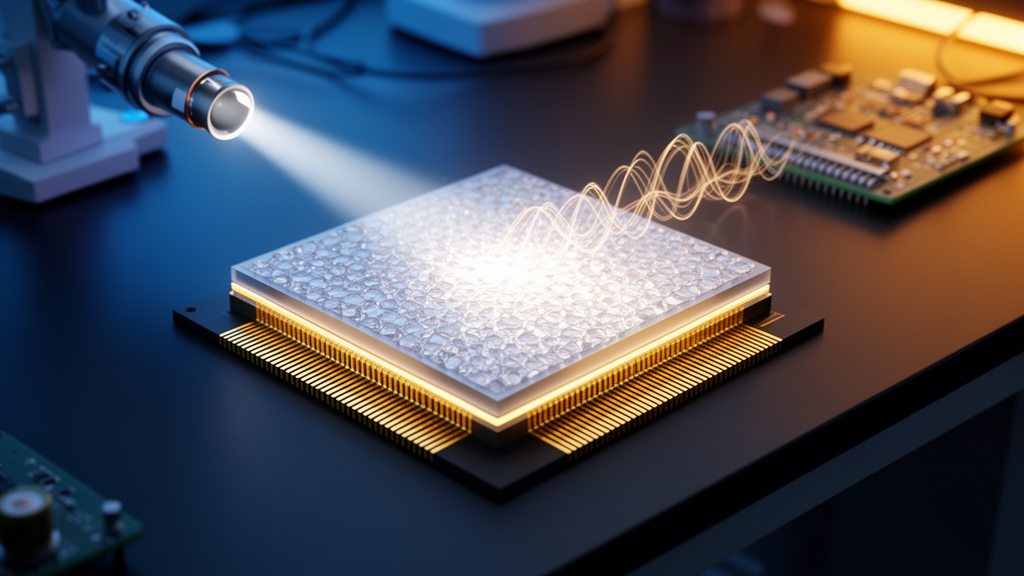
A simulation study published in the Springer Nature journal Discover Sensors reports that a lead-free caesium tellurium iodide perovskite, Cs₂TeI₆, could form the light-sensing core of a photodetector that operates without any external bias voltage, making it a candidate receiver for visible light communication, the technology that turns LED lighting into a wireless data channel. The work, led by Manasvi Raj, Shrestha Dhankar, Aditya Dubey and Neeraj Goel, combines two computational stages: a first-principles materials screen using density functional theory, and a device-level simulation with the one-dimensional solar cell simulator SCAPS-1D. Because every reported number comes from simulation rather than a fabricated prototype, the findings should be read as a design prediction, not a laboratory demonstration.
The motivation lies in a practical bottleneck of visible light communication. A VLC receiver must convert rapidly modulated light into electrical signals with high sensitivity, and conventional silicon photodiodes and avalanche photodiodes, while fast, bring drawbacks the authors list as relatively high fabrication cost, rigid architectures, limited spectral tunability and the need for external biasing or amplification. Silicon’s low bandgap also makes it sensitive across a broad spectrum, so ambient light interferes with the signal. Alternative materials each carry their own burdens: III–V semiconductors such as GaAs and InGaAs require expensive epitaxial growth, organic and quantum dot detectors suffer from low carrier mobility and instability, and lead-based halide perovskites raise toxicity and moisture-sensitivity concerns despite their excellent optical properties.
To narrow the field, the team evaluated eight caesium-based perovskite compounds with DFT calculations performed in the CASTEP module using the HSE-06 hybrid functional for improved accuracy. The candidates included Cs₂AgBiI₆, Cs₂SbCl₆, Cs₂TeBr₆, Cs₂TeCl₆, Cs₂TeI₆, Cs₂TiCl₆, Cs₂TiI₆ and CsSnBr₃. The screening focused on two optical quantities in the visible range: the absorption coefficient and the complex dielectric function, whose imaginary component governs optical transitions and photocarrier generation. Cs₂AgBiI₆ showed an absorption onset at higher photon energies with weaker visible absorption; Cs₂SbCl₆ concentrated its strong absorption in the ultraviolet; Cs₂TeBr₆ and Cs₂TeCl₆ shifted their dominant peaks toward higher energies with suppressed imaginary dielectric response at visible wavelengths.
The second group fared no better as VLC absorbers. Cs₂TiCl₆ absorbed mainly in the deep ultraviolet with a delayed onset, Cs₂TiI₆ showed low and non-uniform visible absorption, and CsSnBr₃ displayed absorption peaks at higher energies accompanied by a suppressed ε₂ component in the visible region, which the authors interpret as limited optical transition probability and increased recombination losses. Cs₂TeI₆ stood apart: it exhibited a strong, continuous absorption profile extending deep into the visible region, markedly higher in intensity than the other candidates, together with a pronounced imaginary dielectric component at low photon energies and a sufficiently high real part to support strong light–matter interaction. On these combined optical criteria it was selected as the most promising material of the eight.
The electronic structure calculations reinforce that choice. DFT places the indirect bandgap of Cs₂TeI₆ at 1.64 eV, a value the authors note agrees with previous reports and sits within the optimal range for visible-light harvesting. Although an indirect gap normally suppresses absorption, the paper attributes the strong visible response to a small energy difference between indirect and direct transitions, allowing efficient absorption near the band edge. Charge density analysis shows electron localization concentrated around iodine atoms with contributions from tellurium sites, and the partial density of states confirms that the valence band is dominated by iodine p orbitals while the conduction band draws largely on tellurium p and d states. This Te–I orbital hybridization near the band edges enhances the probability of interband transitions and photocarrier generation.
With the material chosen, the researchers modelled an FTO/Cs₂TeI₆/Au stack in SCAPS-1D under AM 1.5G illumination at 300 K, assuming a shunt resistance of 2500 Ω·cm². The band diagram shows that the work-function difference between the FTO front contact and the gold back contact bends the bands in the absorber and establishes a built-in electric field, which serves as the driving force for separating and collecting photogenerated carriers at zero external bias. The conduction-band offset at the FTO interface is small enough to let electrons through without a spike-like barrier, and the valence-band offset at the Cs₂TeI₆/Au interface favours hole extraction while suppressing interfacial accumulation, minimizing recombination losses in the simulated device.
The headline performance figures all peak at 400 nm, a wavelength the authors note aligns with the emission of common VLC light sources. At that wavelength the simulated external quantum efficiency approaches 90 percent, responsivity reaches a maximum of 490 mA/W, and specific detectivity peaks at 7.8 × 10¹⁰ Jones. The photoresponse is broadband, spanning 300 to 700 nm, with a long-wavelength cut-off near 757 nm consistent with the calculated bandgap. The detectivity was computed assuming shot-noise-limited conditions dominated by dark current; the authors explicitly state that noise spectral density was not simulated because SCAPS-1D does not provide direct noise analysis. A simulated EQE spike in the 300–400 nm ultraviolet region is attributed to strong near-surface absorption and the wavelength sensitivity of optical parameters in the model.
Temperature robustness and electrical behaviour add further simulated context. Sweeping the temperature from 300 to 350 K left responsivity at roughly 0.48 A/W and detectivity near 6.2 × 10¹⁰ Jones essentially unchanged, which the authors attribute to a stable band structure and a low density of thermally activated trap states; the EQE even increased slightly with temperature, consistent with thermally assisted carrier transport. The dark current density–voltage curve showed a nearly constant reverse current of about 0.12 mA/cm², indicating low leakage, while illumination produced a photocurrent of roughly 17–18 mA/cm² across a wide voltage range, with a sharp drop near 1.3–1.4 V marking the open-circuit voltage. The authors also sketch a VLC receiver architecture in which the DC part of the photocurrent could, in principle, be harvested for energy while the AC component carries the data through amplification, filtering and digitization stages.
The authors are careful about the limits of their approach. The study addresses steady-state optoelectronic metrics only: rise and fall times, pulse response and −3 dB bandwidth cannot be extracted from SCAPS-1D and will require transient simulations or experiments. Dedicated investigations of noise characteristics, response speed, bandwidth and actual communication performance are still needed to validate VLC receiver operation, and experimental fabrication will have to overcome challenges in depositing high-quality Cs₂TeI₆ films with low defect density, optimizing both interfaces, and protecting the material against moisture, oxygen and thermal stress over the long term. Within those boundaries, the integrated DFT–SCAPS framework offers a rational, application-driven route to lead-free, self-powered perovskite photodetectors, and the proposed device remains a promising computational candidate awaiting experimental confirmation.
Subject of Research: Simulation-driven design of a self-powered, lead-free Cs₂TeI₆ perovskite photodetector for visible light communication receivers
Article Title: Numerical simulation and performance analysis of self-powered Cs₂TeI₆ photodetector for visible light communication receivers
Article References: Raj, M., Dhankar, S., Dubey, A., & Goel, N. (2026). Numerical simulation and performance analysis of self-powered Cs₂TeI₆ photodetector for visible light communication receivers. Discover Sensors, 2(1), Article 43. https://doi.org/10.1007/s44397-026-00077-7
Image Credits: AI Generated
DOI: 10.1007/s44397-026-00077-7
Keywords: Cs₂TeI₆, perovskite photodetector, visible light communication, self-powered photodetector, density functional theory, SCAPS-1D, lead-free perovskite, external quantum efficiency, responsivity, detectivity, built-in electric field, optical absorption
News Source: Denise Maddox. (October 29, 2026). Lead-Free Perovskite Photodetector Simulated for Self-Powered Visible Light Communication Receivers. Scienmag.