• HOME
  • NEWS
  • EXPLORE
    • CAREER
      • Companies
      • Jobs
    • EVENTS
    • iGEM
      • News
      • Team
    • PHOTOS
    • VIDEO
    • WIKI
  • BLOG
  • COMMUNITY
    • FACEBOOK
    • INSTAGRAM
    • TWITTER
Tuesday, May 12, 2026
BIOENGINEER.ORG
No Result
View All Result
  • Login
  • HOME
  • NEWS
  • EXPLORE
    • CAREER
      • Companies
      • Jobs
        • Lecturer
        • PhD Studentship
        • Postdoc
        • Research Assistant
    • EVENTS
    • iGEM
      • News
      • Team
    • PHOTOS
    • VIDEO
    • WIKI
  • BLOG
  • COMMUNITY
    • FACEBOOK
    • INSTAGRAM
    • TWITTER
  • HOME
  • NEWS
  • EXPLORE
    • CAREER
      • Companies
      • Jobs
        • Lecturer
        • PhD Studentship
        • Postdoc
        • Research Assistant
    • EVENTS
    • iGEM
      • News
      • Team
    • PHOTOS
    • VIDEO
    • WIKI
  • BLOG
  • COMMUNITY
    • FACEBOOK
    • INSTAGRAM
    • TWITTER
No Result
View All Result
Bioengineer.org
No Result
View All Result
Home NEWS Science News Chemistry

Finding missing network links could help develop new drugs, stop disease, ease traffic

Bioengineer by Bioengineer
June 25, 2019
in Chemistry
Reading Time: 3 mins read
0
IMAGE
Share on FacebookShare on TwitterShare on LinkedinShare on RedditShare on Telegram

Sex, drugs and traffic: Search for missing links in networks could help uncover new cancer treatments, build more efficient traffic networks and stop the spread of sexually transmitted diseases
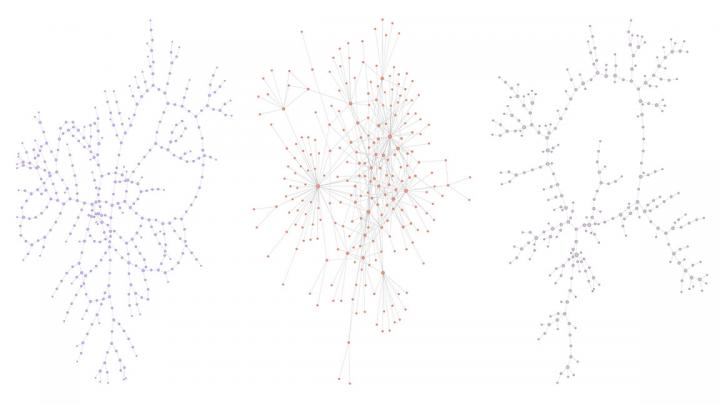
IMAGE

Credit: Keke Shang

WASHINGTON, D.C., June 25, 2019 — A new mathematical model of the structure of networks could help find new cancer drugs, speed up traffic flow and combat sexually transmitted disease.

Although the three challenges seem diverse, they all could benefit from a theory that helps to uncover unknown information about a network by analyzing its structure. The study was published in the journal Chaos, from AIP Publishing.

An example of how filling in missing links could be useful is in choosing a genetic target for a cancer drug, said team member Michael Small, from the University of Western Australia.

“Say you have a network of genes that are somehow connected, and there are some known drug targets. But if you don’t know all the genes, you would like to make guesses at information that you don’t have to work out what might be other likely targets to investigate,” Small said.

Successful link prediction algorithms already exist for certain types of networks, but the researchers analyzed differently structured networks to come up with their alternative algorithm.

An example of traditional link prediction might be a social network suggesting friends with which to connect. Two people who share a friend are likely to themselves be friends with a direct connection. Adding this third connection creates a triangle, which is a structure where existing algorithms focus.

In contrast, the authors focused on treelike networks, which have many branches but very few cross links between branches. They studied three example datasets: the social network Twitter, a water distribution network and a sexual contact network.

They found these three treelike networks could be characterized by a number of parameters, such as the average distance between branch points in the network, the size of loops and a comparison of the number of links that adjacent nodes have — a measure of the network’s regularity describing heterogeneity.

The authors then developed an algorithm that suggested links that would preserve these characteristics of the network.

They tested this approach by taking a known network and removing links from it and seeing if the algorithm could predict where the missing links should be.

The team found the algorithm performed better (around 44% for the Twitter network, around 15% for the sexual contact network and around 4% for the water distribution network) for treelike networks than most of conventional algorithms which rely on other parameters, such as assuming highly connected individuals will attract more connections (known as preferential attachment) or building lots of triangular connections (known as clustering).

Author Keke Shang attributes the team’s success to thinking about examples of real-world networks.

“I hope we can make network technology serve our lives better,” he said.

###

The article, “Link prediction for tree-like networks,” is authored by Keke Shang, Tong-chen Li, Michael Small, David Burton and Yan Wang. The article will appear in the journal Chaos on June 25, 2019 (DOI: 10.1063/1.5107440). After that date, it can be accessed at http://aip.scitation.org/doi/full/10.1063/1.5107440.

ABOUT THE JOURNAL

Chaos is devoted to increasing the understanding of nonlinear phenomena in all disciplines and describing their manifestations in a manner comprehensible to researchers from a broad spectrum of disciplines.

Media Contact
Larry Frum
[email protected]

Related Journal Article

http://dx.doi.org/10.1063/1.5107440

Tags: Algorithms/ModelsAnthropologyChemistry/Physics/Materials SciencesMathematics/StatisticsMedicine/HealthSocial/Behavioral ScienceSystems/Chaos/Pattern Formation/Complexity
Share12Tweet8Share2ShareShareShare2

Related Posts

Humans and Zebra Finches Share Similar Speech Learning Techniques #ASA190 — Chemistry

Humans and Zebra Finches Share Similar Speech Learning Techniques #ASA190

May 11, 2026
Unveiling Dark Matter Through Molecular Insights — Chemistry

Unveiling Dark Matter Through Molecular Insights

May 11, 2026

From Touch to Sight: A Bioinspired Multisensory Framework Endows Robots with Human-Like Perception

May 11, 2026

Announcing the 2026 Carbon Future Young Investigator Award Winners

May 11, 2026
Please login to join discussion

POPULAR NEWS

  • Research Indicates Potential Connection Between Prenatal Medication Exposure and Elevated Autism Risk

    841 shares
    Share 336 Tweet 210
  • New Study Reveals Plants Can Detect the Sound of Rain

    728 shares
    Share 290 Tweet 182
  • Salmonella Haem Blocks Macrophages, Boosts Infection

    62 shares
    Share 25 Tweet 16
  • Breastmilk Balances E. coli and Beneficial Bacteria in Infant Gut Microbiomes

    57 shares
    Share 23 Tweet 14

About

We bring you the latest biotechnology news from best research centers and universities around the world. Check our website.

Follow us

Recent News

Humans and Zebra Finches Share Similar Speech Learning Techniques #ASA190

New Study Uncovers How Fungal Parasites Attack Strawberries and Raspberries

City of Hope Researchers to Present Groundbreaking Immunotherapy and Precision Medicine Advances Across Multiple Cancer Types at ASCO 2026

Subscribe to Blog via Email

Enter your email address to subscribe to this blog and receive notifications of new posts by email.

Join 82 other subscribers
  • Contact Us

Bioengineer.org © Copyright 2023 All Rights Reserved.

Welcome Back!

Login to your account below

Forgotten Password?

Retrieve your password

Please enter your username or email address to reset your password.

Log In
No Result
View All Result
  • Homepages
    • Home Page 1
    • Home Page 2
  • News
  • National
  • Business
  • Health
  • Lifestyle
  • Science

Bioengineer.org © Copyright 2023 All Rights Reserved.