• HOME
  • NEWS
  • EXPLORE
    • CAREER
      • Companies
      • Jobs
    • EVENTS
    • iGEM
      • News
      • Team
    • PHOTOS
    • VIDEO
    • WIKI
  • BLOG
  • COMMUNITY
    • FACEBOOK
    • INSTAGRAM
    • TWITTER
Sunday, May 10, 2026
BIOENGINEER.ORG
No Result
View All Result
  • Login
  • HOME
  • NEWS
  • EXPLORE
    • CAREER
      • Companies
      • Jobs
        • Lecturer
        • PhD Studentship
        • Postdoc
        • Research Assistant
    • EVENTS
    • iGEM
      • News
      • Team
    • PHOTOS
    • VIDEO
    • WIKI
  • BLOG
  • COMMUNITY
    • FACEBOOK
    • INSTAGRAM
    • TWITTER
  • HOME
  • NEWS
  • EXPLORE
    • CAREER
      • Companies
      • Jobs
        • Lecturer
        • PhD Studentship
        • Postdoc
        • Research Assistant
    • EVENTS
    • iGEM
      • News
      • Team
    • PHOTOS
    • VIDEO
    • WIKI
  • BLOG
  • COMMUNITY
    • FACEBOOK
    • INSTAGRAM
    • TWITTER
No Result
View All Result
Bioengineer.org
No Result
View All Result
Home NEWS Science News Chemistry

Final images from Cassini spacecraft

Bioengineer by Bioengineer
January 14, 2020
in Chemistry
Reading Time: 2 mins read
0
IMAGE
Share on FacebookShare on TwitterShare on LinkedinShare on RedditShare on Telegram

IMAGE

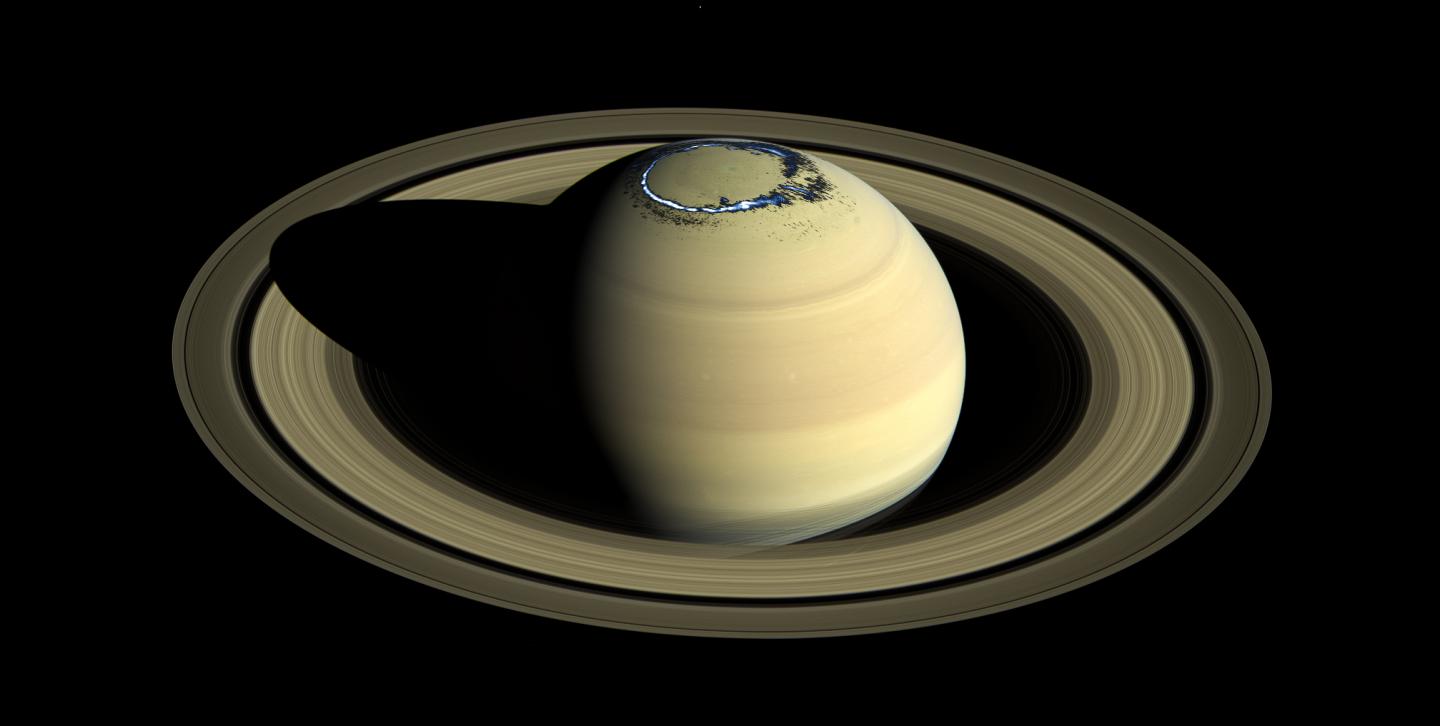
Credit: NASA/JPL-Caltech/Space Science Institute/A. Bader (Lancaster University).


Researchers are busy analysing some of the final data sent back from the Cassini spacecraft which has been in orbit around Saturn for more than 13 years until the end of its mission in September 2017.

For the last leg of its journey, Cassini was put on a particularly daring orbit passing between Saturn and its rings which brought it closer to Saturn than ever before. This allowed scientists to obtain images of Saturn’s ultraviolet auroras in unprecedented resolution.

The new observations are detailed in two new studies published in Geophysical Research Letters and JGR: Space Physics.

Saturn’s auroras are generated by the interaction of the solar wind, a stream of energetic particles emitted by the Sun, with Saturn’s rapidly rotating magnetic field. They are located in the planet’s polar regions and known to be highly dynamic, often pulsating and flashing as different dynamic processes occur in the planet’s plasma environment.

Lancaster University PhD student and lead author of the research Alexander Bader said: “Surprisingly many questions revolving around Saturn’s auroras remain unanswered, even after the outstanding success of the Cassini mission.

“This last set of close-up images gives us unique highly detailed views of the small-scale structures which couldn’t be discerned in previous observations by Cassini or the Hubble Space Telescope. We have some ideas about what their origin could be, but there is still a lot of analysis to be done.”

Satellite imagery alone will hardly be enough to unravel the aurora’s mysteries – the energetic particles causing the bright lightshows around Saturn’s poles originate far away from the planet’s surface where magnetic field lines twist and clouds of plasma interact with one another. When located in the right region, Cassini was sometimes embedded in the particle stream connecting the auroras to the magnetosphere.

First analysis of the spacecraft’s particle measurements recorded during these times showed that Saturn’s auroras, like Jupiter’s, are generated by much more energetic particles than Earth’s. However, the underlying physical mechanisms appear to show similarities between all the three.

Even though Cassini’s mission is over, the data it provided remains full of surprises and will continue to help researchers understand the workings of giant planet auroras, especially in combination with Juno observations of Jupiter’s magnetosphere.

###

Media Contact
Gillian Whitworth
[email protected]
01-524-592-612

Related Journal Article

http://dx.doi.org/10.1029/2019GL085800

Tags: AstronomyAstrophysicsExperiments in SpaceMeteorologyPlanets/MoonsSatellite Missions/ShuttlesSpace/Planetary Science
Share12Tweet8Share2ShareShareShare2

Related Posts

Miniature Sensor Uses Light to Detect Touch — Chemistry

Miniature Sensor Uses Light to Detect Touch

May 8, 2026
Iron Minerals Determine Whether Dissolved Organic Matter Fuels Microbes or Becomes Long-Term Carbon Storage — Chemistry

Iron Minerals Determine Whether Dissolved Organic Matter Fuels Microbes or Becomes Long-Term Carbon Storage

May 8, 2026

Kate Evans Appointed Associate Lab Director for Biological and Environmental Systems Science at ORNL

May 8, 2026

Advancing Multiscale Modeling and Overcoming Operational Challenges in Autothermal COâ‚‚-to-Methanol Reactors

May 8, 2026
Please login to join discussion

POPULAR NEWS

  • Research Indicates Potential Connection Between Prenatal Medication Exposure and Elevated Autism Risk

    840 shares
    Share 336 Tweet 210
  • New Study Reveals Plants Can Detect the Sound of Rain

    727 shares
    Share 290 Tweet 181
  • Scientists Investigate Possible Connection Between COVID-19 and Increased Lung Cancer Risk

    68 shares
    Share 27 Tweet 17
  • Salmonella Haem Blocks Macrophages, Boosts Infection

    61 shares
    Share 24 Tweet 15

About

We bring you the latest biotechnology news from best research centers and universities around the world. Check our website.

Follow us

Recent News

Evaluating Digoxin Use in Patients with Symptomatic Rheumatic Heart Disease

Evaluating the Effectiveness and Safety of Digitalis Glycosides in Treating Heart Failure

Urdu Fall Risk Questionnaire Adapted for Elderly

Subscribe to Blog via Email

Success! An email was just sent to confirm your subscription. Please find the email now and click 'Confirm' to start subscribing.

Join 82 other subscribers
  • Contact Us

Bioengineer.org © Copyright 2023 All Rights Reserved.

Welcome Back!

Login to your account below

Forgotten Password?

Retrieve your password

Please enter your username or email address to reset your password.

Log In
No Result
View All Result
  • Homepages
    • Home Page 1
    • Home Page 2
  • News
  • National
  • Business
  • Health
  • Lifestyle
  • Science

Bioengineer.org © Copyright 2023 All Rights Reserved.