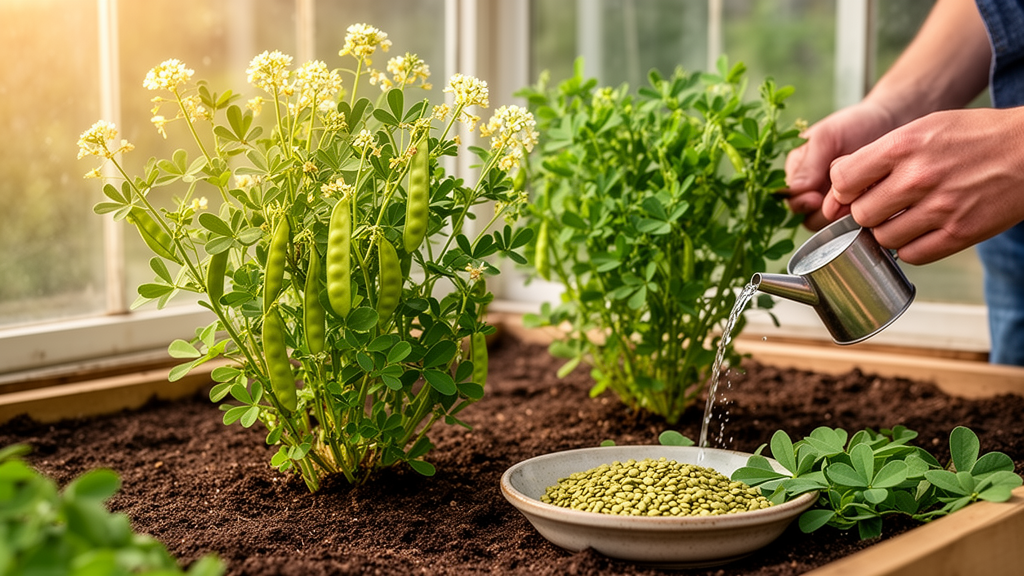
A two-year field study found that withholding water from fenugreek sharply reduced seed production but increased several measures of seed biochemical quality. Across five irrigation treatments, average seed yield was highest when the crop received its full irrigation allocation and lowest under rainfed conditions. The results illustrate a clear trade-off: fenugreek grown under severe water stress yielded substantially less, yet its seeds contained more phenolics, flavonoids and hydrolysable tannins, with stronger antioxidant activity. The authors say irrigation decisions therefore depend on whether the objective is maximum yield or enhanced phytochemical quality.
The experiment, conducted in 2021 and 2022 under drip irrigation, used a randomized complete-block design with three replications. Five treatments were compared: FI100, in which depleted soil water was replenished to field capacity; FI75, FI50 and FI25, which received 75%, 50% and 25% of the FI100 irrigation allocation; and FI0, a rainfed control. Fenugreek was sown in late March and harvested in late July. The researchers measured crop water consumption, irrigation, crop water productivity, yield response, agronomic characteristics, seed oil and fatty-acid composition, phenolic compounds, antioxidant activity and treatment-specific and seasonal yield-response factors, or Ky.
Yield showed strong sensitivity to reduced water supply. Averaged over the two years, seed yield reached 1,474 kg ha⁻¹ under FI100 but fell to 533 kg ha⁻¹ under FI0, a reduction of about 64%. Seasonal Ky values were 1.12 and 1.18, indicating that yields declined as water stress became more severe. The treatment-specific analysis revealed a non-linear pattern: Ky rose from approximately 0.97 under rainfed conditions to approximately 2.8 at FI75, suggesting that the crop was most sensitive to water shortage near full irrigation. This pattern also means that a treatment described as only moderately reduced irrigation could carry a particularly large yield penalty relative to its water saving.
The biochemical results moved in the opposite direction to yield. Water deficit improved seed quality as assessed by the measured compound groups, while total phenolics, flavonoids, hydrolysable tannins and antioxidant activity peaked under FI0. Oil composition also changed: saturated fatty acids increased and polyunsaturated fatty acids decreased under water stress. Principal component analysis explained 89.1% of the observed variation and identified a negative relationship between yield and oil-quality traits on one side and phenolic-based antioxidant traits on the other. In other words, the seeds produced under the driest conditions were not simply poorer overall; they presented a different chemical profile in which antioxidant-related compounds were more abundant while productivity was much lower.
The study identifies FI75 as a potential middle ground when irrigation water is the principal limiting resource. This treatment used 25% less irrigation water than full irrigation but reduced yield by about 41%, according to the reported two-year comparison. The findings do not establish that reduced irrigation is the best option in every environment or production system, because the experiment covered one crop, two growing seasons and specific field conditions. They do, however, provide measured evidence that irrigation can be managed to favor different targets. Near-full irrigation supported the greatest seed output, whereas controlled deficit irrigation enhanced the antioxidant-related seed traits, with intermediate irrigation offering a compromise between water conservation and yield.
Subject of Research: Effects of irrigation deficit on fenugreek yield, seed oil composition and antioxidant capacity
Article Title: Evaluation of fenugreek under water stress: agronomic traits, seed oil quality and antioxidant capacity
Article References: Varol, I. S. (2026). Evaluation of fenugreek under water stress: agronomic traits, seed oil quality and antioxidant capacity. BMC Plant Biology, 26(1), Article 1630. https://doi.org/10.1186/s12870-026-09939-z
Image Credits: AI Generated
DOI: 10.1186/s12870-026-09939-z
Keywords: fenugreek, deficit irrigation, water stress, seed yield, water-use efficiency, seed quality, phenolic compounds, antioxidant activity, fatty acids, drip irrigation, Evaluation, under
News Source: Alan Morgan. (October 20, 2026). Fenugreek trades water savings for lower yield and richer seed antioxidants. Scienmag.