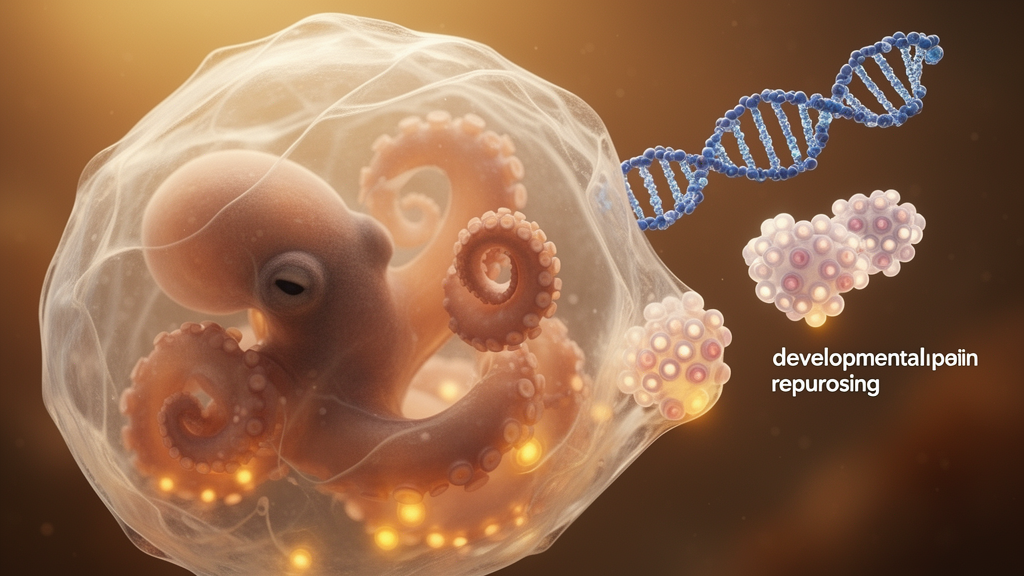
Developing suckers on the arms of cuttlefish and octopus activate the gene Ets1 in a pattern distinct from the appendage-patterning activity observed along the arms themselves, according to a comparative developmental study led by researchers at the University of Tokyo. The results suggest that cephalopod suckers may have evolved through the reuse of genes already involved in early molluscan development. The researchers compared gene activity during embryonic development in cuttlefish, octopus and snail body parts, identifying Ets1 expression in the regions where suckers form. Because the study primarily mapped gene activity, it does not establish that Ets1 directly causes sucker formation or that the gene alone is sufficient to produce the structure.
Arms and suckers appeared to share fewer developmental signals than the researchers initially expected. Several genes associated with appendage patterning were active along developing cephalopod arms, consistent with the observation that arm development involves conserved patterning genes also used in appendage development in insects and mammals. No comparable pattern was detected in developing suckers. Sucker tissue instead expressed Ets1, a gene normally involved in early developmental processes in mollusks. The pattern points to a possible evolutionary route in which an existing molecular program was redirected to build a specialized anatomical structure. Postdoctoral fellow Ryosuke Kimbara said the researchers changed direction after encountering difficulty identifying genes expressed in suckers and expanded their screening to a more comprehensive approach. The distinctive Ets1 signal emerged from that broader search rather than from the original expectation that appendage-patterning genes would explain both arms and suckers.
As suckers developed, researchers also observed changes in cell shape and cell movement, alongside cell proliferation involved in forming the adhesive structures. These cellular activities resembled the epithelial–mesenchymal transition observed during early embryonic development. The resemblance supports the hypothesis that mechanisms used early in molluscan embryogenesis may have been recruited later in sucker production, but the study did not directly demonstrate that epithelial–mesenchymal transition occurs in forming suckers. The precise role of Ets1 and the extent to which the transition-like process contributes to sucker formation therefore remain experimentally unresolved. Tests that switch individual genes on or off will be needed to determine whether Ets1 drives any of the observed cellular changes.
The researchers also report that early developmental patterns and gene expression in suckers are broadly similar among cephalopods such as squid, cuttlefish and octopus, despite differences in the morphology and adhesive mechanisms of their developed suckers. This difference leaves open the possibility that the underlying molecular mechanisms may have evolved independently as each lineage acquired its specialized structures. More broadly, the findings illustrate how evolution can produce a new structure without requiring an entirely new set of genes: a gene already serving another role in the developing organism can be repurposed for a novel function. The researchers suggest that similar mechanisms may eventually help explain other unusual cephalopod structures, including chromatophores, the ink sac and the hard beak, although those ideas remain untested. Comparisons across more mollusk species and functional gene experiments will be needed to reconstruct how cephalopod suckers arose from the simpler body plan of their molluscan ancestors.
Subject of Research: Developmental gene reuse in the evolution of cephalopod arm suckers
Article Title: Why are cephalopods such suckers?
Article References: Why are cephalopods such suckers?. Original publication (Bibliographic details unavailable.)
Image Credits: AI Generated
DOI: Not provided
Keywords: cephalopod evolution, octopus, cuttlefish, sucker development, Ets1, gene co-option, embryonic development, mollusks, cephalopods, such, suckers, scientific research
News Source: Juliet Wilcox. (October 20, 2026). Cephalopod suckers may evolve through repurposed development genes. Scienmag.