Vascular cognitive impairment and dementia, a group of distinct syndromes caused by cerebrovascular injury and mixed vascular-neurodegenerative pathology, is the focus of a new structured narrative review examining extracellular vesicles, the tiny membrane-bound particles that cells release into blood and other fluids. The review, published in Frontiers in Neurology, organizes a rapidly growing but fragmented literature in which these vesicles are being investigated both as biomarkers for patient stratification and as candidate therapeutic products. The authors performed an expanded PubMed search through 8 October 2026, deliberately incorporating exosome, microvesicle and microparticle terminology to capture studies that older, narrower searches would have missed.
The scale of the evidence base is modest but growing. The revision search retrieved 140 records, and the review’s representative evidence tables summarize 13 preclinical therapeutic studies and 10 human biomarker studies. That distribution captures the field’s central imbalance: therapeutic evidence remains predominantly preclinical, generated largely in laboratory and animal models, while the human work consists of exploratory cohorts and studies with separate validation datasets or longitudinal follow-up. Prospective clinical utility, the review concludes, remains unestablished for both applications.
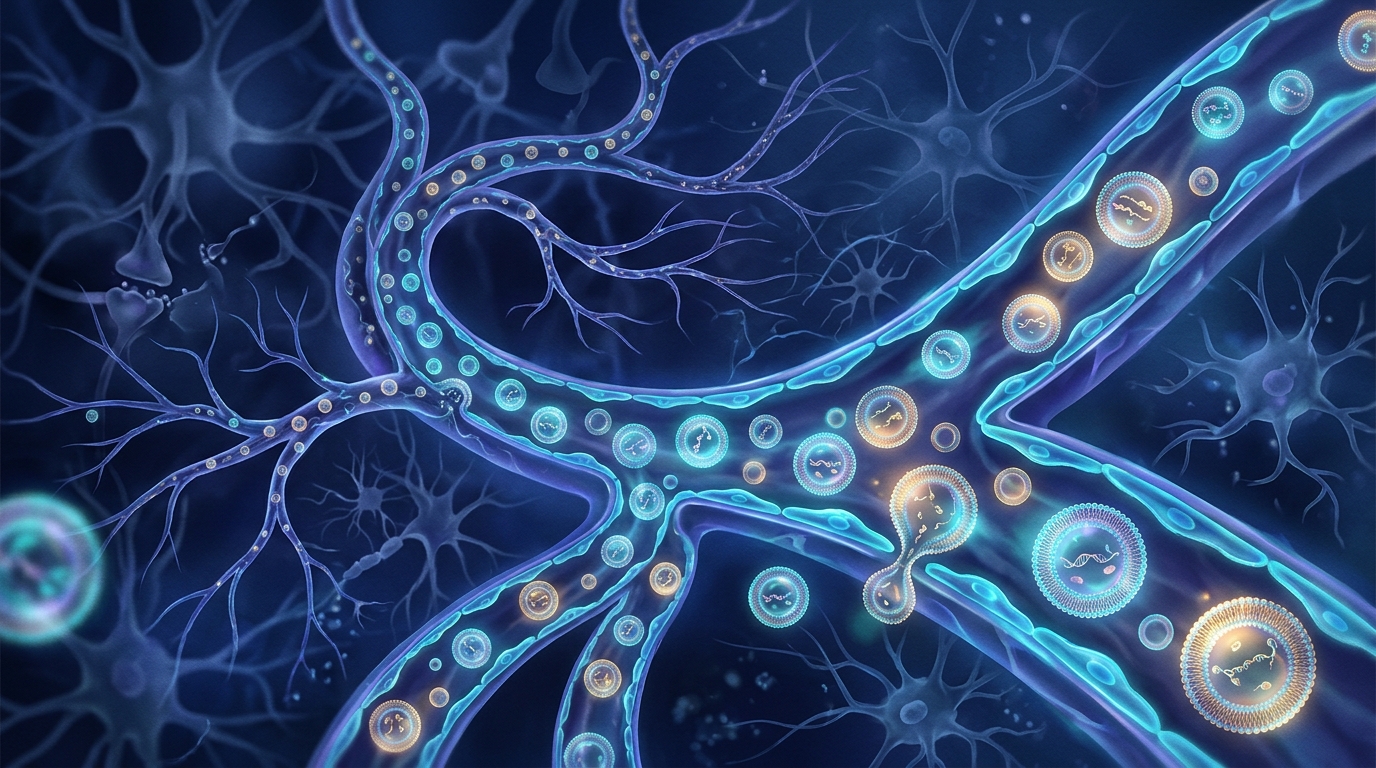
Extracellular vesicles have attracted attention in this field because they carry molecular cargo from the cells that release them, including proteins and nucleic acids that may reflect processes occurring in the brain. In vascular cognitive impairment and dementia, the relevant biology centers on the neurovascular unit, the integrated assembly of brain endothelial cells, pericytes, astrocytes and neurons whose dysfunction links cerebrovascular injury to cognitive decline. The review organizes the evidence by EV preparation, neurovascular unit mechanism, clinical phenotype and development pathway, a structure designed to make explicit which vesicle type, which mechanism and which patient group each study actually addressed.
That organizational scheme matters because cross-study comparison is currently one of the field’s weakest points. The authors identify differences in EV separation, characterization, purity and cellular attribution as factors that limit how findings from one laboratory can be aligned with those of another. Preparations enriched for small EVs, for example, are not standardized across studies, and attributing vesicles to particular cell types of origin remains technically difficult. Without consistent technical controls, a biomarker signal reported in one cohort may not be reproducible in another, and a therapeutic effect observed in one animal model may not translate to a different preparation or disease phenotype.
To address these gaps, the review proposes five evidence domains covering biological rationale, technical control, phenotype-relevant translation, clinical validation and prospective evaluation. The framework is explicitly an author-developed map that integrates existing EV, biomarker and VCID development principles rather than a consensus document. The authors state that it has not undergone consensus development, inter-rater reliability testing or prospective validation, and that it does not assign readiness scores or mandate sequential progression. Its intended use is narrower and more practical: to make evidence gaps explicit and to connect candidate assays or products to defined patient populations, outcomes and safety requirements.
The distinction between exploratory and validated human findings is central to how the review frames clinical translation. Human biomarker studies summarized in the evidence tables include both initial cohort discoveries and work with separate validation datasets or longitudinal follow-up, which represent stronger forms of evidence but still fall short of demonstrating that a test changes clinical decision-making. For therapeutic candidates, the 13 preclinical studies represent the current frontier, and none of the summarized evidence establishes efficacy in patients. The review’s framing therefore cautions against reading preclinical neurovascular mechanisms as demonstrated clinical benefits.
The clinical phenotype dimension of the map reflects the heterogeneity of vascular cognitive impairment and dementia itself. Because the syndrome comprises distinct entities arising from cerebrovascular injury and from mixed vascular-neurodegenerative pathology, a vesicle-based biomarker validated in one patient group may not apply to another. The review’s approach of linking each candidate assay to a defined phenotype and population is intended to prevent the kind of overgeneralization that has slowed biomarker development in related fields. Patient stratification, in this framework, means matching a candidate vesicle signature to the specific syndrome and stage it was actually tested against.
For readers following the field, the review’s most consequential message is methodological rather than promotional. The authors do not claim that extracellular vesicles are ready for the clinic, and they explicitly separate what has been shown from what remains untested. The five-domain map is offered as a planning tool for researchers and developers, identifying where biological rationale exists, where technical controls are missing, where phenotype-relevant translation has been attempted, and where clinical validation and prospective evaluation must occur before any assay or product could be considered for routine use.
The review, authored by Siqi Li of Qinghai University and Junli Liu of Qinghai University Affiliated Hospital in Xining, China, was received on 2 September 2026 and accepted on 19 October 2026. As a structured narrative review rather than a systematic review or meta-analysis, it summarizes representative studies from the retrieved records rather than exhaustively pooling all available data, and its conclusions about the state of the field are correspondingly framed as an evidence map rather than a definitive assessment. The work was published under a Creative Commons Attribution license, and the authors note that all claims expressed in the article are solely their own.
Subject of Research: Extracellular vesicles as biomarkers and therapeutic candidates in vascular cognitive impairment and dementia
Article Title: Extracellular vesicles in vascular cognitive impairment and dementia: a neurovascular evidence map for patient stratification and clinical translation
Article References: Li, S., & Liu, J. (2026). Extracellular vesicles in vascular cognitive impairment and dementia: a neurovascular evidence map for patient stratification and clinical translation. Frontiers in Neurology, 17, Article 1986081. https://doi.org/10.3389/fneur.2026.1986081
Image Credits: AI Generated
DOI: 10.3389/fneur.2026.1986081
Keywords: extracellular vesicles, vascular cognitive impairment, dementia, neurovascular unit, biomarkers, patient stratification, clinical translation, exosomes, preclinical studies, evidence map, Extracellular, vesicles
News Source: Cassandra Pierce. (November 4, 2026). Extracellular vesicles emerge as biomarkers and therapies for vascular dementia. Scienmag.