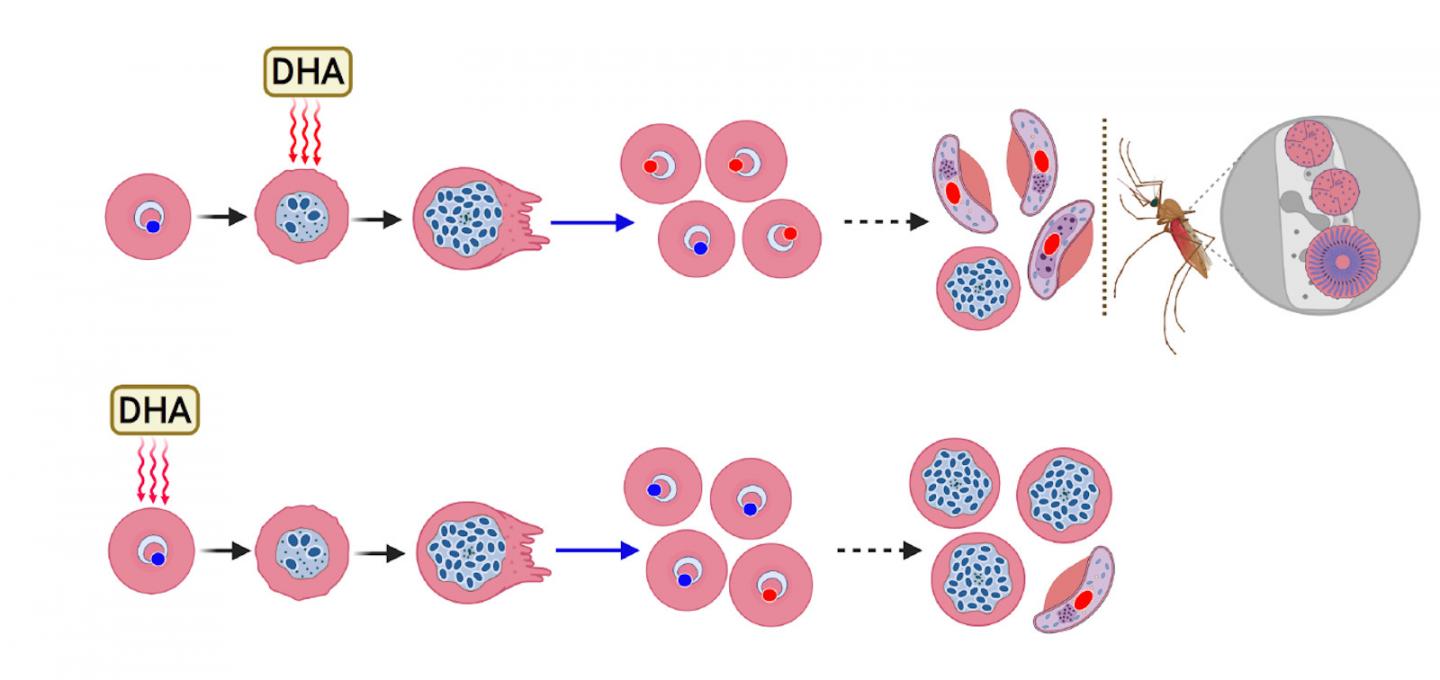
A new study shows that, depending on the parasite stage, suboptimal doses of artemisinin could increase its conversion to the sexual form, which is the only form that can be transmitted
Credit: ISGlobal
Barcelona, October 28, 2020-. Exposure to suboptimal doses of the antiparasitic drug artemisinin could increase the sexual conversion rate of the malaria parasite Plasmodium falciparum, thereby increasing the probability of transmission, according to a study led by the Barcelona Institute for Global Health (ISGlobal), an institution supported by “la Caixa” Foundation. The findings, published in eLife, may have public health implications, particularly in the context of mass antimalarial drug administration campaigns.
The malaria parasite P. falciparum replicates asexually in human blood every 48 hours, causing the typical clinical symptoms of the disease. At each replication cycle, a small number of parasites take a different pathway: that of sexual conversion to generate gametocytes. This sexual form of the parasite is the only one that can be transmitted to the mosquito. Sexual conversion is a highly regulated process, since the parasite needs to maintain a balance between asexual replication within the host and transmission between hosts. “From an evolutionary point of view, the parasite’s capacity to adjust its sexual conversion rate in response to the host’s conditions is clearly advantageous,” explains Alfred Cortés, ICREA researcher at ISGlobal and study coordinator. One factor that clearly decreases the parasite’s “comfort” within the host is exposure to parasite-killing drugs.
In order to determine whether artemisinin (the first-choice drug for treating malaria falciparum) or artemisinin-related drugs can affect the parasite’s sexual conversion rate, Cortés and his team used a transgenic parasite line that allows to quantify sexual conversion in a dish, under different experimental conditions. They found that parasite exposure to artemisinin can lead to a considerable increase in sexual conversion rates and gametocyte numbers. But this effect was only seen with suboptimal drug doses and depended on the stage of the parasite’s cycle (it was observed with trophozoites but not with the previous ring stage).
“Our results show there is a complex interaction between antimalarial drugs and sexual conversion, which depends on the parasite stage, its metabolic state and drug doses,” says Harvie Portugaliza, first author of the study.
“It is possible that patients in which most parasites are at the trophozoite stage at the time of treatment may have a peak in gametocyte production ten days later (the time required for their maturation), if the drug did not manage to kill all the parasites,” says Cortés. Exposure to suboptimal drug concentrations could result from using poor quality drugs or poor adherence to the treatment. Currently, the team led by Cortés is performing epidemiological studies to determine whether sexual conversion is indeed higher among patients treated with artemisinin.
Reference
Portugaliza HP, Miyazaki S, Geurten F, et al. Artemisinin exposure at the ring or trophozoite stage impacts Plasmodium falciparum sexual conversion differently. eLife. 2020. DOI: 10.7554/eLife.60058
About ISGlobal
The Barcelona Institute for Global Health, ISGlobal, is the fruit of an innovative alliance between the “la Caixa” Foundation and academic and government institutions to contribute to the efforts undertaken by the international community to address the challenges in global health. ISGlobal is a consolidated hub of excellence in research that has grown out of work first started in the world of health care by the Hospital Clínic and the Parc de Salut MAR and in the academic sphere by the University of Barcelona and Pompeu Fabra University. The pivotal mechanism of its work model is the transfer of knowledge generated by scientific research to practice, a task undertaken by the institute’s Education and Policy and Global Development departments. ISGlobal has been named a Severo Ochoa Centre of Excellence and is a member of the CERCA programme of the Generalitat de Catalunya.
Media Contact
Carolina Pozo
[email protected]
Original Source
https:/
Related Journal Article
http://dx.