A Nagoya University-led research team has identified a cellular pathway in which stressed motor neurons use an interferon-beta signal to increase immunoproteasome activity and break down aggregation-prone TDP-43 before it accumulates in the cytoplasm. The peer-reviewed experimental study, published in EMBO Reports on 5 October 2026, combined findings from cultured human neurons, including stem cell-derived motor neurons, mice, and postmortem spinal-cord tissue from people with ALS and people without the disease. The results reveal a potential research route for improving clearance of the protein, but the work did not test an ALS treatment in people.
TDP-43 normally resides in the nucleus, where it has several roles in maintaining neuronal health and function. In most cases of ALS, the protein leaves the nucleus and aggregates in the cytoplasm. The research group had previously shown that sudden stress can prevent TDP-43 from forming the pairs or small groups in which it normally operates, causing individual molecules to be re-exported from the nucleus as dysfunctional material. The team’s new experiments traced what happens when these unpaired TDP-43 molecules enter the cytoplasm. They physically interact with TBK1, a sensor protein known to activate autophagy and one whose gene mutations can cause inherited ALS.
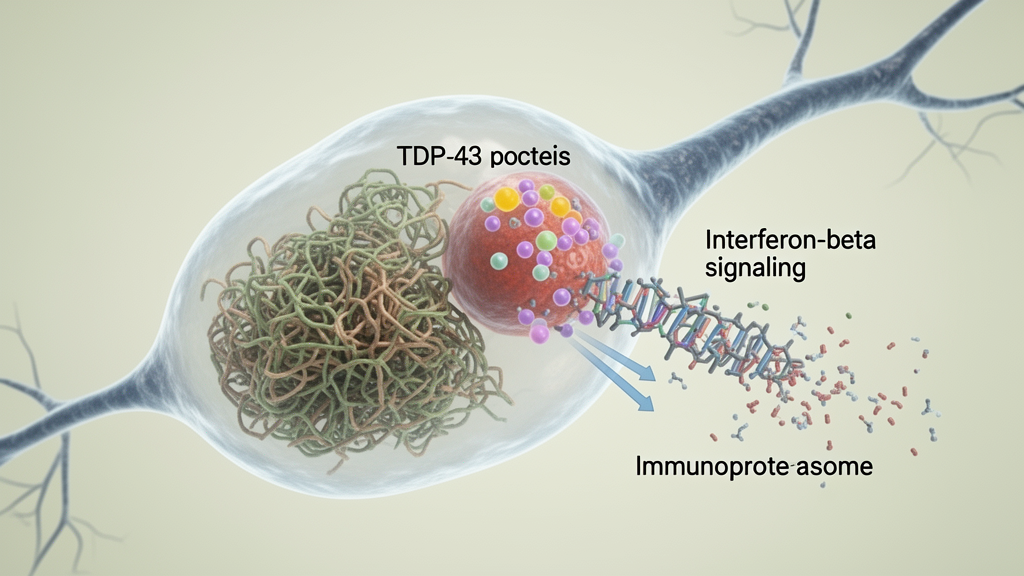
Autophagy is the process by which faulty proteins are collected in small vesicles and digested. When Sakai inhibited that process, the elimination of TDP-43 was not blocked in his experiments, leading the researchers to investigate a parallel mechanism. TBK1 also activates a signal mediated by interferon beta that can be perceived by the neuron producing it and by neighboring cells. Neurons that received the signal increased production of the immunoproteasome, a protein-degrading system that normally helps immune cells disassemble virus components and display peptide fragments on their surfaces. In the experimental models, increased immunoproteasome activity broke down TDP-43 before it aggregated. The finding shows that motor neurons can deploy this system in response to abnormal proteins, in addition to its better-established role in immune cells during viral infection.
Evidence for the pathway came from multiple experimental systems. Cultured neurons and human stem cell-derived motor neurons were used to examine the sequence connecting TDP-43 with TBK1, interferon beta and immunoproteasome activity, while mouse experiments provided additional support. The researchers also analyzed spinal-cord samples donated after death by people with ALS. The receptor for the interferon-beta signal was present in significantly lower quantities in motor neurons from the ALS samples than in samples from people without ALS. This tissue-level difference is an association: the study did not establish that reduced receptor abundance causes TDP-43 accumulation or ALS. Cultured-cell and mouse findings also cannot by themselves demonstrate clinical benefit in patients.
The researchers described the pathway as a possible therapeutic avenue, but they cautioned that directly administering interferon beta does not appear practical for ALS. Interon beta has been used in treatments for other conditions, but it triggers many biological responses, and its severe side effects cannot be ignored. Yamanaka said the group’s next objective is to identify other compounds that can activate the immunoproteasome in motor neurons. Sakai said the pathway’s true therapeutic potential remains to be established. The study therefore identifies a mechanism for further investigation rather than a proven intervention: the reported findings come from neuronal cultures, mice and postmortem human tissue, and no treatment efficacy or safety was evaluated in people with ALS.
Subject of Research: Mechanisms of TDP-43 clearance and immunoproteasome activation in ALS models
Article Title: A new path(way) for ALS research opens
Article References: A new path(way) for ALS research opens. Original publication (Bibliographic details unavailable.)
Image Credits: AI Generated
DOI: Not provided
Keywords: ALS, TDP-43, TBK1, interferon beta, immunoproteasome, motor neurons, protein aggregation, stem cell-derived neurons, mouse models, Nagoya University, path, research
News Source: Cassandra Pierce. (October 20, 2026). Experimental ALS study identifies interferon-beta immunoproteasome pathway for TDP-43 clearance. Scienmag.