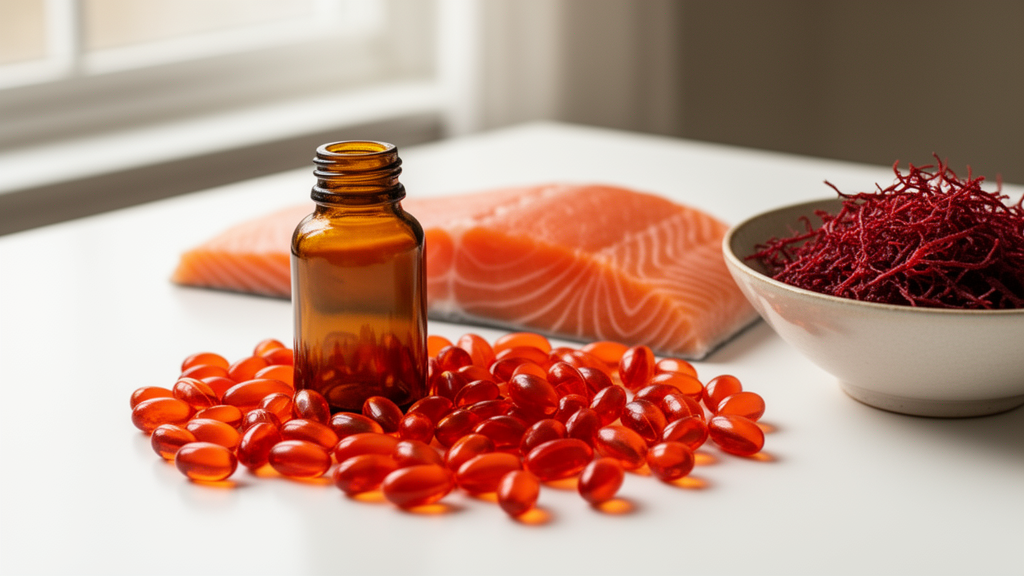
A four-week quasi-experimental study found a statistically significant reduction in serum myeloperoxidase levels among 21 adults with abdominal obesity who received 4 mg of astaxanthin daily. The 21-person untreated control group showed no statistically significant change in the same biomarker. The finding concerns a laboratory measure associated with inflammation and oxidative stress; the study did not establish clinical benefits or changes in health outcomes.
The research was conducted from August to October 2025 at the Clinical Pathology Laboratory of Hasanuddin University Hospital in Makassar, Indonesia. It used a pretest–posttest control-group design without placebo treatment. Eligible participants were adults without diabetes mellitus who had abdominal obesity, defined as a waist circumference of at least 80 cm for women and 90 cm for men. People with a current infection or acute inflammation and those using antioxidant supplements or vitamins were excluded.
Participants were assigned systematically according to their arrival sequence rather than through true randomization. Those arriving with odd sequence numbers received astaxanthin, while those arriving with even sequence numbers served as untreated controls. The intervention consisted of 4 mg of astaxanthin per day for four weeks. Participants in both groups were asked to maintain their usual diet and physical activity and avoid other supplements. Each group included 17 women and four men, and no adverse reactions were reported during the study period.
Blood samples were collected at baseline and again on day 28. Before baseline sampling, participants fasted for 8–10 hours overnight. Researchers measured blood pressure, body mass index and waist circumference, collected 5 mL of blood for fasting plasma glucose testing, and conducted a two-hour oral glucose tolerance test. Serum was separated and stored at −20 °C before myeloperoxidase concentrations were measured by enzyme-linked immunosorbent assay at the Hasanuddin University Medical Research Center.
Among participants receiving astaxanthin, the reported median serum myeloperoxidase concentration fell from 20.30 pg/mL before supplementation to 17.29 pg/mL after four weeks. The corresponding interquartile ranges were 16.16 and 10.23 pg/mL. The before-and-after difference was statistically significant according to a Wilcoxon test, with p = 0.014. This was an analysis of changes within the supplemented group rather than a reported direct comparison of treatment effects between groups.
In the untreated control group, the reported median myeloperoxidase concentration changed from 19.94 pg/mL at baseline to 17.49 pg/mL after four weeks, with interquartile ranges of 7.17 and 9.14 pg/mL. That within-group change was not statistically significant, with p = 0.876. The source does not report a direct between-group treatment-effect estimate or a confidence interval for the difference in changes.
Myeloperoxidase is an enzyme produced primarily by neutrophils and also by other innate immune cells, including macrophages and monocytes. The study notes that plasma myeloperoxidase levels can be elevated in people with obesity and that increased infiltration of neutrophils and macrophages into adipose tissue may contribute to its release into circulation. Under pathological conditions, excessive enzyme release may increase oxidative stress and contribute to inflammation and tissue damage. Astaxanthin was investigated because of its reported antioxidant and anti-inflammatory properties, but the human experiment did not directly measure the proposed cellular pathway.
One possible explanation offered by the researchers was that astaxanthin’s antioxidant activity could reduce oxidative stress and thereby lessen proinflammatory activity among macrophages and monocytes in adipose tissue, potentially decreasing their production of myeloperoxidase. This mechanism remained a proposal rather than a pathway directly established by the study. Separate experiments in rats with carbon tetrachloride-induced liver injury and mice with Helicobacter pylori-induced gastric mucosal inflammation reported lower tissue myeloperoxidase activity after astaxanthin supplementation, but those animal findings do not by themselves demonstrate clinical benefits in humans.
The study has important constraints on interpretation. Systematic allocation rather than randomization may have introduced selection bias, and the open-label design meant that placebo effects or behavioral changes could not be completely ruled out. The trial was also registered retrospectively with the Thai Clinical Trials Registry on 18 March 2026, after completion of data collection. Its scope was limited to 42 adults with abdominal obesity who did not have diabetes, a four-week intervention period, and a biomarker-based outcome. The authors said further research is needed to assess different doses, longer treatment periods and populations with more severe obesity.
Subject of Research: Effects of four-week astaxanthin supplementation on serum myeloperoxidase in adults with abdominal obesity
Article Title: Astaxanthin supplementation is associated with a reduction in serum myeloperoxidase levels in subjects with abdominal obesity
Article References: Mulyamin, W., Kurniawan, L. B., Zainuddin, A. A., Leman, Y., Aminuddin, A., Pangkahila, W., Djabir, Y. Y., & As’ad, S. (2026). Astaxanthin supplementation is associated with a reduction in serum myeloperoxidase levels in subjects with abdominal obesity. Pharmacia, 73, Article e200901. https://doi.org/10.3897/pharmacia.73.e200901
Image Credits: AI Generated
DOI: 10.3897/pharmacia.73.e200901
Keywords: astaxanthin, abdominal obesity, myeloperoxidase, serum biomarkers, inflammation, oxidative stress, quasi-experimental study, supplementation, neutrophils, macrophages, associated, reduction
News Source: Daisy Hatcher. (October 20, 2026). Four-week astaxanthin trial measures serum myeloperoxidase in adults with abdominal obesity. Scienmag.