


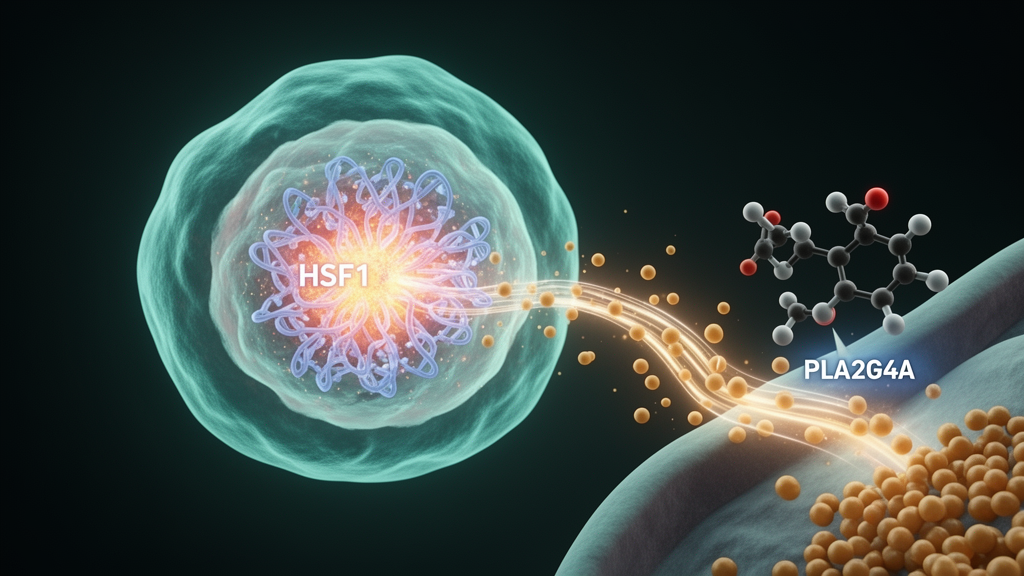
Cytosolic phospholipase A2, encoded by the gene PLA2G4A, is the rate-limiting enzyme that initiates arachidonic acid metabolism, a pathway whose aberrant activity has long been recognized as a hallmark of cancer. A new open-access study published in Cell Death Discovery reports that this enzyme acts cell-intrinsically in non-small cell lung cancer (NSCLC), promoting proliferation, survival and metastatic behavior through a signaling chain running from SP1 to PLA2G4A, then to interleukin-1β, the MAPK pathway and finally heat shock factor 1 (HSF1).
The researchers first found that PLA2G4A is significantly upregulated in NSCLC patients and in NSCLC cell lines. To test whether the enzyme actively drives malignant behavior rather than merely marking it, they performed gain-of-function experiments in 16HBE cells, a normal human bronchial epithelial cell line. Ectopic expression of PLA2G4A in these non-cancerous cells promoted proliferation and induced epithelial-mesenchymal transition, the process by which epithelial cells acquire migratory, invasive traits. When PLA2G4A was combined with MYC, a well-known oncogenic transcription factor, the pair cooperated to drive tumor formation in vivo.
The complementary loss-of-function experiments used CRISPR-Cas9 to knock out PLA2G4A in NSCLC cells. This suppressed cell proliferation, colony formation in soft agar—a standard assay for anchorage-independent growth—and invasion. At the cell-cycle level, the knockout induced arrest in the G1 phase, and the cells also underwent increased apoptosis. In animal models, PLA2G4A knockout inhibited tumor growth and reduced lung colonization, indicating effects on both primary tumor expansion and metastatic seeding.
To trace the mechanism, the team combined transcriptomic profiling with biochemical analyses. PLA2G4A knockout reduced expression of the inflammatory cytokine IL-1β and dampened MAPK pathway activity, which in turn led to decreased phosphorylation of HSF1, the heat shock factor 1 transcription factor. Pharmacological inhibition of IL-1β reproduced, or phenocopied, these cellular effects, supporting IL-1β as a functional intermediate in the pathway. Critically, when the researchers re-introduced HSF1 ectopically into PLA2G4A-deficient cells, the proliferative defect caused by PLA2G4A ablation was rescued—placing HSF1 downstream in the axis.
Upstream of the enzyme, the study identifies SP1, a transcription factor, as a candidate regulator of PLA2G4A expression. Taken together, the data suggest a largely linear signaling axis—SP1, PLA2G4A, IL-1β, MAPK, HSF1—that operates within the cancer cell itself to support NSCLC proliferation, survival and metastasis, rather than acting through the tumor microenvironment.
The authors propose that targeting this pathway may represent a potential therapeutic avenue for NSCLC. Because the work relies on cell-line experiments, engineered knockout and in vivo tumor models, the findings are preclinical; clinical efficacy in patients has not been demonstrated. The article was published as an accepted, peer-reviewed manuscript shared early under a permanent DOI, a version subject to further editorial updates before the final Version of Record.
Subject of Research: The role of PLA2G4A-driven arachidonic acid metabolism and the HSF1 signaling axis in non-small cell lung cancer progression.
Article Title: PLA2G4A-driven arachidonic acid metabolic reprogramming promotes NSCLC progression via the HSF1 signaling axis
Article References: Wang, W., Wang, Z., Li, K., Tong, X., Wen, Z., Jia, Y., Yan, J., Wang, S., Wang, H., Jin, H., Ma, T., Zhao, W., Wang, R., Li, S., Chen, T., Li, X., & Li, B. (2026). PLA2G4A-driven arachidonic acid metabolic reprogramming promotes NSCLC progression via the HSF1 signaling axis. Cell Death Discovery. https://doi.org/10.1038/s41420-026-03415-1
Image Credits: AI Generated
DOI: 10.1038/s41420-026-03415-1
Keywords: PLA2G4A, arachidonic acid, NSCLC, HSF1, IL-1β, MAPK, SP1, CRISPR-Cas9, epithelial-mesenchymal transition, lung cancer, Cell Death Discovery, phospholipase A2
News Source: Nathaniel Bowman. (October 29, 2026). Enzyme PLA2G4A fuels lung cancer growth through an HSF1 signaling axis. Scienmag.



