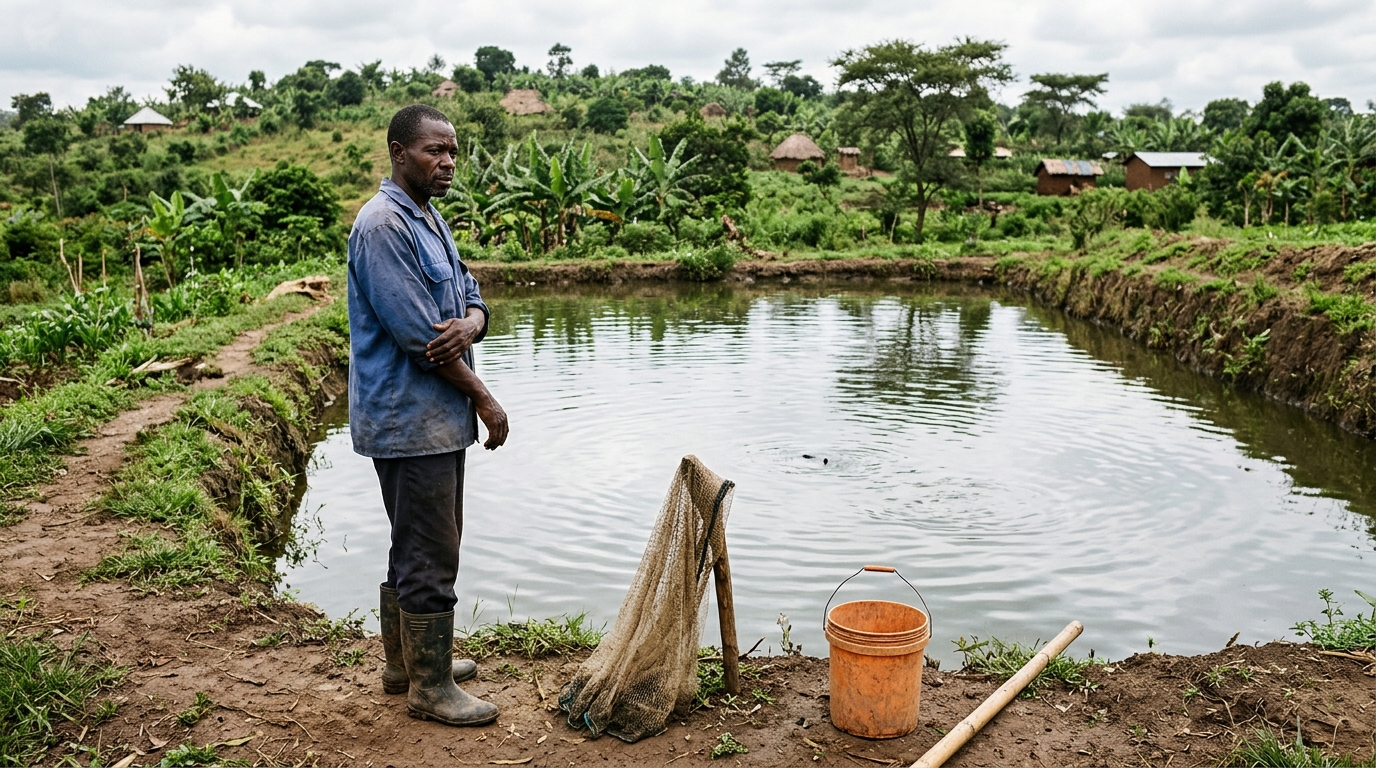
Aquaculture in East Africa is being held back not by a lack of ambition but by the weakness of the advisory systems meant to support it, according to a systematic review of extension services in Uganda, Kenya and Tanzania published in the journal Aquaculture Science and Management. The review, which synthesized 150 studies, technical reports and project evaluations published between 1990 and March 2025, found that extension coverage and quality across the three countries remain uneven, limiting technology adoption, farm productivity and knowledge transfer among small-scale producers. Using Egypt as a benchmark, the authors traced how decades of fragmented reforms, chronic underfunding and short-lived donor projects have left fish farmers reliant on informal networks, while Egypt’s sustained state-led coordination helped build Africa’s largest aquaculture sector.
The review followed PRISMA guidelines and screened 1,220 records from academic databases and grey literature, ultimately including 150 studies appraised with the Mixed Methods Appraisal Tool. Its starting point is stark: global aquaculture production reached 130.9 million tonnes in 2022, valued at more than USD 280 billion, with Asia accounting for at least 89 percent of output. Africa’s production is heavily concentrated, with Egypt alone contributing 67 percent of the continent’s total, followed by Nigeria at 11.2 percent, Ghana at 5.7 percent, Uganda at 4.4 percent, Zambia at 2.9 percent, Tanzania at 1.2 percent and Kenya at 1.0 percent. Annual per-capita fish consumption in Kenya, Uganda and Tanzania stands at 2.7 to 4.7 kg, 12.5 kg and 7.6 kg respectively, well below the global average of 20.5 kg.
Despite national commitments, including Uganda’s Fisheries and Aquaculture Policy target of 1.0 million tonnes of aquaculture output by 2030 and similar ambitions in Kenya’s Blue Economy strategy and Tanzania’s Fisheries Sector Master Plan, growth has been modest compared with Egypt, Nigeria and Ghana. The review identifies poor seed and feed quality, limited access to affordable credit, weak infrastructure, climate variability and policy gaps as contributing factors, but singles out inadequate extension services as a consistent bottleneck. Extension, defined as the systems through which farmers receive technical advice, training and support, is described as critical for transforming aquaculture from a subsistence activity into a commercially viable sector.
The staffing picture is severe. In Uganda, the ratio of extension staff to farmers is approximately 1:1,500, far above the 1:500 recommended by the Food and Agriculture Organization. Comparable ratios in Kenya range from 1:1,000 to 1:5,000, and in Tanzania stand at about 1:2,000. Many extension workers are general agricultural officers with little or no aquaculture training, limiting their ability to advise on specialized topics such as biosecurity, genetics, fry and broodstock management, feed management or fish health. This mismatch has left smallholders dependent on informal peer-to-peer learning or guidance from input suppliers, which the review notes often prioritizes sales over technical integrity.
The review describes East African extension as a pluralistic but weakly coordinated ecosystem. Public services are positioned to protect equity, biosecurity and standards, yet face chronic underfunding and the extreme farmer-to-agent ratios noted above. Donor and NGO programs have spread farmer field schools and demonstration ponds, but gains often fade after projects end. Private embedded and fee-based advisory services deliver timely, site-specific support in commercial clusters, but raise conflict-of-interest risks and limit access for poorer or remote farmers. In Uganda, the National Agricultural Advisory Services, launched in 2001, contracted private providers but sidelined district fisheries officers and provided input support without adequate technical guidance; evaluations cited in the review found it had no tangible positive effect on aquaculture production at household or national level, and it was restructured in 2014.
Kenya’s experience illustrates both the potential and fragility of intensive support. Under the Economic Stimulus Programme of 2009, the Fish Farming Enterprise Productivity Program deployed 480 fisheries extension officers on short-term contracts alongside infrastructure and input provision. Production nearly tripled within a year, rising from approximately 4,900 tonnes in 2009 to over 12,000 tonnes in 2010 and reaching around 20,000 tonnes by 2014. But when the program ended, the withdrawal of short-term officers and underdeveloped supply chains for fingerlings and feed led to widespread pond abandonment, and production declined. Devolution in 2013 further complicated delivery, as many counties lacked the budget or expertise to maintain support.
Tanzania’s trajectory reflects chronic under-investment. Early pond promotion campaigns in the late 1960s and 1970s produced poorly managed or abandoned ponds, and formal policy recognition came only with the Fisheries Act of 2003 and the National Fisheries Policy of 2015. Institutional arrangements remain fragmented between mainland Tanzania and Zanzibar, and officer numbers are extremely low: only 436 officers serve an estimated need of 16,000, most handling multiple agricultural sectors. Reports cited in the review indicate that 677 fisheries officers, out of 6,000 extension agents recommended, managed to reach 12,902 of 31,998 fish farmers in the country. Donor projects such as FAO’s Technical Cooperation Project from 2009 to 2012 demonstrated the potential of structured extension but were short-term and geographically limited.
Egypt offers the contrasting benchmark. The establishment of the General Authority for Fisheries Resources Development in 1983 positioned aquaculture as a strategic sector supported through coordinated policy, infrastructure and technical services. Public investment converted marginal and saline lands in the Nile Delta into aquaculture zones, supported by government hatcheries, feed mills and extension services, with production approaching one million tonnes annually by 2010 and contributing roughly 80 percent of the national fish supply. Extension evolved through a mixed model combining state-led initiatives with private-sector knowledge dissemination, including extension farms that served as demonstration and training hubs. The Abbassa Aquaculture Center, established in 1997 through collaboration between WorldFish and the Egyptian government, became a focal point for technology development and skills training. The IEIDEAS project from 2012 to 2015 trained more than 2,400 farmers in best management practices, with participating farms reporting average annual profit increases of approximately USD 16,000 and sector-wide benefits estimated at USD 27 million.
On delivery methods, the review finds that blended approaches combining digital and interpersonal channels achieve stronger adoption than digital-only delivery. Farmer field schools and demonstration ponds in Uganda and Kenya enhanced knowledge of water quality management and broodstock handling, while digital tools such as Kenya’s aQuaFish mobile app and Tanzania’s mFISH SMS platform extend reach. Yet digital-only methods tend to increase awareness rather than change behavior: Uganda’s eFishery radio and SMS campaigns improved understanding of feed management but did not significantly alter practices without follow-up visits. Evidence from Ghana shows that farmers who combined digital tools with face-to-face extension experienced the greatest benefits in management practices, productivity and incomes. The review also notes that evidence on costs, sustained adoption beyond one production cycle, inclusion of women and youth, and environmental outcomes remains thin, and that heterogeneity and short follow-up periods limit inference.
The authors outline a practical agenda: protecting public goods through a strong public core, accrediting and co-financing private advice through vouchers or performance-based public-private partnerships, strengthening research-to-extension-to-farmer platforms such as Uganda’s Zonal Aquaculture Innovation Platforms established in 2022/2023, investing in competency-based training and inclusive multilingual digital-human blends, and adopting shared metrics such as cost per sustained adopter and cost per tonne added, tracked beyond a single production cycle. Governments should set staffing norms and budget lines, establish advisor accreditation and conflict-of-interest rules, and require shared metrics including profit gains and inclusion of women and youth. Donors and industry should align incentives to build durable local capacity rather than short-lived projects. The review concludes that without these steps, aquaculture expansion in East Africa is likely to remain uneven and vulnerable to policy shifts, but that extension can become the engine of scalable, inclusive and climate-smart aquaculture growth if they are taken.
Subject of Research: Systematic review of aquaculture extension systems in Uganda, Kenya and Tanzania, benchmarked against Egypt
Article Title: Aquaculture extension systems in East Africa: development, challenges, and future opportunities
Article References: Kwikiriza, G., Muthoka, M., Luttamaguzi, A. N., Efitre, J., Kisakye, J. J., Magondu, E., Munguti, J., Aruho, C., & Tibihika, P. D. (2026). Aquaculture extension systems in East Africa: development, challenges, and future opportunities. Aquaculture Science and Management, 3(1), Article 2. https://doi.org/10.1186/s44365-026-00034-w
Image Credits: AI Generated
DOI: 10.1186/s44365-026-00034-w
Keywords: aquaculture, extension services, East Africa, Uganda, Kenya, Tanzania, Egypt, systematic review, smallholder farmers, fish farming, advisory services, food security
News Source: Alan Morgan. (November 5, 2026). East Africa’s fish farming advice fails farmers, review finds. Scienmag.