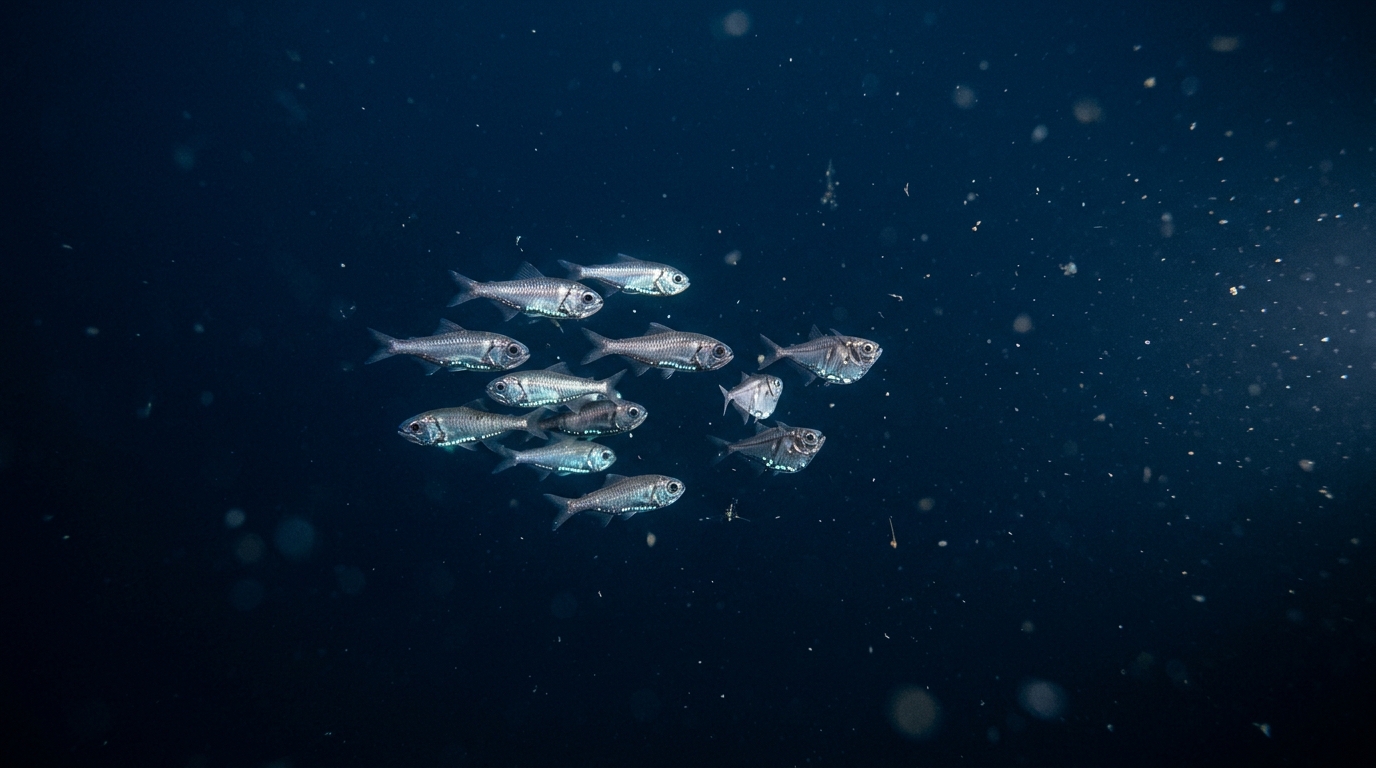
Environmental DNA drawn from a fixed deep-water intake on the seafloor of a continental slope off Kume Island, Japan, has revealed 283 deep-sea fish taxa over 26 months of monitoring, and shown that the composition of the assemblage shifted significantly from survey to survey despite remarkably stable water temperatures at 612 meters depth. The study, published in the journal Metabarcoding and Metagenomics, used the Okinawa Prefectural Deep Sea Water Research Center’s intake system, which continuously pumps deep seawater from 612 meters on the continental slope, roughly 2,300 meters offshore. Between December 2020 and February 2023, researchers collected 60 high-volume water samples of 20 liters each during six sampling events, filtering a total of 1,200 liters of deep-sea water through Sterivex cartridges.
The technical setup is what makes the approach distinctive. Rather than sending ships, trawls, or remotely operated vehicles into the deep, the team tapped directly into the facility’s pumping infrastructure, which has a maximum intake capacity of 13,000 tons per day for both deep and surface seawater, making it the largest deep seawater intake facility in Japan. A custom-built filtration device made from PVC pipes was connected to a faucet inside the Ocean Thermal Energy Conversion facility, and the system’s inherent water pressure drove 20 liters of water through each filter cartridge within about an hour. By running three cartridges in parallel and repeating the process three to four times per survey, the researchers filtered 180 to 240 liters per event, far exceeding the roughly one liter typically used in Japanese coastal eDNA studies. Given the low DNA density in deep-sea environments, this high-volume approach maximized the detection of rare or low-density taxa that small-volume surveys might overlook.
Laboratory work followed established protocols with strict contamination controls. Samples were preserved with RNAlater, stored frozen, and processed in three physically separated rooms using filtered tips. The mitochondrial 12S rRNA MiFish region, approximately 172 base pairs long, was amplified with a mixture of MiFish-U and MiFish-E-v2 primers, with eight technical replicates per template to minimize PCR dropouts. Sequencing on an Illumina MiSeq platform produced 8,776,761 raw reads across the 60 non-blank libraries, with an average of 96.6 percent of base calls reaching Phred quality scores of at least 30. After merging, trimming, and quality filtering, 7,194,954 reads, or 82.0 percent of the initial data, were retained for taxonomic assignment. Sixteen blank libraries processed identically to the field samples yielded only 48 reads after denoising, indicating minimal laboratory contamination.
Taxonomic assignment against the MiFish database identified 99.3 percent of the denoised reads as fish sequences. The fish sequences were classified into 394 species across 248 genera and 126 families, which the researchers then filtered by habitat and depth criteria from FishBase to isolate deep-sea taxa. This produced two lists: 283 deep-sea fish species spanning 161 genera and 78 families, and 111 non-deep-sea species. The deep-sea assemblage accounted for 6,988,970 reads, or 97.9 percent of total fish sequences, from 1,848 detections. The non-deep-sea group included eight purely freshwater species, likely trace-level contamination from prior laboratory experiments, which were excluded from further analysis.
The non-deep-sea detections, though quantitatively minor, tell an important story about how the intake samples its surroundings. The intake sits on the upper continental slope only about 1,500 meters from a coral reef edge and directly beneath open-ocean surface waters, so eDNA from adjacent habitats can be transported there by currents, vertical mixing, or animal movement. The 103 marine non-deep-sea species detected included coastal pelagic groups such as flying fish, jacks, mackerels, and needlefish, alongside reef-associated families like triggerfish, groupers, damselfish, and surgeonfish. Their sequences made up only 2.0 percent of total fish reads and 9.1 percent of detections, showing that deep-sea taxa strongly predominated. The researchers caution that the eDNA collected at the intake should be interpreted as a spatially integrated signal rather than a precise census of organisms immediately around the intake mouth, and that the 283 deep-sea taxa represent an operationally defined assemblage rather than proof that all detected sequences originated locally at 612 meters.
To gauge how complete their sampling was, the team applied the Chao2 richness estimator, which projected an asymptotic richness of approximately 409 species under the present design. The observed 283 species therefore represented 69.2 percent of that estimate, a figure describing sampling completeness for this dataset rather than the proportion of the regional fauna recovered. The most species-rich families were lanternfishes with 63 species, dragonfishes with 19, and bristlemouths with 10, followed by snake mackerels, cutlass eels, grenadiers, lantern sharks, slickheads, hatchetfishes, and ridgeheads, which together accounted for 145 species, or 51.2 percent of detected deep-sea richness. The ten most frequently detected taxa included the benthopelagic roughy Hoplostethus crassispinus with 59 detections and the lanternfish relative Neoscopelus microchir with 47, a mixture of slope residents and midwater migrants characteristic of the Okinawa Trough.
Comparing the eDNA results with a regional checklist of 548 deep-sea fish species compiled from historical records and multi-gear surveys around the Ryukyu Islands revealed a striking pattern. At the family level, overlap was high: eDNA detected 78 families, 67 of which, or 85.9 percent, were shared with the checklist. At the genus level, 116 of 161 detected genera, or 72.0 percent, were shared. But at the species level the picture diverged sharply. Only 105 of the 283 eDNA-detected species, or 37.1 percent, appeared in the checklist, while 178 were unique to the eDNA dataset, and 443 checklist species were not detected by eDNA. Reference-database incompleteness contributed to some non-detections but could not explain most of the discrepancy: 69.3 percent of checklist species had exact species-level references in the database, yet 62.1 percent of the undetected checklist species also had such references. The eDNA dataset concentrated richness in a few pelagic-leaning families, with lanternfishes alone representing 22.3 percent of detected species, whereas the checklist spread its richness across 18 families in a long-tailed structure.
Body size and habitat profiles reinforced this complementarity. The eDNA-detected species skewed significantly smaller than checklist species, with many in the 5 to 20 centimeter range, including numerous lanternfishes and bristlemouths, although both datasets contained fishes exceeding 100 centimeters. Pelagic-oceanic and bathypelagic species accounted for 33.2 percent of eDNA-detected species but only 14.8 percent of the checklist, while bathydemersal species made up 40.9 percent of the checklist against 23.7 percent of the eDNA dataset. Both datasets showed roughly 30 percent benthopelagic species. The researchers stress these differences should not be read as direct measures of sampling efficiency, since habitat, body size, taxonomic composition, sampling selectivity, and spatial coverage are interrelated; instead, intake-based eDNA and the regional checklist capture different but complementary components of the deep-sea fish fauna.
The temporal findings are the study’s most provocative. Of the 283 taxa, 26, or 9.2 percent, were detected in all six sampling events, dominated by subtropical continental slope swimmers such as Hoplostethus crassispinus and Neoscopelus microchir, with a single sedentary bottom-dweller, the ogcocephalid Coelophrys sp., among them. Non-metric multidimensional scaling based on Jaccard dissimilarity revealed temporal structuring of the community, and PERMANOVA confirmed significant differences among sampling events, with sampling event explaining 25.8 percent of the total variance. February 2023 showed the greatest separation from the other events, while the December 2020 and December 2021 samples occupied relatively similar regions of the ordination space. Indicator-value analysis tied Rouleina sp.1, Hoplostethus sp., and Ceratoscopelus warmingii to February 2023, and an exploratory post hoc comparison found Gephyroberyx japonicus and Neoscopelus microchir significantly associated with all non-February events, supporting their reduced detectability that month without demonstrating biological absence.
The researchers are careful about what these patterns do and do not prove. The similarity between the two December assemblages suggests seasonal processes may contribute to the observed variation, but because equivalent seasons were not repeatedly sampled across multiple years except for December, the study cannot establish a recurring annual cycle. The concentration of eight non-detections among near-persistent taxa in February 2023 is noteworthy, yet failure to detect eDNA does not demonstrate biological absence; reduced detection may reflect lower local abundance, shifts in distribution, hydrodynamic transport, variation in DNA production or degradation, or stochastic detection. SIMPER analysis showed the November 2022 to February 2023 difference was distributed across numerous taxa, with the largest individual contributions at just 2.34 percent each from Rouleina sp.1 and Diaphus sp.2. The authors frame their results as generating a testable hypothesis that part of the assemblage variation may have a recurring seasonal component, one that will require comparable sampling across additional annual cycles, improved reference-database coverage, and concurrent oceanographic measurements to confirm. What the study does establish is that a fixed deep-water intake, already built for energy and aquaculture research, can serve as a repeatable, non-invasive window into one of the planet’s least explored biomes.
Subject of Research: Deep-sea fish biodiversity monitoring using environmental DNA metabarcoding from a fixed deep-water intake system off Kume Island, Japan
Article Title: Monitoring deep-sea fish biodiversity via a direct deep-water intake from 612 m: Insights into taxonomic composition and temporal dynamics revealed by eDNA metabarcoding
Article References: Oka, S.-I., Sado, T., Teruya, S., Yonashiro, Y., Sato, K., & Miya, M. (2026). Monitoring deep-sea fish biodiversity via a direct deep-water intake from 612 m: Insights into taxonomic composition and temporal dynamics revealed by eDNA metabarcoding. Metabarcoding and Metagenomics, 10, Article e200199. https://doi.org/10.3897/mbmg.10.200199
Image Credits: AI Generated
Keywords: environmental DNA, eDNA metabarcoding, deep-sea fish, Kume Island, Okinawa Trough, MiFish primers, temporal dynamics, continental slope, biodiversity monitoring, Chao2 estimator, PERMANOVA, deep seawater intake
News Source: Margaret Porter. (November 6, 2026). Deep-Sea Fish Biodiversity Tracked for 26 Months via eDNA from a 612-Meter Water Intake. Scienmag.