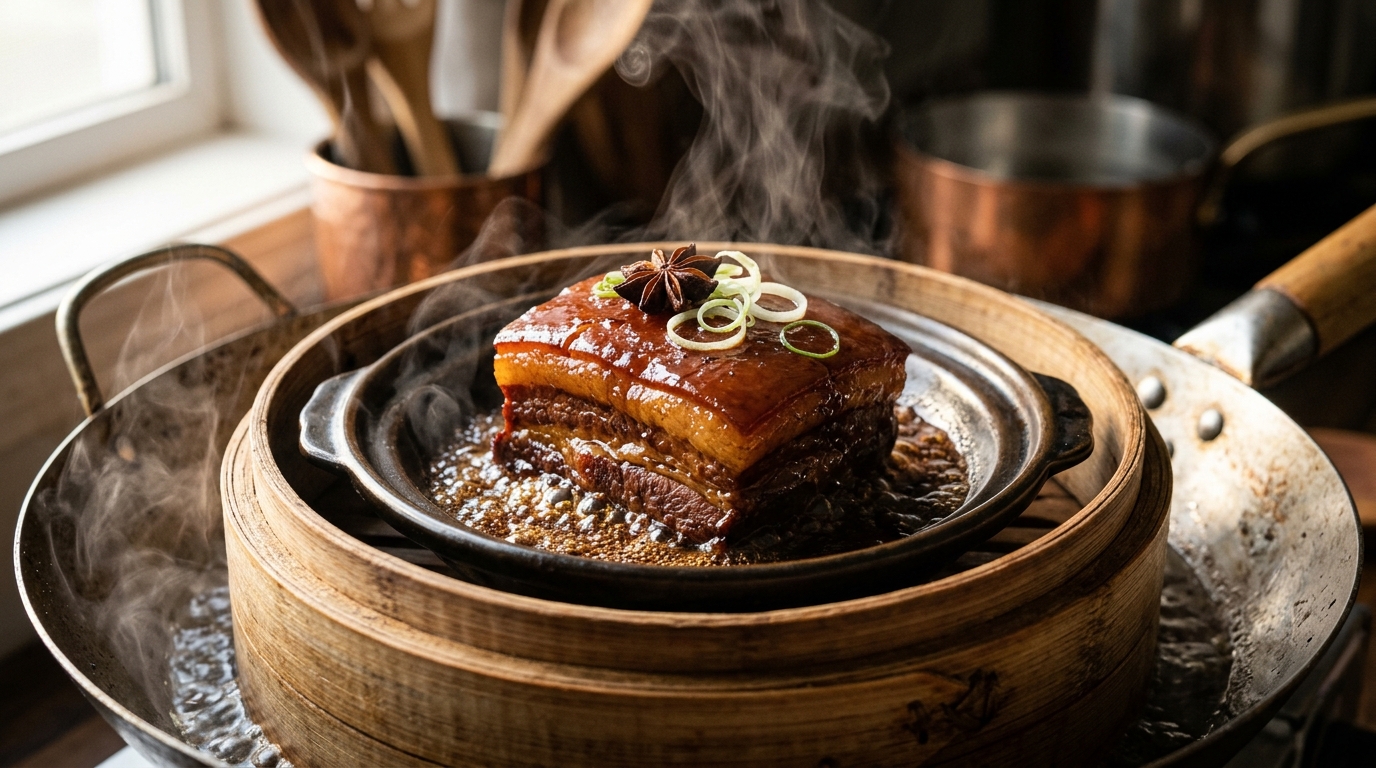
Chinese prefabricated meat products have surged in popularity as traditional dishes such as White-Cut Chicken and Kung Pao Chicken move into ready-to-eat formats, but the industry faces a stubborn technical bottleneck: heat treatment, especially reheating, strips away the very flavors that define these cuisines. A new review published in Agricultural Products Processing and Storage examines the mechanisms of flavor formation and the strategies available for quality control, drawing on evidence from studies of lipid oxidation, the Maillard reaction, spice chemistry and oral processing.
The commercial stakes are considerable. The review notes that China’s prepared food market reached 516.5 billion yuan in 2023, a year-on-year increase of 23.1 percent, and is projected to exceed 1 trillion yuan by 2027. Prefabricated meat products are not merely convenience foods; the authors describe them as potential carriers of the eight major Chinese cuisines into global markets. Yet excessive heat application during processing often leads to flavor loss and a declining tasting experience, which the review identifies as a core obstacle restricting industrialization and globalization. The challenge is compounded by the fact that instrumental analysis of flavor compounds does not always correlate cleanly with what consumers actually perceive.
The review traces the standard process chain of prefabricated meat products through industrial pre-cooking, storage and consumer reheating. During storage, slow oxidation of intramuscular fat and weak degradation of free amino acids generate precursor substances that feed into the Maillard reaction and secondary lipid oxidation during reheating. When heat is applied again, carbonyl-amine condensation and thermal cleavage of fatty acids reconstruct the flavor profile into something distinct from home cooking. The authors emphasize that initial cooking builds flavor directionally, but reheating operates on ingredients already in a fragile state where flavors are prone to loss and components are susceptible to degradation.
The review states that lipid oxidation and degradation account for the formation of over half of the volatile compounds in cooked meat. Saturated and unsaturated fatty acids undergo thermal decomposition at high temperatures, and in the presence of oxygen, methylene groups oxidize to form hydroperoxides that break down into aldehydes, ketones and hydrocarbons. Among these, aldehydes are the most prominent volatile flavor compounds in meat. Specific examples illustrate the point: (E)-2-octenal and nonanal serve as key odorants for lamb, while hexanal, heptanal, octanal, nonanal, (E,E)-2,4-decadienal and 1-octen-3-ol have been reported as key odorants in Peking duck.
The same chemistry that creates desirable aromas also produces warmed-over flavor, or WOF, the off-flavor that develops during subsequent storage and reheating. Tikk and colleagues monitored flavor changes in pre-cooked pork meatballs using GC-MS, electronic nose and sensory evaluation, finding that with extended storage and reheating, off-odors became the dominant sensory characteristic. Rhee and colleagues compared odor changes in pre-cooked beef, pork and chicken during storage and found that red meat showed a stronger correlation with lipid oxidation, with off-odors developing more rapidly in red meat after pre-cooking. Xu and colleagues found that steam reheating of beef nearly doubled the content of long-chain fatty aldehydes such as tridecanal and hexadecanal compared with raw beef, and these compounds were associated with waxy, oily and cardboard-like odors.
The Maillard reaction, the second major pathway, involves complex reactions between reducing sugars and amino acids or proteins, playing a vital role in food flavor and color formation. Temperature and heating method are primary factors: when valine reacts with glucose across the range of 90 to 180 degrees Celsius, the reaction yields a grilled flavor at the lower end and a chocolate flavor at the higher end. The review also notes that Maillard reaction products exhibit antioxidant activity, scavenging reactive oxygen free radicals and terminating free radical chain reactions through reductive ketones that provide hydrogen atoms. However, the reaction carries a safety dimension. Lipid oxidation products participate in cross-linking reactions with proteins, generating compounds such as acrylamide, 5-hydroxy-methylfurfural, heterocyclic amines and advanced glycation end products. Zhao and colleagues found that the content of AGEs in chicken meatballs increased after frozen storage and subsequent heat treatment.
Reheating method selection matters considerably. The review summarizes evidence that steaming and boiling help maintain moisture and texture while reducing nutrient loss. Microwave heating is fast but requires careful control of time and power, and may lead to concentrated formation of oxidation products due to uneven heating and localized overheating. Frying and air-frying reheating strongly promote both the Maillard reaction and deep lipid oxidation, producing benzaldehyde, furans and pyrazines, but may simultaneously intensify off-flavor formation. Traditional water bath or sous-vide reheating, with precise low-temperature uniform heating, maximizes inhibition of explosive free radical generation and delays WOF development. For Chinese dishes suited to steaming or boiling, the authors suggest water bath heating represents a promising choice because uniform temperature distribution helps mitigate oxidation of fats and proteins while minimizing loss of volatile compounds.
Spices and condiments offer a regulatory tool that operates through antioxidant and flavor-enhancing effects. Eugenol and beta-caryophyllene, main components of clove essential oil, exhibit the best inhibitory effect on reheating-induced WOF according to the review. Eugenol chelates metal ions such as heme iron, inhibits lipoxygenase activity in early heating stages and reacts with peroxyl radicals during cold storage and reheating, blocking or delaying the oxidative chain reaction. Tea polyphenols reduced the thiobarbituric acid value and off-odor value of chicken by 90.6 percent and 55.6 percent respectively in one cited study. Ginger extract blocked heterocyclic amine formation during baking of beef patties with an inhibition rate as high as 79 percent. Spices such as star anise, fennel, cinnamon and clove show strong anti-glycation activity correlated with total phenolic content.
The review’s most forward-looking proposal is an AI-oral processing model that combines virtual reality headsets, smart wristbands and molecular docking to simulate flavor release and perception. Users wearing VR head-mounted devices integrated with AI algorithms would taste prefabricated meat products while the devices capture chewing frequency, saliva secretion and bite force in real time, alongside process data such as temperature curves and heat transfer efficiency. Smart wristbands monitor physiological indicators including blood glucose, blood pressure and heart rate. The AI algorithm integrates these multi-dimensional data with preset sensory dimensions such as tenderness perception and flavor recognition, identifying process defects such as accelerated lipid oxidation within specific temperature ranges. Molecular docking, enhanced by structural biology tools like AlphaFold3, simulates interactions between key flavor molecules and olfactory receptor structures. The authors position this as a method for dynamic identification of quality deterioration nodes and optimized processing strategies, enabling a closed loop from perception analysis through precise improvement to stable production.
The review concludes that flavor formation and quality control in Chinese prefabricated meat products are synergistically influenced by the entire heat treatment chain and multiple factors. Existing studies have clarified key mechanisms and some regulatory methods, but core challenges remain. The authors identify two future directions: quantifying the correlation between reheating parameters and harmful substances to establish safety thresholds, and leveraging AI to integrate multimodal data from process, oral sensing and physiological feedback. They acknowledge that significant difficulty remains in quantifying dietary intake of hazardous substances such as heterocyclic amines and advanced glycation end products in daily human diets, and that greater research efforts should be devoted to these fields. The goal, as framed by the authors, is to move from restoring traditional flavors toward standardized improvement, laying a foundation for industrial mass production and international dissemination of these culturally significant products.
Subject of Research: Flavor formation and quality control in Chinese prefabricated meat products during heat treatment and oral processing
Article Title: Flavor changes and quality control of prefabricated meat products based on heat treatment and oral processing: a review on Chinese cuisine
Article References: Li, X., Dai, Y., Yang, Y., Tan, W., Liu, X., Tang, Y., & Li, Z. (2026). Flavor changes and quality control of prefabricated meat products based on heat treatment and oral processing: a review on Chinese cuisine. Agricultural Products Processing and Storage, 2(1), Article 29. https://doi.org/10.1007/s44462-026-00060-w
Image Credits: AI Generated
DOI: 10.1007/s44462-026-00060-w
Keywords: prefabricated meat products, Chinese cuisine, lipid oxidation, Maillard reaction, warmed-over flavor, reheating methods, oral processing, spices, artificial intelligence, virtual reality, heterocyclic amines, advanced glycation end products
News Source: Alan Morgan. (November 6, 2026). Heat and the Bite: How Reheating Reshapes the Flavor of Chinese Prefabricated Meat. Scienmag.