• HOME
  • NEWS
  • EXPLORE
    • CAREER
      • Companies
      • Jobs
    • EVENTS
    • iGEM
      • News
      • Team
    • PHOTOS
    • VIDEO
    • WIKI
  • BLOG
  • COMMUNITY
    • FACEBOOK
    • INSTAGRAM
    • TWITTER
Saturday, December 20, 2025
BIOENGINEER.ORG
No Result
View All Result
  • Login
  • HOME
  • NEWS
  • EXPLORE
    • CAREER
      • Companies
      • Jobs
        • Lecturer
        • PhD Studentship
        • Postdoc
        • Research Assistant
    • EVENTS
    • iGEM
      • News
      • Team
    • PHOTOS
    • VIDEO
    • WIKI
  • BLOG
  • COMMUNITY
    • FACEBOOK
    • INSTAGRAM
    • TWITTER
  • HOME
  • NEWS
  • EXPLORE
    • CAREER
      • Companies
      • Jobs
        • Lecturer
        • PhD Studentship
        • Postdoc
        • Research Assistant
    • EVENTS
    • iGEM
      • News
      • Team
    • PHOTOS
    • VIDEO
    • WIKI
  • BLOG
  • COMMUNITY
    • FACEBOOK
    • INSTAGRAM
    • TWITTER
No Result
View All Result
Bioengineer.org
No Result
View All Result
Home NEWS Science News Chemistry

Dramatic transition in Streptomyces life cycle explained in new discovery

Bioengineer by Bioengineer
December 3, 2019
in Chemistry
Reading Time: 2 mins read
0
IMAGE
Share on FacebookShare on TwitterShare on LinkedinShare on RedditShare on Telegram

IMAGE

Credit: John Innes Centre


Streptomyces bacteria are our primary source of antibiotics, which are produced in the transition from vegetative growth to sporulation in a complex developmental life cycle.

Previous research by Professor Mark Buttner’s lab at the John Innes Centre has shown that the signalling molecule c-di-GMP binds BldD, a master repressor of gene activity, to control the initiation of development in these soil-dwelling bacteria.

c-di-GMP is an example of a nucleotide second messenger, an intracellular signal widespread in bacteria responsible for regulating crucial processes, including mobility, virulence and biofilm formation.

In a new study, experiments using the model species Streptomyces venezuelae show that c-di-GMP also intervenes later in development to control the differentiation of the reproductive hyphae into spores.

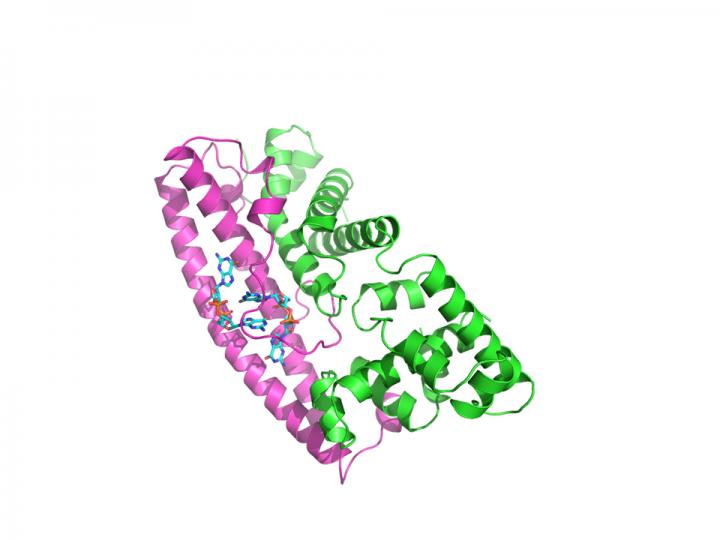
It does this by mediating an interaction between the major sporulation sigma factor in Streptomyces, WhiG, and the anti-sigma factor RsiG.

A sigma factor is a protein needed for the initiation of transcription, the process of turning DNA into RNA. Anti-sigma factors bind to the sigma and inhibit activity until the time is appropriate.

The study shows that RsiG and c-di-GMP bind and hide sigma WhiG, preventing its target genes being expressed and therefore stopping the reproductive hyphae turning into spores.

It is the first instance of c-di-GMP binding to a sigma factor and affecting its functionality.

First author of the study Dr Kelley Gallagher says: “As a result of this discovery, it is now clear that c-di-GMP signals through BldD and sigma WhiG respectively to control the two most dramatic transitions of the Streptomyces life cycle, the formation of the reproductive aerial hyphae and their differentiation into spore chains. In both cases, c-di-GMP functions as a brake.”

###

“c-di-GMP arms an anti-σ to control progression of multicellular differentiation in Streptomyces” appears in the journal Molecular Cell

Media Contact
Adrian Galvin
[email protected]
01-603-450-238

Related Journal Article

http://dx.doi.org/10.1016/j.molcel.2019.11.006

Tags: BacteriologyBiochemistryBioinformaticsBiologyBiotechnologyCell BiologyMicrobiologyMolecular Biology
Share12Tweet8Share2ShareShareShare2

Related Posts

Cutting Electrolyte Reduction Boosts High-Energy Battery Performance

Cutting Electrolyte Reduction Boosts High-Energy Battery Performance

December 19, 2025
Microenvironment Shapes Gold-Catalysed CO2 Electroreduction

Microenvironment Shapes Gold-Catalysed CO2 Electroreduction

December 11, 2025

Photoswitchable Olefins Enable Controlled Polymerization

December 11, 2025

Cation Hydration Entropy Controls Chloride Ion Diffusion

December 10, 2025
Please login to join discussion

POPULAR NEWS

  • Nurses’ Views on Online Learning: Effects on Performance

    Nurses’ Views on Online Learning: Effects on Performance

    70 shares
    Share 28 Tweet 18
  • NSF funds machine-learning research at UNO and UNL to study energy requirements of walking in older adults

    70 shares
    Share 28 Tweet 18
  • Unraveling Levofloxacin’s Impact on Brain Function

    53 shares
    Share 21 Tweet 13
  • Exploring Audiology Accessibility in Johannesburg, South Africa

    51 shares
    Share 20 Tweet 13

About

We bring you the latest biotechnology news from best research centers and universities around the world. Check our website.

Follow us

Recent News

Assessing the K-NHSPSC: Korean Patient Safety Culture Insights

Spot Urine CA 19-9: New Insights in Pediatric Hydronephrosis

Discharge Choices for Elderly Surgical Patients Explored

Subscribe to Blog via Email

Enter your email address to subscribe to this blog and receive notifications of new posts by email.

Join 70 other subscribers
  • Contact Us

Bioengineer.org © Copyright 2023 All Rights Reserved.

Welcome Back!

Login to your account below

Forgotten Password?

Retrieve your password

Please enter your username or email address to reset your password.

Log In
No Result
View All Result
  • Homepages
    • Home Page 1
    • Home Page 2
  • News
  • National
  • Business
  • Health
  • Lifestyle
  • Science

Bioengineer.org © Copyright 2023 All Rights Reserved.