A traditional red resin harvested from Dracaena trees may offer a multi-target approach to one of stroke medicine’s most stubborn problems: the memory loss that lingers long after blood flow is restored. A new review published in Frontiers in Cellular Neuroscience synthesizes preclinical evidence suggesting that Dragon’s Blood, and particularly its phenolic constituents such as loureirins and pterostilbene, could interfere with the pathological cascades that destroy memory circuits after cerebral ischemia. The authors, from Shijiazhuang Medical College in China, argue that the resin’s antioxidant, anti-inflammatory and neuroprotective activities make it a candidate worth pursuing for post-stroke cognitive impairment, while acknowledging that clinical proof for memory protection specifically remains thin.
The clinical stakes are considerable. Stroke ranks as the second leading cause of death and the third leading cause of disability worldwide, with ischemic stroke predominating. Post-stroke cognitive impairment affects an estimated 20 to 80 percent of survivors globally, and roughly 60 percent of patients may develop cognitive decline within one year of stroke onset. Unlike motor deficits, which often improve with rehabilitation, cognitive function in many patients declines persistently. The review also notes that cognitive impairment after stroke is significantly associated with apoplexy relapse and all-cause mortality risk, and that despite advances in revascularization techniques, the incidence of post-stroke cognitive impairment has not fallen accordingly.
Memory loss after ischemia is not random. Neuroimaging and lesion-symptom mapping studies indicate that infarcts in strategic nodes of memory circuitry, including the thalamus, medial temporal lobe hippocampus, caudate nucleus and anterior radiate body, are far more likely to produce lasting deficits than lesions elsewhere. Even small infarcts in these hubs can disrupt information transmission across the memory network. Resting-state functional MRI studies show that patients with ischemic stroke and cognitive impairment exhibit disrupted hippocampal functional connectivity, particularly between the hippocampus and prefrontal cortex, with the degree of reduced connectivity correlating with the severity of memory deficits. Functional near-infrared spectroscopy has similarly revealed abnormal oxygen consumption in the prefrontal cortex of these patients.
The review frames post-ischemic memory dysfunction as a cascade of interlocking processes. Cerebral ischemia triggers energy depletion, excitotoxicity, oxidative stress, neuroinflammation and blood-brain barrier disruption, which together drive neuronal death. In the hippocampus, reactive oxygen species accumulate, antioxidant enzyme activity falls, and ATP deficiency derails energy metabolism, producing neuronal loss in the CA1, CA3 and dentate gyrus regions, mitochondrial damage, and abnormalities in synaptic morphology that suppress long-term potentiation. In the amygdala’s basolateral subregion, ischemic injury can cause neuronal loss of up to 20 to 25 percent, severing information flow through the amygdala-hippocampus-prefrontal cortex circuit that supports emotional memory.
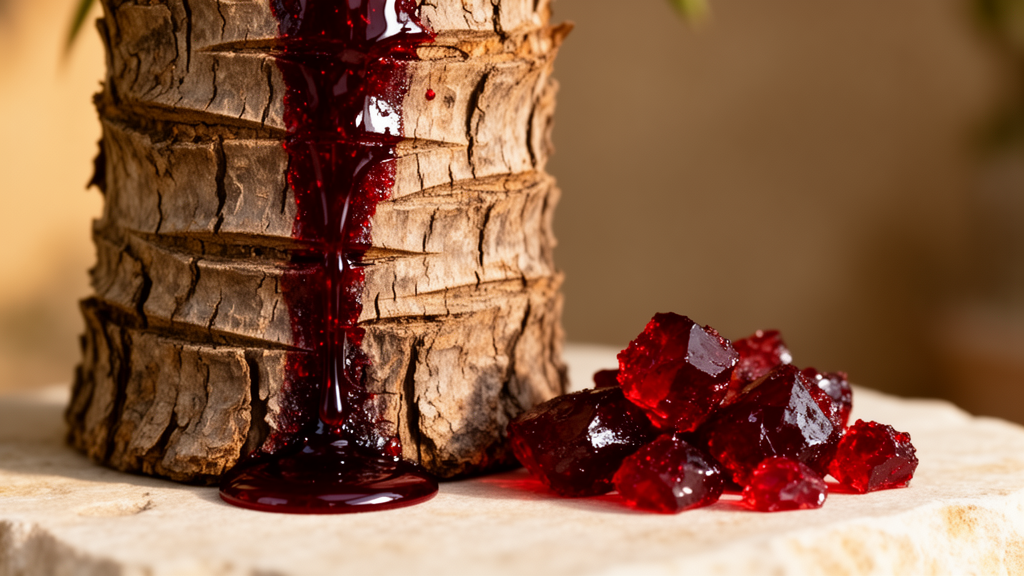
Dragon’s Blood is a general term for red resins from several plant taxa, and the review deliberately restricts its scope to Resina Draconis derived from Dracaena cochinchinensis, the species processed for medicinal use in China. The authors caution that pharmacological findings from one botanical source should not be extrapolated to chemically distinct resins from other origins, such as Pterocarpus indicus. The resin’s signature components are phenolics: more than 180 phenolic compounds have been isolated from Dracaena species, with flavonoids accounting for 50 to 80 percent of total constituents. The major bioactive monomers highlighted include Loureirin A, Loureirin B, Loureirin C, 7,4′-dihydroxyflavone, resveratrol and pterostilbene, a highly fat-soluble stilbene that crosses the blood-brain barrier and accumulates in brain tissue.
The mechanistic evidence spans several tiers, and the review is unusually careful to keep them separate. At the chemical level, in vitro assays show that Dragon’s Blood capsules scavenge DPPH radicals with an IC50 of 0.14 milligrams per milliliter, and that pterostilbene and resveratrol show comparable radical-scavenging rates of roughly 73 and 71 percent respectively. At the cellular level, Loureirin B at 10 micromoles per liter mitigates oxygen-glucose deprivation and reoxygenation injury in PC12 cells by activating the Nrf2 pathway and upregulating HO-1 and Bcl-2. In animal models, Dragon’s Blood dropping pills and Longxue Tongluo capsules elevate brain tissue levels of the antioxidant enzymes SOD, GSH-Px and CAT in rats subjected to middle cerebral artery occlusion, while reducing malondialdehyde, a marker of lipid peroxidation.
Some findings link these molecular effects to behavior. Total flavonoids from the resin improved pathological damage to hippocampal neurons in rats with cerebral ischemia-reperfusion, reduced apoptosis and enhanced spatial learning and memory. Loureirin A reduced infarct volume, improved neuronal morphology in the hippocampal CA1 region and improved learning and memory in rodents. Loureirin C, which acts through Nrf2-mediated inhibition of ferroptosis, upregulated the synaptic proteins SYP, PSD95 and GAP43 and improved spatial and working memory in mouse models of vascular dementia. Pterostilbene upregulated synaptophysin and PSD95 in the prefrontal cortex and hippocampus of ischemic rats, activated the CREB/BDNF pathway and improved spatial learning and memory, apparently by rebuilding hippocampal-prefrontal functional connectivity.
Beyond oxidative stress, the resin’s components target thrombosis, inflammation and the blood-brain barrier. Loureirin B acts as a plasminogen activator inhibitor-1 inhibitor and, in a ferric chloride-induced murine thrombosis model, significantly reduced thrombus weight and intravascular thrombus area. Loureirin A inhibits platelet aggregation via the PI3K/AKT pathway, and Loureirin D antagonizes ADP binding to the P2Y12 receptor. Clinically, the resin’s antithrombotic effects have been compared to low-molecular-weight heparin, and Longxue Tongluo capsules have shown efficacy in improving neurological deficits during stroke recovery. High-dose resin administration over 14 days reduced cerebral infarct volume and brain water content in MCAO rats, and resveratrol restored blood-brain barrier ultrastructure and tight junction protein expression.
The review’s authors are candid about the limits of this evidence base. Most animal studies report neurological scores and biochemical readouts without dedicated cognitive-behavioral testing, so the causal link between antioxidant biochemical changes and memory improvement remains preliminary. Chemical radical-scavenging capacity, cellular signaling activation, tissue-level biomarker changes and behavioral recovery are distinct tiers of evidence that cannot be collapsed into one another. Direct evidence that the resin or its characteristic components rescue ischemia-induced memory impairment in formal behavioral assays is still scarce. No published study has yet targeted the basolateral amygdala directly, and evidence for striatal protection is absent. Research also neglects cross-talk among the multiple signaling pathways the resin’s components presumably engage.
Clinical translation faces even steeper hurdles. Existing human data come largely from small, single-center observational studies in ischemic stroke patients using oral capsule or dropping-pill preparations, with endpoints such as neurological deficit scores, cerebral blood flow and activities of daily living rather than cognitive measures like the MoCA or MMSE. The authors explicitly warn that efficacy for cognitive recovery cannot be extrapolated from general stroke outcomes, and that large-sample safety data specific to ischemic cognitive impairment are insufficient. They call for multicenter, well-controlled trials with cognitive-focused primary endpoints, more diverse animal models including transgenic and non-human primate systems, and systematic investigation of how the resin’s many constituents work together. Until such work is done, Dragon’s Blood remains a laboratory lead with intriguing breadth, not a validated therapy for the memory deficits that follow stroke.
Subject of Research: Preclinical mechanisms by which Dragon's Blood resin and its constituents may protect memory circuits after cerebral ischemia
Article Title: Dragon’s Blood as a promising strategy against cerebral ischemia-induced memory processing impairment
Article References: Chen, P., Zhang, J., & Yao, X. (2026). Dragon’s Blood as a promising strategy against cerebral ischemia-induced memory processing impairment. Frontiers in Cellular Neuroscience, 20, Article 1960961. https://doi.org/10.3389/fncel.2026.1960961
Image Credits: AI Generated
DOI: 10.3389/fncel.2026.1960961
Keywords: Dragon's Blood, cerebral ischemia, post-stroke cognitive impairment, hippocampus, pterostilbene, loureirins, oxidative stress, neuroinflammation, blood-brain barrier, synaptic plasticity, Resina Draconis, memory circuits
News Source: Cassandra Pierce. (October 27, 2026). Dragon’s Blood Resin Shows Preclinical Promise for Protecting Post-Stroke Memory. Scienmag.