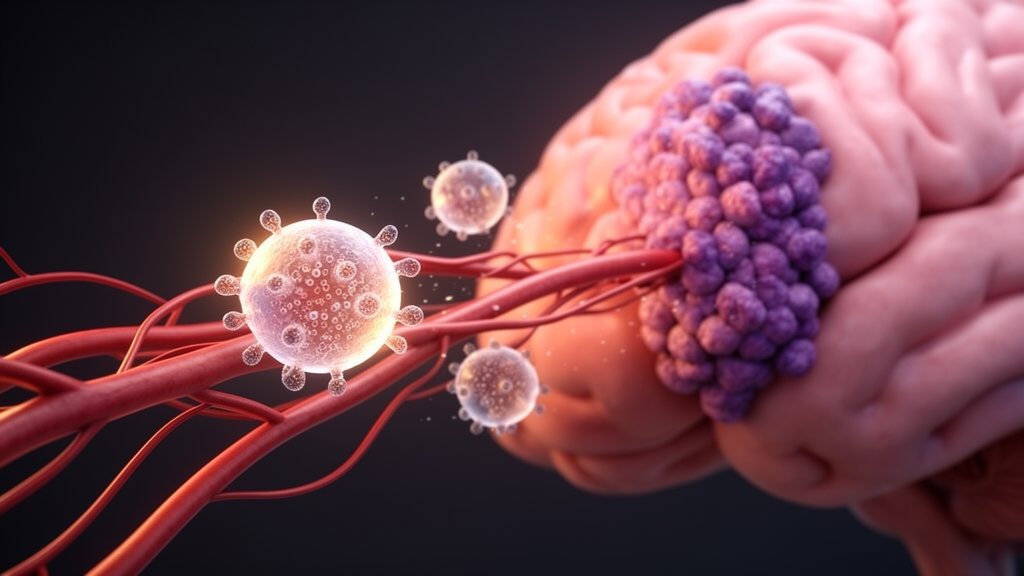
Scientists at UC San Francisco have engineered a new generation of CAR-T cells that remain essentially dormant as they travel through the body and only switch on once they reach the brain, where they activate to destroy tumor cells. In mouse studies, these programmable cells cleared diffuse midline glioma, or DMG, a lethal form of childhood brain cancer that weaves itself into healthy tissue and has resisted virtually every therapeutic approach attempted so far. The work, described in a paper published in Science Translational Medicine on October 28, represents a deliberate redesign of the CAR-T concept, built around the idea that the timing and location of the cells’ activation may matter as much as the target they recognize.
The urgency behind the project reflects the grim reality of DMG. The tumor is exceptionally hard to treat because it infiltrates the brainstem, the region that controls essential functions such as breathing, heartbeat, and swallowing. Against that backdrop, the UCSF team reports that its new therapy has the potential to succeed where standard CAR-T cell therapy has failed, a claim grounded in consistent laboratory results rather than clinical outcomes, since human trials have not yet begun.
CAR-T cell therapies are made of immune T cells that engineers equip with synthetic receptors, called CARs, which sense proteins on the surface of tumor cells and prompt the T cells to attack. The new system, named B-SYNC, is the latest iteration of a CAR-T strategy developed by Hideho Okada, MD, PhD, a professor of Neurological Surgery at UCSF, together with his colleague Wendell Lim, PhD, professor of Cellular and Molecular Pharmacology at UCSF. Okada, a co-corresponding author of the new paper, has spent years trying to reconcile two competing demands: a cell therapy potent enough to eradicate an infiltrative brain tumor, yet restrained enough to avoid unacceptable side effects.
“It’s been a struggle to make CAR-T cells that overcome DMG without causing unacceptable side-effects,” Okada said. “By limiting B-SYNC’s CAR expression to when and where it matters — in the brain — we saw consistent, total shutdown of DMG tumors in the lab.” The mechanism behind that control is a cellular sensor called synNotch. Rather than letting the CAR receptor fire continuously wherever the T cell happens to travel, the synNotch circuit gates the production of the CAR behind a separate trigger, creating a two-step activation sequence that the researchers had already tested in an earlier construct.
That earlier version, announced by Okada and Lim in 2021 under the name E-SYNC, was designed for a different brain cancer, glioblastoma. E-SYNC used synNotch to detect EGFRvIII, a mutant protein found on some glioblastomas, and the detection event spurred the production of a CAR that targeted EphA2 and IL13Rα2, proteins that dot many tumor cells. The two-step approach proved better than a one-step CAR T design in the laboratory. But the strategy carried an inherent limitation: only about 20 percent of patients have tumors with EGFRvIII, and even among those patients, tumors can lose EGFRvIII as E-SYNC eliminates the cells that carry it. The researchers therefore went looking for a more stable activation signal that would work in more patients.
The signal they settled on was brevican, a protein found throughout the brain. The team engineered synNotch to activate the CAR only in response to brevican. The resulting B-SYNC CAR-T cells then roamed the brain looking for cells that carried EphA2 or IL13Rα2, even if those cells did not have EGFRvIII. Because the two brain cancers share EphA2 and IL13Rα2 on many of their tumor cells, the approach designed for glioblastoma also seemed well suited to DMG. Postdoctoral researcher Senthilnath Lakshmanachetty, PhD, in Okada’s lab, put the idea to the test in a series of experiments in mice implanted with human DMG cells.
In the first experiment, Lakshmanachetty gave B-SYNC CAR-T cells intravenously to the mice. Some of the cells crossed into the brain, where they made the CAR and attacked the cancer. Crucially, the experiment showed that the therapeutic activity was restricted to the brain: B-SYNC cells found outside the brain, including in the blood and the spleen, did not express the CAR, “just as we designed it,” Lakshmanachetty said. That spatial gating is the central safety feature of the platform, because it means the potent anti-tumor machinery is not manufactured while the cells are circulating through the rest of the body.
The team then changed the delivery route, injecting B-SYNC directly into the brain with an intracerebroventricular, or ICV, injection. The treatment cleared tumors in every mouse tested across two human DMG models, while conventional CAR-T cells again failed to control the cancer. The scientists are not certain why the gated cells outperformed the conventional ones, but they suspect that focusing the CAR-Ts on the brain somehow made them more potent. One hypothesis is that controlling where the B-SYNC T cells become active may prevent them from becoming “exhausted” before they have reached the cancer, which could help explain why other CAR-T cell therapies have failed against brain tumors.
The experiments also revealed an unexpected durability. When the scientists introduced another round of cancer several weeks later, the cells were still able to fight. Nearly seven weeks after the initial treatment, the team gave already-treated mice a second round of DMG cells, and every mouse that had received B-SYNC rejected the new tumors. “We didn’t expect B-SYNC CAR-T cells to necessarily persist,” Lakshmanachetty said.
Encouraged by the strong laboratory results, the team is now preparing the therapy for clinical trials at UCSF Health that may begin as early as April 2027. In partnership with UCSF oncologists, Okada, Lim, and Lakshmanachetty are designing a first trial in which each patient’s own T cells are transformed into the B-SYNC CAR-T cell therapy. The trial will be led by UCSF’s Marie Jaeger-Krause, MD, and Sabine Mueller, MD, PhD, and will test both ICV and IV delivery of the therapy in different combinations. For the ICV route, a shunt will be implanted to connect the brain ventricles with a reservoir on the scalp, enabling multiple rounds of therapy. Mueller, director of the UCSF Pediatric Brain Tumor Center and co-founder of the Pediatric Neuro-Oncology Consortium, called the preclinical data very promising. “Mice with DMG are being cured, and we are incredibly excited to bring this therapy to the children and young adults we care for,” she said. “This is exactly the kind of innovative approach they deserve.” For now, the findings remain preclinical, and the decisive test of whether dormant-until-activated CAR-T cells can do in patients what they have done in mice will come only when the trial begins.
Subject of Research: A brain-activation-gated CAR-T cell therapy that cleared diffuse midline glioma in mouse models
Article Title: Smarter CAR-T cells could beat a deadly pediatric brain cancer
Article References: Smarter CAR-T cells could beat a deadly pediatric brain cancer. Original publication (Bibliographic details unavailable.)
Image Credits: AI Generated
DOI: Not provided
Keywords: CAR-T cells, diffuse midline glioma, pediatric brain cancer, synNotch, brevican, UC San Francisco, glioblastoma, immunotherapy, Science Translational Medicine, brainstem tumor, preclinical study, clinical trials
News Source: Nathaniel Bowman. (October 29, 2026). Dormant Until They Reach the Brain: Engineered CAR-T Cells Clear a Lethal Pediatric Tumor in Mice. Scienmag.