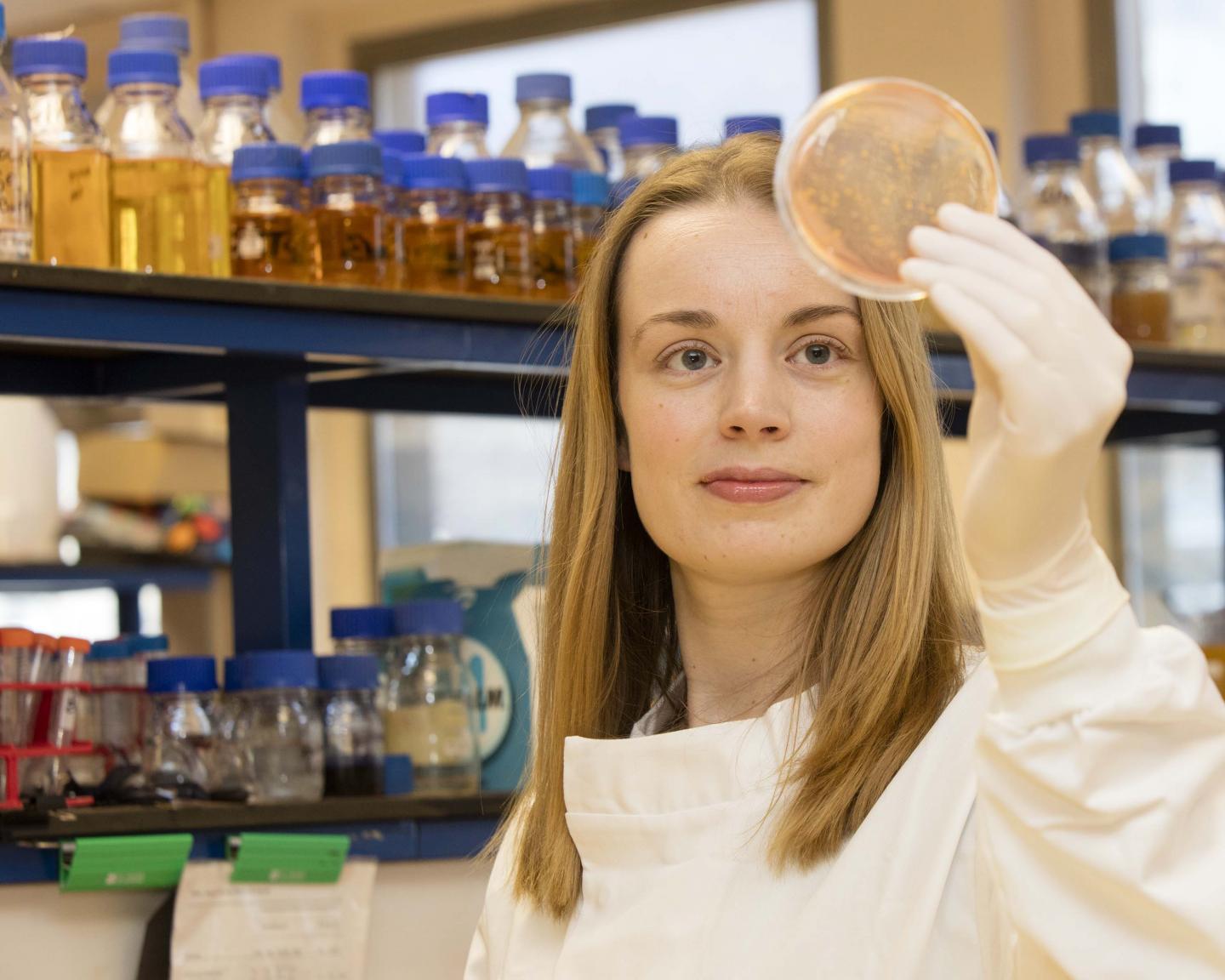
Credit: Dave Cullen
Researchers from Trinity College Dublin have discovered a key mechanism underlying bacterial skin colonisation in atopic dermatitis, which affects millions around the globe.
Atopic dermatitis (AD, also called commonly eczema) is the most common chronic inflammatory skin disorder in children, affecting 15-20% of people in childhood. During disease flares, patients experience painful inflamed skin lesions accompanied by intense itch and recurrent skin infection.
The bacterium Staphylococcus aureus (S. aureus) thrives on skin affected by AD, increasing inflammation and worsening AD symptoms. Although a small number of therapies are available at present for patients with moderate to severe AD, it is vital that we understand how S. aureus colonises AD skin so that we can develop new treatments that directly target the bacterium.
The researchers, from Trinity’s School of Genetics and Microbiology and School of Clinical Medicine, set out to identify the human and bacterial factors that enable S. aureus to interact with skin by studying the attachment of the bacterium to “corneocytes”, which are dead, flattened skin cells in the outer layer of the skin.
The findings, recently published in the prestigious journal Proceedings of the National Academy of Sciences of the USA, show that S. aureus binds to a specific region of human corneodesmosin, a protein located on the surface of AD patient corneocytes.
Bacterial binding to corneocytes in the lab is reduced if the relevant region of corneodesmosin is blocked with an antibody, indicating the importance of this interaction during S. aureus attachment to human skin.
In lab experiments, Dr Aisling Towell, PhD graduate in Microbiology at Trinity, showed that bacterial interaction with corneodesmosin relies on two proteins attached to the surface of S. aureus, FnBPB and ClfB.
Explaining the significance, Dr Joan Geoghegan, Associate Professor of Microbiology in Trinity’s Department of Microbiology, said:
“Our findings provide new insights into how S. aureus bacteria attach to corneocytes at the skin surface, which is a crucial step during colonisation. Specifically, our discovery of an interaction between bacterial proteins and corneodesmosin on AD patient corneocytes is a key advance that could pave the way towards developing targeted approaches for preventing S. aureus skin colonisation in AD.”
Alan Irvine, Professor of Dermatology at Trinity, added:
“AD is both a common and incredibly uncomfortable condition that has a massive impact on quality of life in both children and adults. Colonisation of the skin with S. aureus is a major driver of AD and a cause of disease flares. By identifying a major mechanism through which S aureus binds to the skin of patients with AD we have opened the possibility of targeting this pathway as a therapeutic option in AD.
“Targeting S. aureus binding to human skin by using small molecules would be a welcome addition to our therapeutic options. This is especially important in an era where antimicrobial resistance is an emerging global threat.”
###
A multidisciplinary team of scientists from Trinity, Université Catholique de Louvain and University of Amsterdam collaborated on this study. The research at Trinity was supported by the British Skin Foundation, Irish Research Council and the National Children’s Research Centre, Dublin.
Media Contact
Joan Geoghegan
[email protected]
Original Source
https:/
Related Journal Article
http://dx.