• HOME
  • NEWS
  • EXPLORE
    • CAREER
      • Companies
      • Jobs
    • EVENTS
    • iGEM
      • News
      • Team
    • PHOTOS
    • VIDEO
    • WIKI
  • BLOG
  • COMMUNITY
    • FACEBOOK
    • INSTAGRAM
    • TWITTER
Thursday, May 21, 2026
BIOENGINEER.ORG
No Result
View All Result
  • Login
  • HOME
  • NEWS
  • EXPLORE
    • CAREER
      • Companies
      • Jobs
        • Lecturer
        • PhD Studentship
        • Postdoc
        • Research Assistant
    • EVENTS
    • iGEM
      • News
      • Team
    • PHOTOS
    • VIDEO
    • WIKI
  • BLOG
  • COMMUNITY
    • FACEBOOK
    • INSTAGRAM
    • TWITTER
  • HOME
  • NEWS
  • EXPLORE
    • CAREER
      • Companies
      • Jobs
        • Lecturer
        • PhD Studentship
        • Postdoc
        • Research Assistant
    • EVENTS
    • iGEM
      • News
      • Team
    • PHOTOS
    • VIDEO
    • WIKI
  • BLOG
  • COMMUNITY
    • FACEBOOK
    • INSTAGRAM
    • TWITTER
No Result
View All Result
Bioengineer.org
No Result
View All Result
Home NEWS Science News Chemistry

Discovery of graphene switch

Bioengineer by Bioengineer
June 15, 2020
in Chemistry
Reading Time: 2 mins read
0
IMAGE
Share on FacebookShare on TwitterShare on LinkedinShare on RedditShare on Telegram

IMAGE

Credit: JAIST

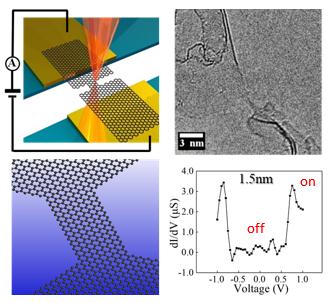
Researchers at Japan Advanced Institute of Science and Technology (JAIST) have successfully measured the current-voltage curve of graphene nanoribbons (GNRs) that were suspended between two electrodes. Measurements were performed using transmission electron microscopy (TEM) observation. Results revealed that, in contrast to the findings of previous reports, the electrical conductance of GNRs with a zigzag edge structure (zigzag GNRs) abruptly increased above the critical bias voltage. This finding is worth noting because the abrupt change in these GNRs can be applied to switching devices, which are the smallest devices in the world.

The electrical structure of GNRs have been systematically investigated through theoretical calculations. Studies have reported that both zigzag and armchair GNRs exhibit semiconducting behavior below several nm in width, although the origin of the energy gap is different. On the other hand, the electrical transport properties have rarely been calculated owing to the non-equiribrium calculations required. In 2009, Nikolic et al. predicted that sharp increments in electrical conductance would occur for extremely thin and short zigzag GNRs as the magnetic-insulator-nonmagnetic-metal phase transition occurs above a certain bias voltage [Phys. Rev.B 79, 205430 (2009)]. The obtained experimental results correspond closely to the results of this non-equilibrium calculation.

A research team led by Ms. Chumeng LIU, Professor Yoshifumi OSHIMA and Associate Professor Xiaobin ZHANG (now of Shibaura Institute of Technology) has developed a special in situ TEM holder and a GNR device for TEM observation. This combination is aimed at clarifying the relationship between the edge structure of GNRs and electrical transport properties. Ms. Liu, the doctoral student of JAIST, said, “The fabrication process of our GNR device is much more difficult than the conventional one because we need to make very narrow GNR which should be stably suspended between both electrodes.” She reviewed the literature focused on the fabrication process of GNR devices and verified their process en route to establishing her original fabrication method. Assoc. Prof. ZHANG said, “We were really happy to see that the I-V curve obviously changed when changing the edge structure to zigzag. I suppose we have encountered new possibilities for graphene nanoribbons.” The team has successfully performed the in situ TEM observation of extremely narrow GNRs, and they plan to continue identifying electrical transport properties that are sensitive to the edge structure of these GNRs.

###

This research was supported by the research grants from the Sasakawa Scientifc Research, the Izumi Science Foundation, and the Iketani Science Foundation. C. Liu gratefully acknowledges the China Scholarship Council (No.201808050001).

Media Contact
Yoshifumi Oshima
[email protected]

Related Journal Article

http://dx.doi.org/10.1016/j.carbon.2020.05.010

Tags: Chemistry/Physics/Materials SciencesMaterialsNanotechnology/MicromachinesSuperconductors/Semiconductors
Share12Tweet8Share2ShareShareShare2

Related Posts

Advancing In Vivo and In Situ Monitoring: Science Bulletin Highlights Host-Based Antifouling Gold Nanotube Sensor for Selective Detection of Mechanically Sensitive Serotonin Release in Intestinal Mucosa — Chemistry

Advancing In Vivo and In Situ Monitoring: Science Bulletin Highlights Host-Based Antifouling Gold Nanotube Sensor for Selective Detection of Mechanically Sensitive Serotonin Release in Intestinal Mucosa

May 20, 2026
How Magnetic Orientation Could Influence the Building Blocks of Life — Chemistry

How Magnetic Orientation Could Influence the Building Blocks of Life

May 20, 2026

Breaking a 200-Year-Old Belief: Novel Surface Design Achieves Two Distinct Wetting States on One Substrate

May 20, 2026

Unveiling Sound Waves: Scientists Discover Hidden Behaviors in Acoustic Phenomena

May 20, 2026
Please login to join discussion

POPULAR NEWS

  • blank

    New Study Reveals Plants Can Detect the Sound of Rain

    733 shares
    Share 292 Tweet 183
  • ESMO 2025: mRNA COVID Vaccines Enhance Efficacy of Cancer Immunotherapy

    301 shares
    Share 120 Tweet 75
  • Research Indicates Potential Connection Between Prenatal Medication Exposure and Elevated Autism Risk

    846 shares
    Share 338 Tweet 212
  • Breastmilk Balances E. coli and Beneficial Bacteria in Infant Gut Microbiomes

    58 shares
    Share 23 Tweet 15

About

We bring you the latest biotechnology news from best research centers and universities around the world. Check our website.

Follow us

Recent News

Experts Warn of a Moral Crisis in Healthcare

Common Food Preservatives Associated with Elevated Blood Pressure and Increased Heart Disease Risk

Study Finds Reusable Catheters a Safe Option That Could Save the NHS Millions

Subscribe to Blog via Email

Enter your email address to subscribe to this blog and receive notifications of new posts by email.

Join 82 other subscribers
  • Contact Us

Bioengineer.org © Copyright 2023 All Rights Reserved.

Welcome Back!

Login to your account below

Forgotten Password?

Retrieve your password

Please enter your username or email address to reset your password.

Log In
No Result
View All Result
  • Homepages
    • Home Page 1
    • Home Page 2
  • News
  • National
  • Business
  • Health
  • Lifestyle
  • Science

Bioengineer.org © Copyright 2023 All Rights Reserved.